Action, adrenaline & risk: how professional action bookings really work
How I handle risk as a sport model and stunt performer: the risk matrix, how an action shoot runs, safety, insurance – and a real example from the Eddie the Eagle stunt.
Written by
Tobi Deckert
Reading Time
8 minutes

| Insignificant 1 | Minor 2 | Significant 3 | Major 4 | Severe 5 | |
|---|---|---|---|---|---|
| Almost certain 5 | Medium 5 | High 10 | Very high 15 | Extreme 20 | Extreme 25 |
| Likely 4 | Medium 4 | Medium 8 | High 12 | Very high 16 | Extreme 20 |
| Possible 3 | Low 3 | Medium 6 | Medium 9 | High 12 | Very high 15 |
| Unlikely 2 | Very low 2 | Low 4 | Medium 6 | Medium 8 | High 10 |
| Rare 1 | Very low 1 | Very low 2 | Low 3 | Medium 4 | Medium 5 |
The same activity moves through the zones depending on conditions — weather, surface, light and daily form shift the rating.
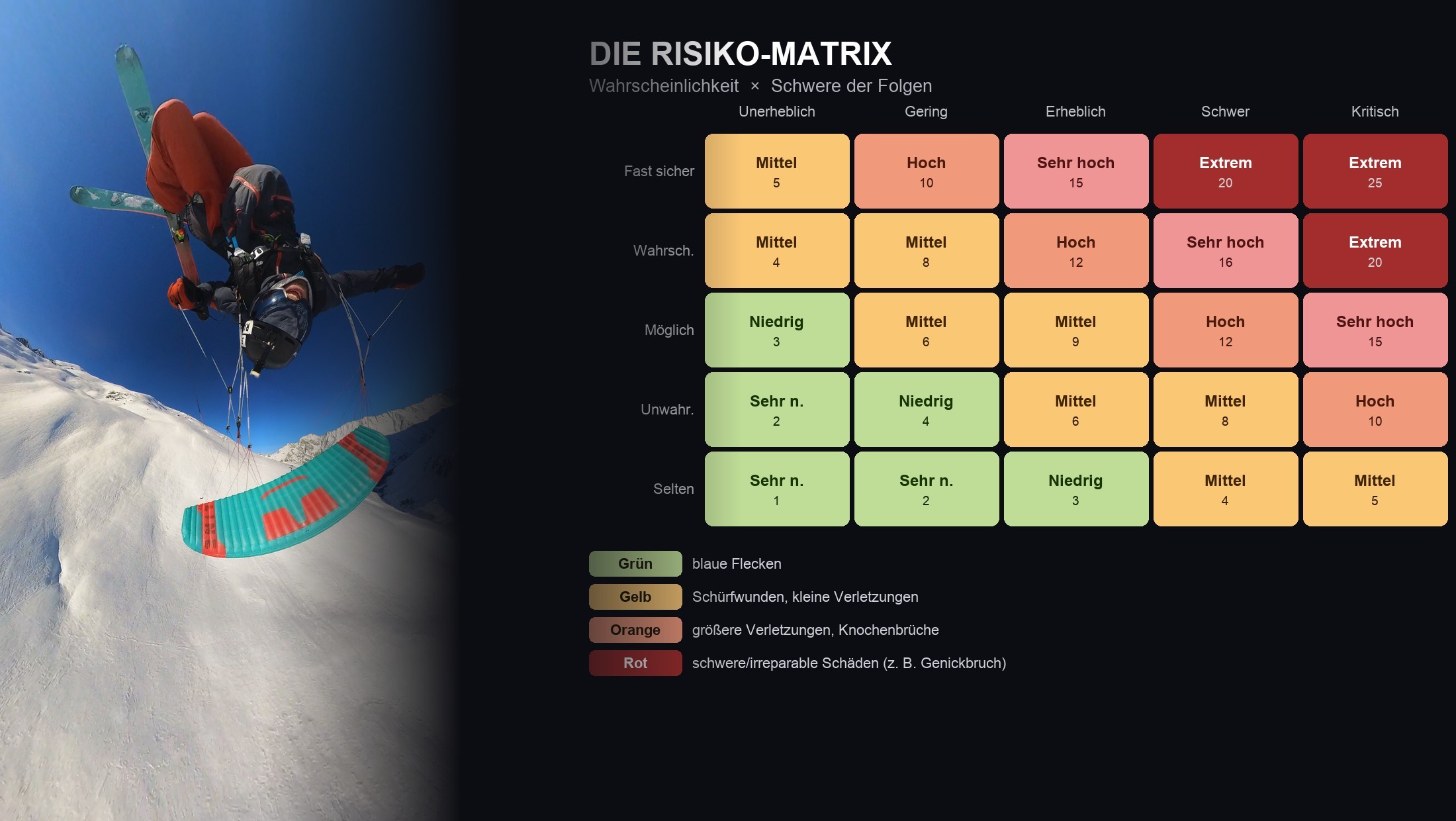
The risk matrix: what a stunt costs – and why
The matrix has two axes – the probability that something goes wrong, and the severity of the possible outcome. Together they define a zone: green is routine, yellow and orange need more preparation, red is either not approved or only under maximum precautions and paid accordingly. The tool also shapes the booking: the harder a stunt, the more expensive it usually is – not only because of the risk, but above all because of the preparation and training you have to put in first.
Important: the same activity moves through the zones depending on circumstances. Cycling is green – in rain and on a slippery surface the risk rises. Light matters too: outdoor shots are often taken in the flat light of sunrise or sunset – the images become emotional and beautiful, but visibility drops and the risk goes up. Weather, surface, light, daily form – all of it shifts the rating. That's exactly why every scene is assessed individually, not across the board.
From learning to walk to mastering the gear
There's a reason I can judge this so soberly. As a child I learned to ski at the same time as learning to walk, and got to learn many sports – on water, snow and in the air. What draws me most is the physics: dealing with wind, forces and terrain. Sport and the adrenaline that comes with it are an important engine in my life. That's no contradiction to my business life, but a parallel: there too it's about handling a plannable risk as well as possible.
When the gear becomes part of your body
Behind every clean action shot lie years of training. It takes good fitness and, above all, real mastery of the equipment. Past a certain number of hours the gear grows onto you – it feels like part of your body. That's when you have maximum freedom, and only physical limits remain. This level is the real difference between “dangerous” and “controlled”: it's not courage that decides, but mastery.
Not one person decides: stunt coordinator and panel
A demanding stunt is never decided by a single person – least of all someone who badly wants the job. Complex stunts require a stunt coordinator, and ideally a panel of experienced stunt people and coordinators judges the risk. That takes individual ambition out of the equation and puts safety above the appeal of the shot. I'm a member of Face-Off Stunts and Rigging – the exchange with experienced colleagues is exactly what makes such assessments reliable.
From practice: the Eddie the Eagle crash
How you bring a stunt out of the red into the doable range is shown by an example from one of my feature films. On the stunt for “Eddie the Eagle”, the stunt coordinator was Vic Armstrong – for decades Harrison Ford's stunt double in all the Indiana Jones films and in several James Bond films, and a second-unit director too. He knew exactly how he wanted the stunts on camera and what lies within the doable.
The scene was meant to look as original as possible: Eddie, who couldn't actually ski, jumped off the ski jump, was already wobbly on the in-run, fell before the take-off table and then flew shoulder-first, in a bad flight position, into the landing hill and landed on his shoulder. That had to be recreated exactly.
The risk was clearly in the red: if the angle and trajectory were only slightly off, you'd land on your head instead of your shoulder – and that quickly means a broken neck with irreversible damage. We were very close to the edge. We defused it with a great deal of training, thorough preparation, mats, prepared equipment and many rehearsals – until the stunt moved from red into the orange, partly yellow range. And we were several stunt colleagues taking turns, so the load on any one person didn't get too high. Bruises are part of it – a broken neck never is.
How an action shoot runs
A professional action shoot follows a clear sequence. First, the preparation phase with the client: together we work out what's possible – and where the limits are. Second, tests and dummy shots: I do test runs, present what's feasible and give an early sense of how it will look. Third, training to reproducibility: once the plan is approved, I train the stunt so often that I can deliver it on cue on set.
Why that matters: the shoot day carries a high cost block. When the whole team – lighting, camera, direction – is waiting for the one moment, it has to land. Whoever has trained the stunt a hundred times delivers it reliably.
Injuries are probabilities, not chance
Many think this kind of sport automatically carries a high injury risk. That's not quite true. Injuries are a chain of probabilities whose causes you can know and minimise. On a paraglider shoot, for instance, the weather is the most important factor. Conditions have to be right – and that can be checked in advance. If the wind isn't right, you wait. Soberly considered, the injury probability in football is higher than in a trained extreme sport where all the risk factors are calculated in.
The most dangerous mistake: routine
The real danger at a high level isn't a lack of skill, but carelessness through routine. Anyone getting a flying licence learns a five-point check in the first lesson: harness, surroundings, all buckles, correctly clipped in. Over the years you quickly get sloppy – you take things for granted even though you're long since operating at the limit. On a professional set that's ruled out: every check has to be done. Helmets are a given, and for dangerous stunts a medic on set is mandatory, provided by the production.
Plan for the worst case: insurance and the last word
Professionalism also means thinking about the worst case. I'm insured with Allianz and carry appropriate accident and occupational-disability cover. In the absolute exception, that also includes covering things like a helicopter rescue. If an athlete, model or stunt performer doesn't bring this protection, I consider that grossly negligent.
And one point is decisive: it's not the production that's responsible for your health, but you yourself. That's why on set the last word is mine. If conditions are questionable, I decide whether a scene can be performed. That's not diva behaviour – it's exactly the reliability a production needs.
Consulting from the start
Because there's a lot of groundwork behind all this, I'm happy to advise productions from the very beginning – as early as the ideation phase. We clarify early what's feasible, where the limits are and what might be better handled by CGI. That way a concept emerges that looks spectacular and is safe to execute – with no nasty surprises on the shoot day.
If you're planning a campaign with real action and want to know what can be done safely: send a booking request.
FAQ
How is a stunt or action scene priced?
Via a risk matrix of probability and severity. The more demanding the scene, the higher the price – not only because of the risk, but above all because of the preparation and training time. Scenes in the red zone are either not approved or only performed under maximum precautions and paid accordingly.
Who decides whether a stunt is safe enough?
Not a single person. Complex stunts require a stunt coordinator, and ideally a panel of experienced stunt people judges the risk – not someone who badly wants the job. On set, the performer also has the last word over their own safety.
Isn't extreme sport on camera far too dangerous?
Soberly, no. Injuries are a chain of probabilities you know and minimise. Conditions like the weather are checked in advance; if something isn't right, you wait. Trained extreme sport with calculated risk factors is often statistically less risky than, say, football.
What insurance should an action performer have?
At least professional liability plus accident and occupational-disability cover – in my case with Allianz, including cover for the ultimate emergency. Working without this protection I consider grossly negligent. On set, the production also provides a medic for dangerous stunts.
How does the preparation for an action shoot work?
In three steps: a joint feasibility check with the client, tests and dummy shots, then training to on-cue reproducibility. That way the decisive moment lands reliably on the expensive shoot day.
By
Tobi Deckert