
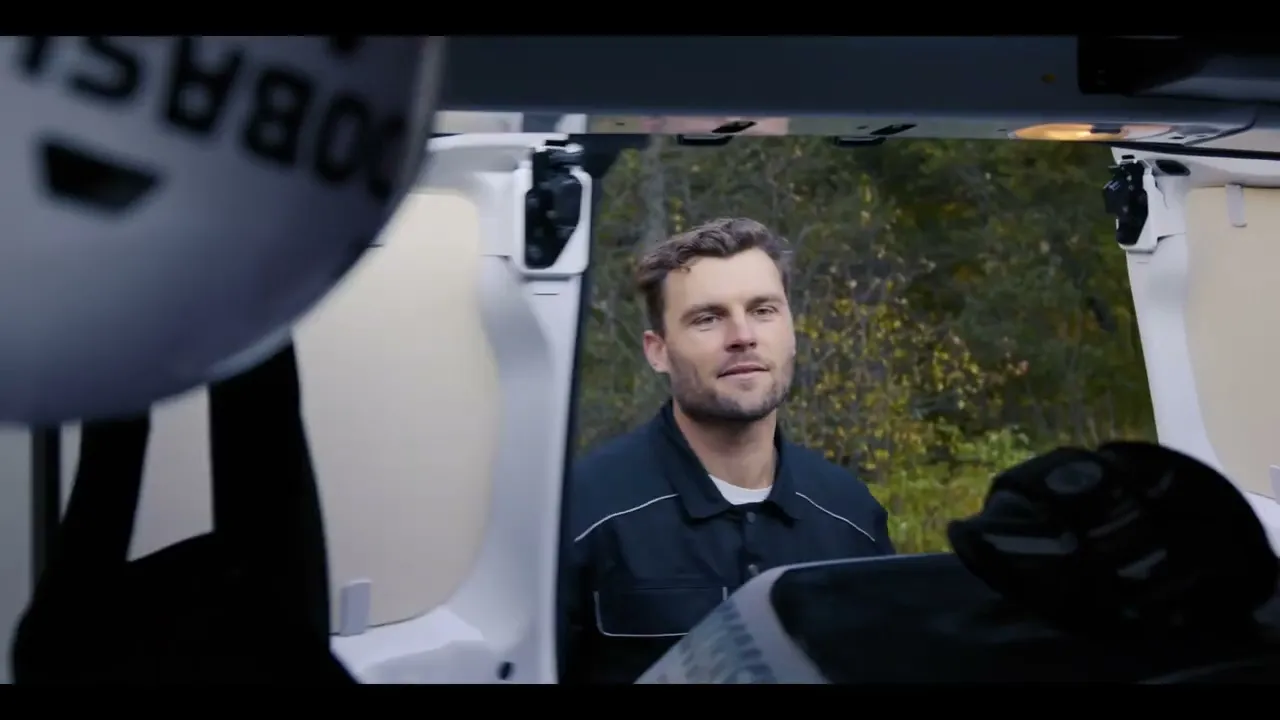
Yodobashi at the Fuschlsee: the delivery boy on a jetboard
Behind the scenes of a jetboard commercial for the Japanese giant Yodobashi at the Fuschlsee: what a jetboard is, how to master new gear in minutes – and how a destroyed board was saved with duct tape.
Written by
Tobi Deckert
Reading Time
7 minutes
The project
Yodobashi is a leading electronics retailer in Japan – a mix of what we'd know as Media Markt and Amazon. In Japan, Western outdoor culture is highly regarded, so the brand keeps running campaigns in which European outdoor and extreme athletes do crazy things.
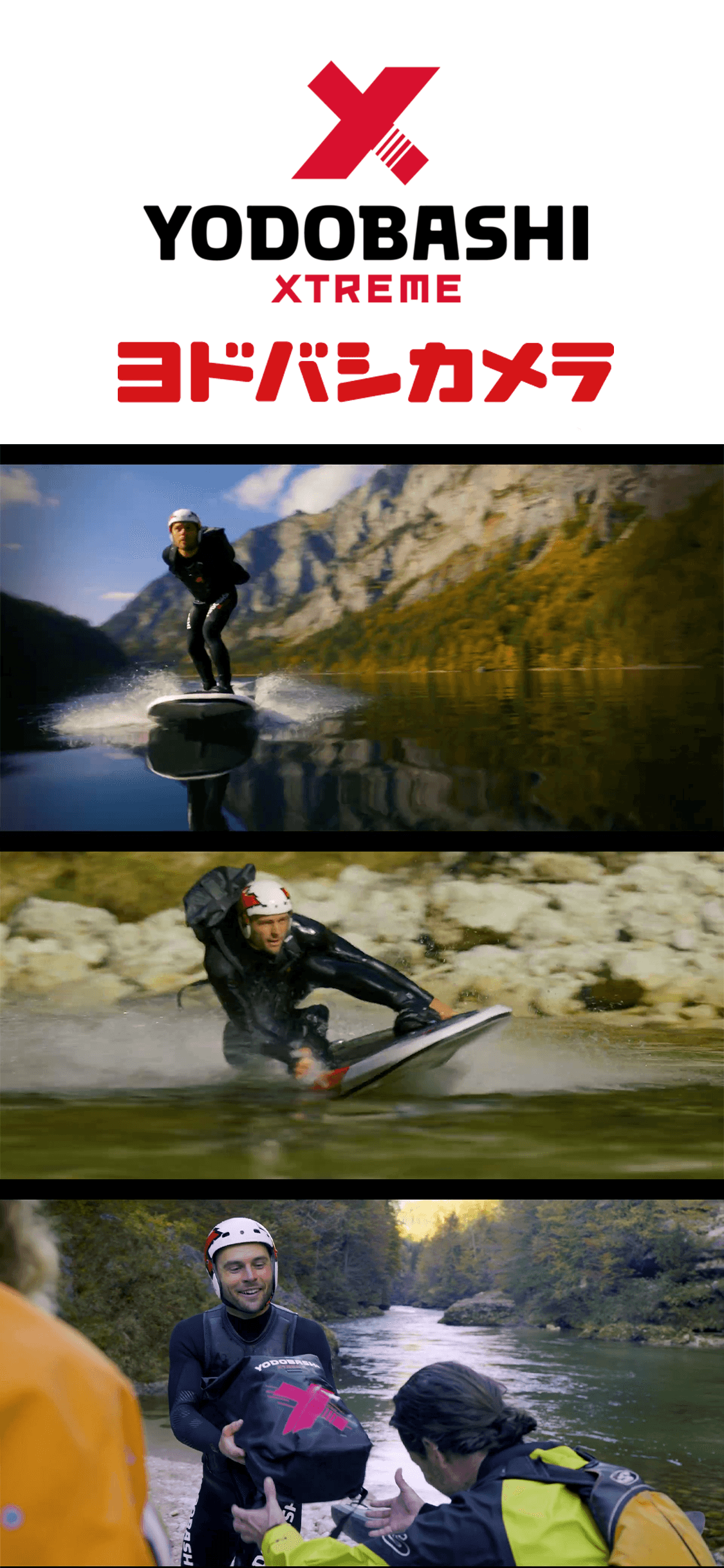
The storyboard: two friends are whitewater kayaking and filming each other with a GoPro. At a drop the camera falls off – and is promptly reordered from Yodobashi. That's where I come in: as the delivery boy. Because the two don't want to wait and paddle on, I have to reroute – and I can't get there by car anymore. The twist: I open the tailgate at the lakeshore, pull out a jetboard, jump on with the package in a waterproof backpack, and ride across the lake and up the whitewater river to reach them. Package delivered, everyone happy.
The spot was produced by Zoom Productions from the Fuschlsee – founded by Ulrich Grill, himself a passionate extreme athlete (paraglider) and known for many projects with Red Bull. Behind the camera was DoP Lukas Kozel, and the collaboration was very productive. I was booked through E-LACE. (Shot in 2021.)
What is a jetboard – and how does it differ from a jetski and an e-foil?
A jetboard has a jet drive: the impeller – essentially a ship's propeller – sits inside the board's hull. The board sucks water in underneath at the front, accelerates it electrically through the impeller, and pushes it out the back. A jetski works very similarly (intake at the front, drive out the back) – the two are closely related, except the jetboard's hull is much smaller and lighter, just a board, and therefore far more agile. Jet drives generally have lots of power and high acceleration, and they steer well because the water jet is directed right at the nozzle – unlike an outboard, where the whole motor turns.
An e-foil is something else: here a hydrofoil – a wing underwater on a mast – carries the board. The drive sits in the wing; above a certain speed the board lifts fully out of the water and you ride only on the foil, steering by shifting your weight. Both jetboard and e-foil are controlled via a handheld throttle. The jetboard for the shoot came from the Swedish maker Radinn.
Why I got the job: versatility
The agency had already tested other models in casting – but wasn't happy with their performance on the board. I got the job because I stood confidently on the board from the very first moment. That's exactly where versatility pays off: if you master many sports at a high level, unusual new gear isn't intimidating – I adapt within a few minutes and perform.
I do a lot of water and board sports in general, had ridden an e-foil before (though never a jetboard), and pick up such devices quickly – safely, if not at pro level in the new discipline. On top of that comes my engineering background: I used to passionately tinker with my own stand-up freestyle jetski. That technical understanding helps a lot in quickly reading a new powered craft.
The hardest scene: jailbreak, crash and the duct-tape rescue
The final scene was also the trickiest: the last, aggressive spray turn in a narrow river mouth, just before I dismount and hand over the package. The first turns didn't look imposing enough – the jetboard was limited to about 40 km/h for regular users. I asked for more power, the production called the maker in Sweden and got a jailbreak code to unlock the board: more speed, and above all more punch off the line.
And then it happened: I was going too aggressively, slipped off the board – and it shot off riderless at around 50 km/h and slammed into the rock wall. The entire deck split apart. There was horror on set: first shot, the branded jetboard destroyed, and there was no second one. Luckily the camera's grip team had plenty of coloured duct tape – we patched the board colour-accurately in the right spot. Only the buoyancy floats sat up front, no electronics, so the board stayed operational and we finished the shoot. This shoot shows me: there are physical limits – and we clearly scratched them here.
FPV drones and safety
To capture the action cleanly, I was filmed by experienced FPV pilots with mini race drones. Those drones often have a wide-angle lens and therefore have to come in very close – sometimes to within a metre of my face, at 60 km/h on the water, while I'm not always entirely predictable. If a drone hit, it would end badly. That too shows: every side needs a professional level of experience for a shoot like this to come together cleanly.
A little side-story: the police at the Chiemsee
When I'd won the casting, I was lent the jetboard to train on. On my first test ride at the Chiemsee, a bystander called the police after ten minutes, and they promptly fished me out of the water. The paradox: I'd checked in advance which propulsion power class is allowed on Bavarian lakes, and I was under it. But there's a special clause in the Bavarian lakes ordinance that bans jet propulsion – which the officer himself didn't know. We had a very pleasant chat. Two weeks later an administrative fine of 2,500 € arrived anyway, which I managed to get waived with a fair bit of paperwork. You have to smile at German administrative zeal – and what I took from it is to check the regulations even more carefully beforehand.
What it comes down to
This shoot stands for what I bring as a sport and action model: versatility across many pieces of gear, technical understanding, and the composure to save the shot even in a crisis on set. Anyone planning an international campaign with real water action gets someone who settles quickly into new equipment and performs reliably.
If you're planning a project with water sports or unusual gear: send a booking request.
FAQ
What is a jetboard?
A motorised board with a jet drive: an impeller in the hull sucks in water at the front and pushes it out the back. Power is controlled via a handheld throttle. A jetboard is closely related to a jetski, only much smaller, lighter and more agile.
What's the difference between a jetboard and an e-foil?
A jetboard stays on the water's surface and is driven by a water jet. An e-foil lifts out of the water on a hydrofoil (a wing underwater) above a certain speed and is steered by shifting your weight.
How can you master a new piece of gear so quickly?
If you ride many board and water sports at a high level, you transfer balance, edge feel and control to new equipment. Together with technical understanding, a few minutes are often enough to perform safely – even if it isn't pro level in the new discipline.
What happens when equipment breaks on set?
You improvise professionally. On this shoot the riderless jetboard slammed into a rock wall and destroyed its deck – it was patched colour-accurately with duct tape and stayed operational, so the shoot could be finished without a spare board.
By
Tobi Deckert