Aircraft Skiing: On Skis Behind an Airplane Across a Frozen Lake
Towed on skis behind a Piper at up to 100 km/h across frozen Lake Riegsee – the Shaping New Tomorrow shoot with pilot Tom Huber, Mischfabrik and an FPV drone. How a world-first stunt is planned, secured and filmed.
Written by
Tobi Deckert
Reading Time
6 minutes



How the idea came about
The idea came from Tom Huber – a highly experienced pilot with his own flight school in Uffing, specialised in winter operations, ski mounts on aircraft and unusual manoeuvres like landing on frozen lakes. With the eyewear brand gloryfy he had once towed a wakeboarder behind an airplane – and he was determined to do the same with a skier.
The moment arrived when Lake Riegsee in the Bavarian foothills froze solid after a long cold spell. The film production company MISCHFABRIK joined in and turned it into a client project – with Shaping New Tomorrow, the Danish fashion brand that promotes its highly elastic suits with action-packed clips: athletes in suits, proving how comfortable and stretchy they really are. The contact to me came through my stunt agency Face Off – via co-founder Mark, who always thinks of me when special ski stunts come up.
The setup: a 30-metre line, 70 km/h – and releasable at any moment
The best part: we had nothing but professionals on set – pilot Tom, photographer Klaus Listl (Freezing Motions), Daniel from Mischfabrik as lead camera and Felix flying the FPV drone. Every scene was planned precisely: which angle, which perspective.
Tow release: the aircraft has a tow coupling at the back – Tom could have released me at any moment if something went wrong.
Handle: I held a grip like on a wakeboard line – never attached, I could let go at any time.
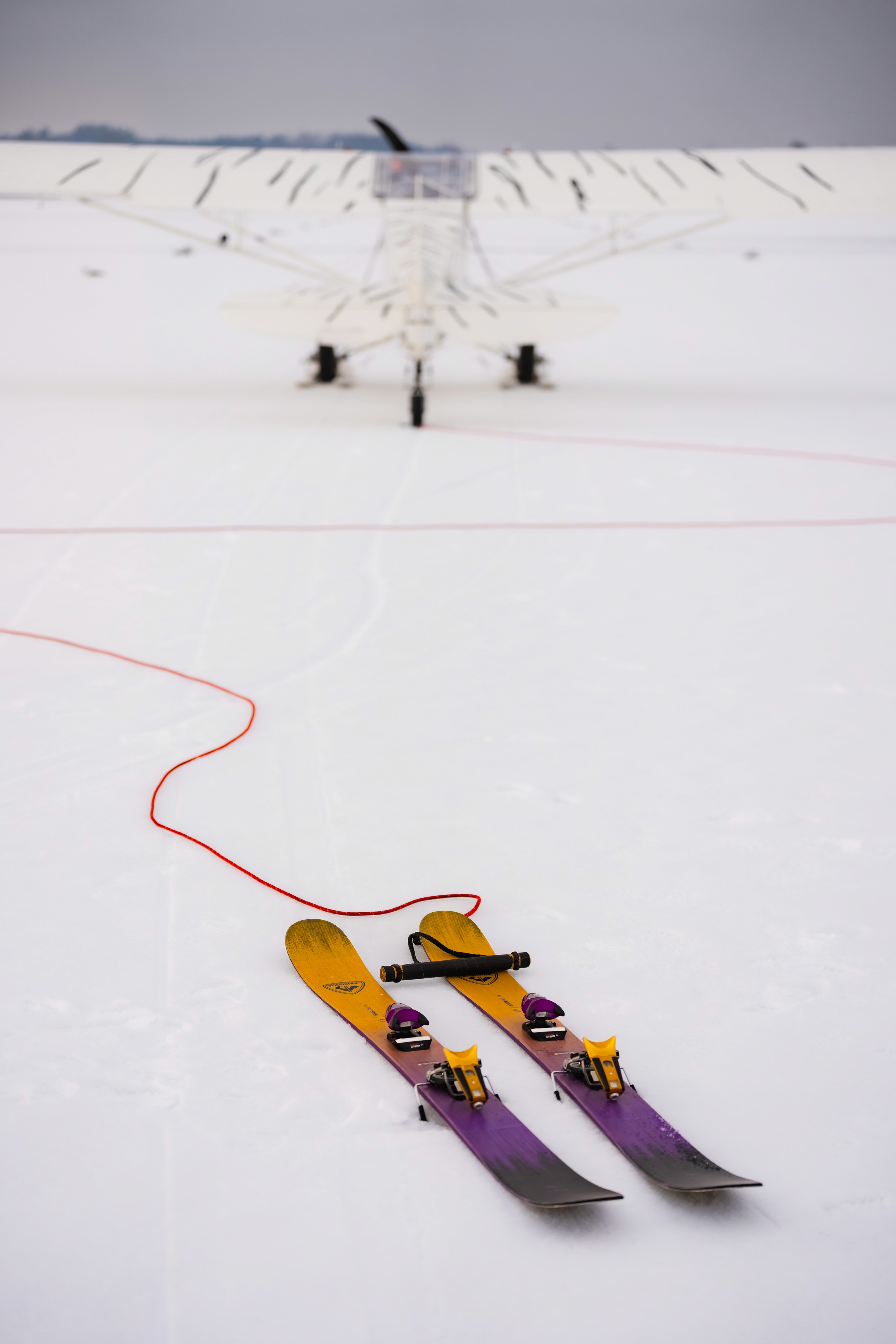
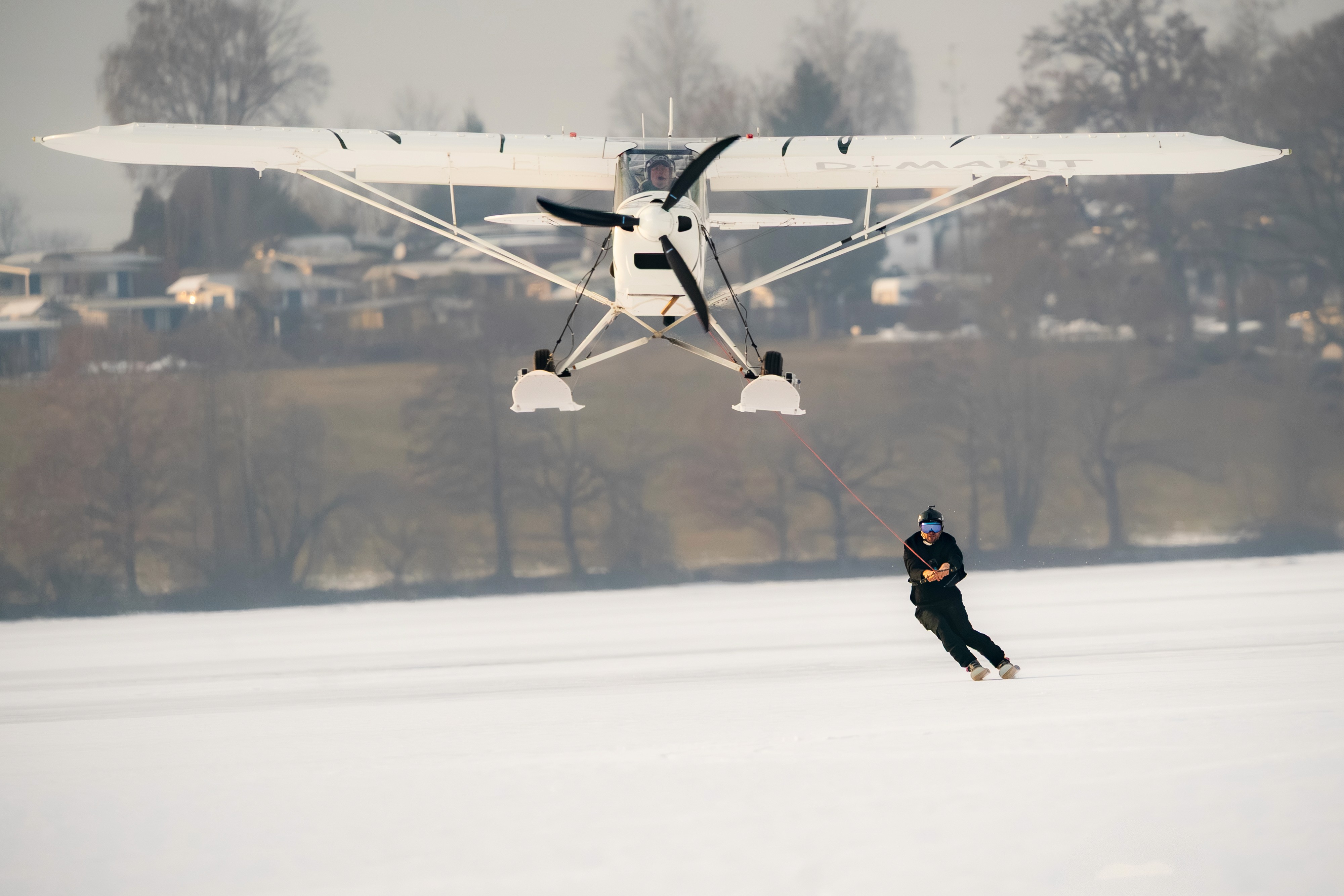
Line & speed: roughly a 30-metre line; the airplane needs about 70 km/h to take off – in the turns, centrifugal forces carried me outwards to 90–100 km/h.
Ice holes: the lake had spots with trapped air bubbles where the ice had not frozen through – round craters, almost impossible to spot in time at that speed. So Tom flew the route several times without me first, then towed me safely between the holes.


Carving against the airplane: the genuinely hard part
The forces on the line are basically like being towed behind a boat: when the vehicle turns tightly, you get carried outwards and suddenly go much faster – physics I knew from wakeboarding and from having been towed on skis many times: by bungee, by winch, by car. It got interesting once everything was dialled in and we wanted hard action that had to look effortless: I started riding carving turns behind the straight-flying airplane. That meant fighting the speed – and Tom fighting me: every hard turn pulled the tail of the airplane towards me through the leverage, and he had to counter-steer firmly. You can barely see it in the video – but it was remarkable how clearly he felt me.
Add the aerial interplay: Hilde, Tom's wife, flew a second airplane filming our machine – partly in formation, partly offset. Plus the FPV drone. Two airplanes, me on the line, one drone – and the action had to happen exactly at the right focus point. Which angle creates which effect is precisely the topic of my article on camera angles & rigs.
Permits & safety on the ice
The long cold spell triggered the whole operation: the ice was partly more than half a metre thick – no danger for crew or aircraft. The middle of the lake also has comparatively little bird life, keeping the impact on nature low. The local police were informed and even attended the main action; Tom holds a landing permit outside the airfield for his machines anyway. Water rescue and emergency services stood by – and plenty of spectators got to watch. How shoots like this are secured and permitted in general is covered in the mountain shoot guide; how the risk enters the calculation, in the risk matrix.
The suit under stress test
And the client? Shaping New Tomorrow promotes its elastic suits with exactly these clips – sport in suits that follow every movement. Carving turns at 90 km/h behind an airplane are a rather honest proof.
Result & rollout
Because nobody had done it in this form before, the clip performed very well on social media. The official client clip plays as a reel further up in this article, the internal directors-cut teaser at the very top. We shot late in the winter, so the campaign goes properly live next winter season. The feedback has been strong already, the client is happy – and more clips are coming, plus a longer behind-the-scenes edition that I will probably edit myself. This article will grow with it.
What a booker takes away
It worked because the team harmonised perfectly – even though we didn't all know each other beforehand. The key is clear role separation: everyone owns their area, gives directions within it and agrees on what is possible and what is not. For me at the end of the line it doesn't matter where the drone flies – my focus is entirely on the ski performance and on anticipating the forces I transfer to the airplane. I can do that because, as an engineer, I bring the technical understanding – the same mindset as with my self-built rigs and my freeskiing. Tom coordinates with Hilde, everyone with the camera team, photographer and camera with each other so nobody ends up in anyone's frame.
That kind of coordination only works with true professionals. Someone doing this for the first time brings a safety risk into the entire action, in every respect. Planning a stunt or action shoot nobody has done before? Send a booking request.
FAQ
How does aircraft skiing work?
An airplane with a tow coupling pulls the skier on a roughly 30-metre line across a frozen lake – with a wakeboard-style handle instead of a fixed connection, so the rider can let go and the pilot can release the line at any moment.
How fast do you go on skis behind an airplane?
The airplane needs around 70 km/h for stable flight – in the turns, centrifugal forces carry the rider outwards to 90–100 km/h.
How is an action like this made safe?
Thick, verified ice (here over half a metre), a route flown several times in advance (ice holes!), informed police on site, water rescue on standby – and a team in which every professional owns a clear role.
Project facts
Client | Shaping New Tomorrow (Danish fashion brand) · production: MISCHFABRIK |
Location | frozen Lake Riegsee, Bavarian foothills |
Team | pilot Tom Huber (flight school Uffing) · Hilde Huber (2nd airplane) · Klaus Listl/Freezing Motions (photo) · Mischfabrik (camera) · FPV drone |
Key figures | ~30 m line · 70 km/h base speed · 90–100 km/h in turns · ice > 0.5 m |
Booked via | Face Off Stunts & Rigging |
Crew and credits
This shoot would not have been possible without the team — thanks to everyone involved for their highly professional work: @flystol.eu, @mischfabrik, @freezingmotions and @radlhuber.
More posts