Die Discounter: Who Does the Ski Backflip? My Job as Thorsten's Stunt Double
Who does the ski backflip in Die Discounter, season 3, episode 4? I doubled Marc Hosemann as store manager Thorsten at the alpincenter Wittenburg on the A24 — kicker build, indoor snow, two takes, and the Rossignol logo you can still see on the ski base.
Written by
Tobi Deckert
Reading Time
11 minutes


Who does the ski backflip in the indoor snow hall? The short answer
If you found this page because you saw the scene and want to know who is actually jumping: that is me. My name is Tobi Deckert, I work as a sports model and ski performer — and in season 3, episode 4 of the Amazon Prime Video series „Die Discounter" („Ausflug in den Skidome" / Trip to the Skidome) I doubled Marc Hosemann in the role of store manager Thorsten for the backflip on skis.
Who is on screen? Marc Hosemann plays Thorsten. The backflip is me, as his ski double.
Where was it shot? At the alpincenter Wittenburg, the indoor ski hall right off the A24 motorway in Mecklenburg-Vorpommern, northern Germany. In the series it is called „Skidome an der A24".
When? The official clip „Thorsten: Die wilden Jahre" went up on 19 December 2023 on the Amazon Prime Video Deutschland channel.
The setup of the episode: the store crew has won the company outing at the Kolinski Summer Games — which is how a supermarket team ends up inside a snow dome. What those 23 seconds of clip do not show: two shoot days, a kicker we shovelled ourselves, a snow problem that does not exist outdoors, and a pair of skis carrying a brand that was not allowed on camera. That is what this piece is about.
Series | „Die Discounter" (Amazon Prime Video) |
Season / episode | Season 3, episode 4 — „Ausflug in den Skidome" |
Character | Store manager Thorsten |
Doubled for | Marc Hosemann |
My job | Ski double / stunt performer — backflip on skis |
Location | alpincenter Wittenburg on the A24, Mecklenburg-Vorpommern, Germany |
Shoot days | 2 — day 1 preparation day (kicker build and rehearsal), day 2 shoot |
Takes for the backflip | 2 — the first one landed, the second was a safety take |
Booked through | stunt-department.de (Mano Röder) via a connection to Face Off |
Clip release | 19 December 2023, Amazon Prime Video Deutschland channel |
The booking: the backflip was in the script from day one
The job came in through stunt-department.de and Mano Röder, via a connection to my stunt agency Face Off. As a ski stunt performer I was already on their list — and that is exactly what those networks are for. A production needs someone who can do a specific thing on skis, so it does not call fifty people, it calls one place that knows who can do it.
One detail matters for understanding the whole scene: the backflip on skis was planned from the start and written into the shooting script. It was not invented on set because a skier happened to be standing around. The writers wanted that jump, the production budgeted it, booked it and prepared it — with a dedicated preparation day.
It is also why the question „sport double or stunt double?" is fairly pointless here. A backflip on skis is sport first. Performed inside a snow dome, in a retro onesie, deliberately clumsy and repeatable on cue — that is film craft. Why I think the hard split between the two labels is overrated is written up in my piece on sport double versus stunt double.
Day 1: building a kicker inside a ski hall
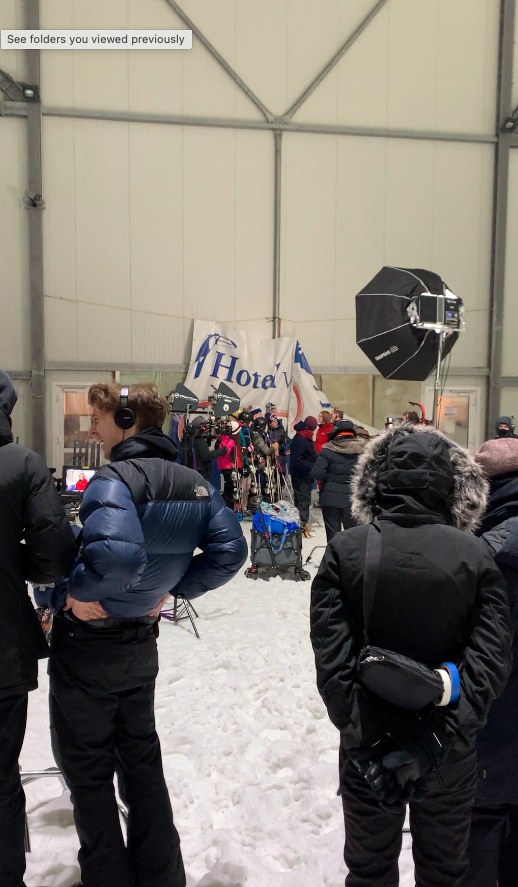
We had two shoot days. Day 1 was a pure preparation day: build the kicker, then rehearse. Day 2 was the shoot itself, with several scenes worked through inside the hall.
For the kicker I drew a small schematic sketch in advance. That let the hall's slope crew shovel the snow mound roughly into shape — after which I only had to do the final shaping, exactly the way I needed it, from the take-off angle all the way into the landing zone. „Only" is doing a lot of work in that sentence. It was still a serious amount of prep, and most of it had a reason you cannot see from the outside.
Indoor snow behaves unlike any snow outdoors. It is extremely artificial and differs not just from natural snow but also from what a snow gun puts on a mountain. It is very powdery and compresses beautifully — which makes it get very hard very fast. For the take-off that is fine, even helpful. For the landing it is a problem, because a landing needs to give. So I broke the landing zone back up with a shovel until the snow was soft enough to absorb the impact. That took me a long time. It is the least spectacular part of the day and the part that decides whether the shoot day is safe.
How you build a double: onesie, height, ski goggles
Building a double does not mean restyling someone until they look like the actor. It means matching exactly the features that end up in frame — and skipping everything else. In this case the list was short:
Identical costume: a retro onesie, the exact piece Thorsten wears in the scene.
Roughly the same height as Marc Hosemann — the basic condition for the swap to work in the edit.
Nothing else. No wig, no hair colouring, no makeup work. I was only visible from behind and wore ski goggles and a beanie while riding, so the face was never an issue.
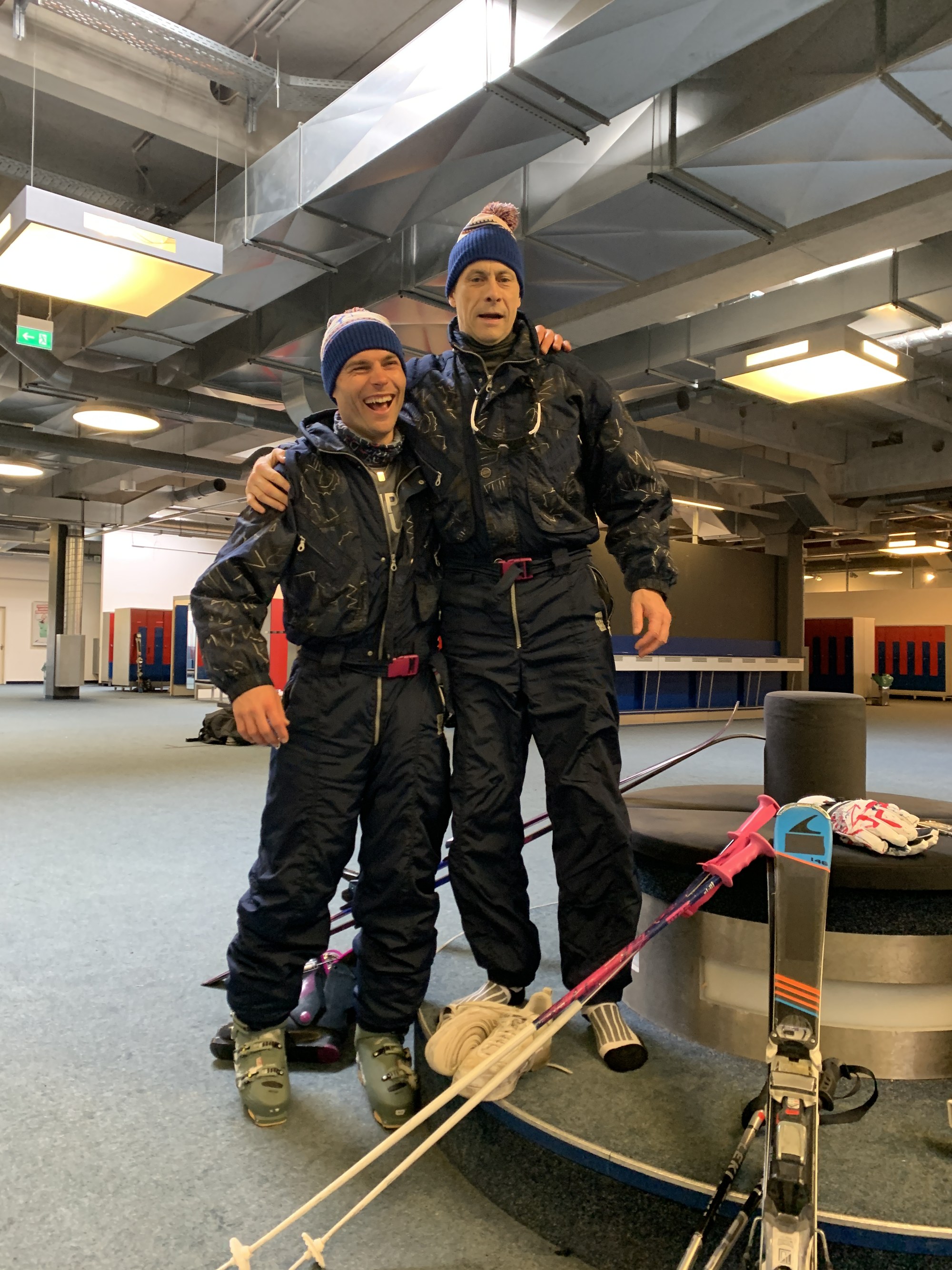
Why a double is used at all is the most ordinary thing in the business: Marc Hosemann is an actor, not a skier — and a backflip on skis is not something you pick up on the side for a comedy series. That is precisely what doubles exist for. Watch the scene closely and you will spot the switch back after the landing. That is not a mistake, that is the edit organising the handover. The other criteria that matter when doubling — build, duplicate costumes, face replacement in post — are collected in my sport double versus stunt double comparison.
The backflip: the art of looking clumsy on purpose
An indoor ski hall is a giant metal shed on a steel stilt structure with a fixed, built-in gradient — you cannot reshape the slope, it is architecture. The first 50 metres or so are fairly flat, then a slightly steeper section begins. That is where we piled up the snow mound that served as take-off and landing in one. There is even a chairlift inside the hall, and a fast one at that. The air is very dry and very cold — no issue for me while moving, but a real challenge across a full day for a crew standing still behind a camera.
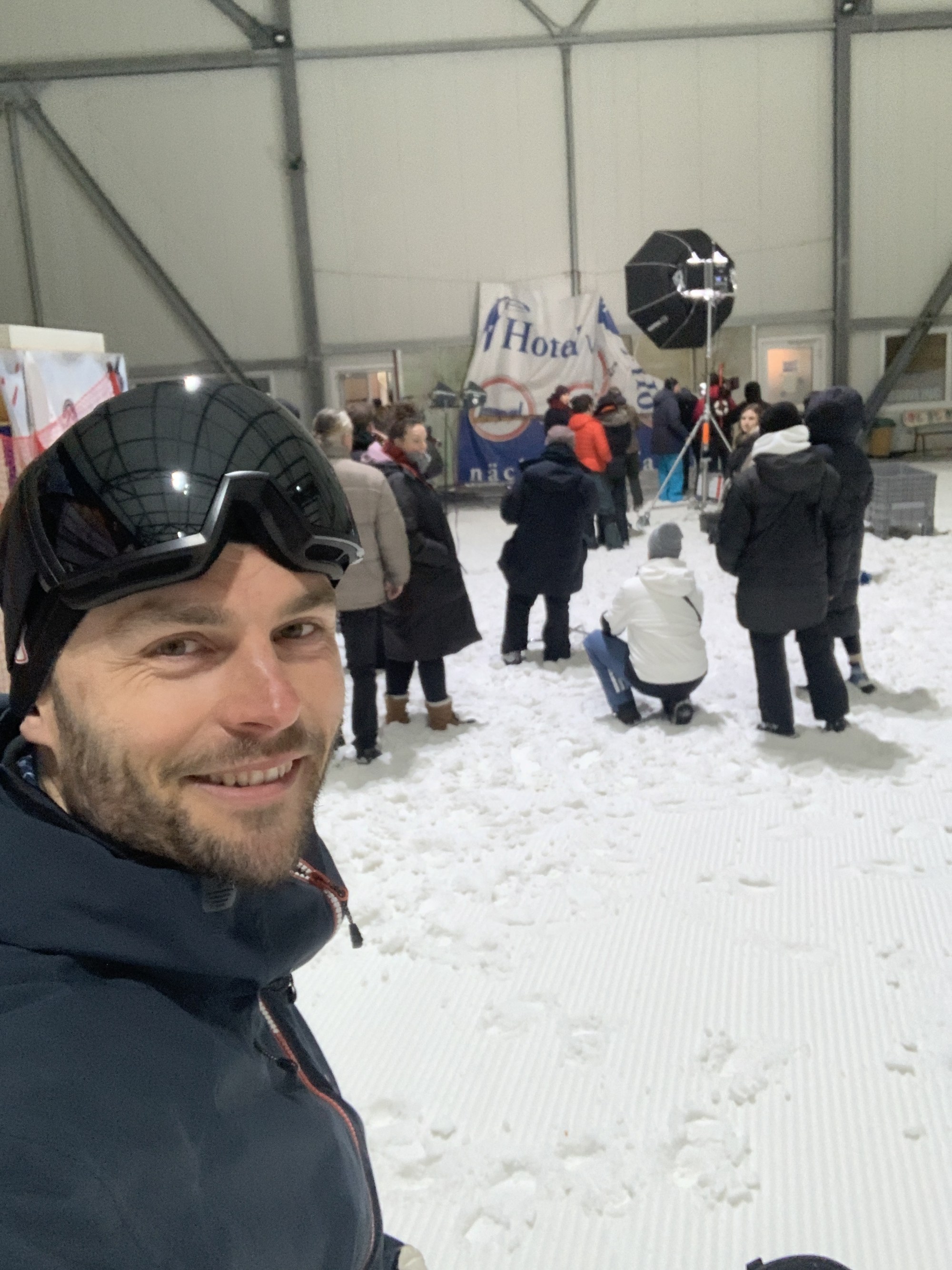
The run-in was fairly short, simply because a hall is finite. I would not have needed a longer one anyway. The ceiling was never a concern — a chairlift fits underneath it, and this particular jump did not go especially high.
Two things were tricky nonetheless, and neither has anything to do with the difficulty of the trick.
First, orientation. Outdoors I have a strong contrast between snow and sky, blue against white, and I can align myself in the air by it. Inside, the structure is grey, the snow is a greyish white, and there is neon light on the ceiling — everything is more or less one colour. You rotate through an environment that gives you almost no reference points. I solve that through timing: on more complex jumps the rotation is mostly a timing question anyway, and a backflip has been routine for me for years. What a purely technical stunt demands on top of that, when a machine rather than the sport generates the movement, is described in my article on the ratchet stunt.
Second, the actual direction — and this was the hardest part of the whole shoot. I was asked to set off looking fairly clumsy and casual. So not a clean, fast approach into a technically perfect backflip, but the impression that Thorsten was tossing the thing off without thinking. That sounds like less work and it is the opposite. You are only allowed to look sloppy on purpose if you own the trick well enough that it still lands under bad conditions — low speed, short run-in, wearing a onesie, with no visual reference. It worked because I have done countless backflips over small kickers in my life. It is in my muscle memory, which is why it came together immediately.
The first take was already perfect. Exactly what the director wanted, exactly as planned and rehearsed. We shot a second one anyway — purely as a safety take for the edit. That was all it took.
The Rossignol story: you can wrap a topsheet, not a base
Here comes the part I like telling most, because it shows how much coordination sits inside a single shot.
The series is financed by Amazon, and one rule applies to every film and commercial shoot alike: no third-party brands in frame without clearance. On a pair of skis the brand would have been clearly visible. That can have consequences once companies start enforcing trademark rights against each other — a topic that turns political and financial fast. I stay out of it and stick to the brief. For the record: I am generally a fan of synergies and always happy to connect deals and networks — I know the companies whose gear I ride. But that belongs in pre-production, not on set.
On top of that came the classic conflict between function and looks. I had to ride my own skis, specifically twin tips, meaning freestyle skis — no discussion from my side, because a backflip on unfamiliar equipment is a completely different task. In the series, however, Thorsten rides retro skis.
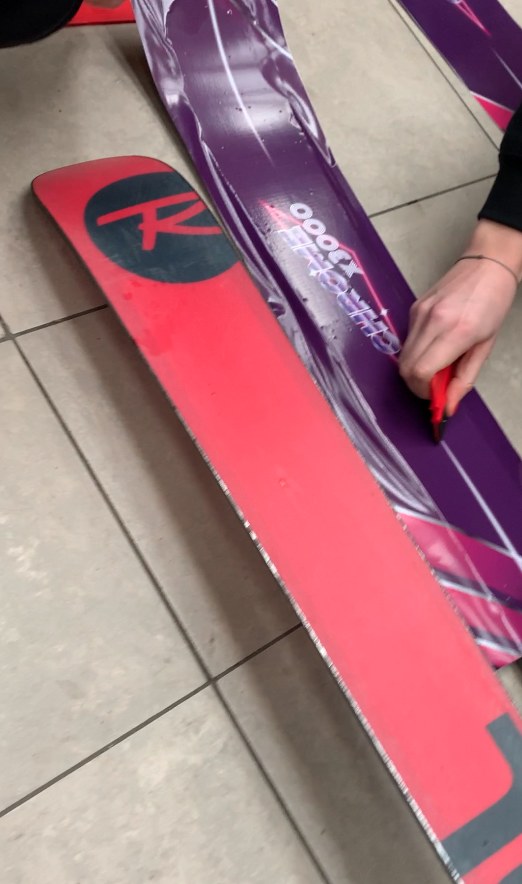
The fix: my Rossignol topsheets were wrapped in the same design, so that from above the skis matched the retro pair from the scene.
What you can still spot if you look carefully:
Thorsten first rides retro skis, and in the stunt shot suddenly twin tips.
And if you look very closely, you can see the base during the flight — with the Rossignol logo on it. Because a topsheet can be wrapped, a base cannot.
That is simply how it is handled in practice. Stop every single frame and you will find it. In a running edit, nobody ever does. Why I still never pick sports equipment by colour, and where the limits of rebranding sit for skis, bikes and paragliders, is in my article on sports gear and the stylist: function before colour.
A shooting script is not a dialogue script — and you still need maximum flexibility
„Die Discounter" is known as an improvised series, and people often draw the wrong conclusion from that: that the set simply rolls camera and sees what happens. It does not work like that, and the distinction matters for any production: there absolutely is a shooting script, there is just no fixed dialogue script. Every scene is planned, including the camera angles. Only the exact spoken lines are left open.
For me that meant: my stunt was not improvised, it was planned down to the detail and written into the script. I had no speaking part in this one, sadly, so improvisation was not my job that day.
Even so, one rule holds for every shoot: bring maximum flexibility. Not only for shoot times and scheduling, which outdoors depend on weather anyway, but above all for the conditions you find on location. The director has a spontaneous idea for something else you could do — so you replan and, if needed, prepare something to make it feasible at all. Or a shot simply does not look the way it was supposed to, and you have to try something different. That is exactly what happened to us on the jump scene for „Eddie the Eagle".
The mood on set — and the other stunts behind Thorsten
Nothing went wrong, and that was down to good planning. The crew works with stunt doubles regularly anyway, because Thorsten does plenty of other things across the series: he rides motocross, he gets on a skateboard, and he pulls a breakdance move in the stockroom. That is his running gag — the store manager who can supposedly do everything. It is told as if he personally were the all-rounder, and behind each of those moments stands a professional stunt performer for that particular discipline.
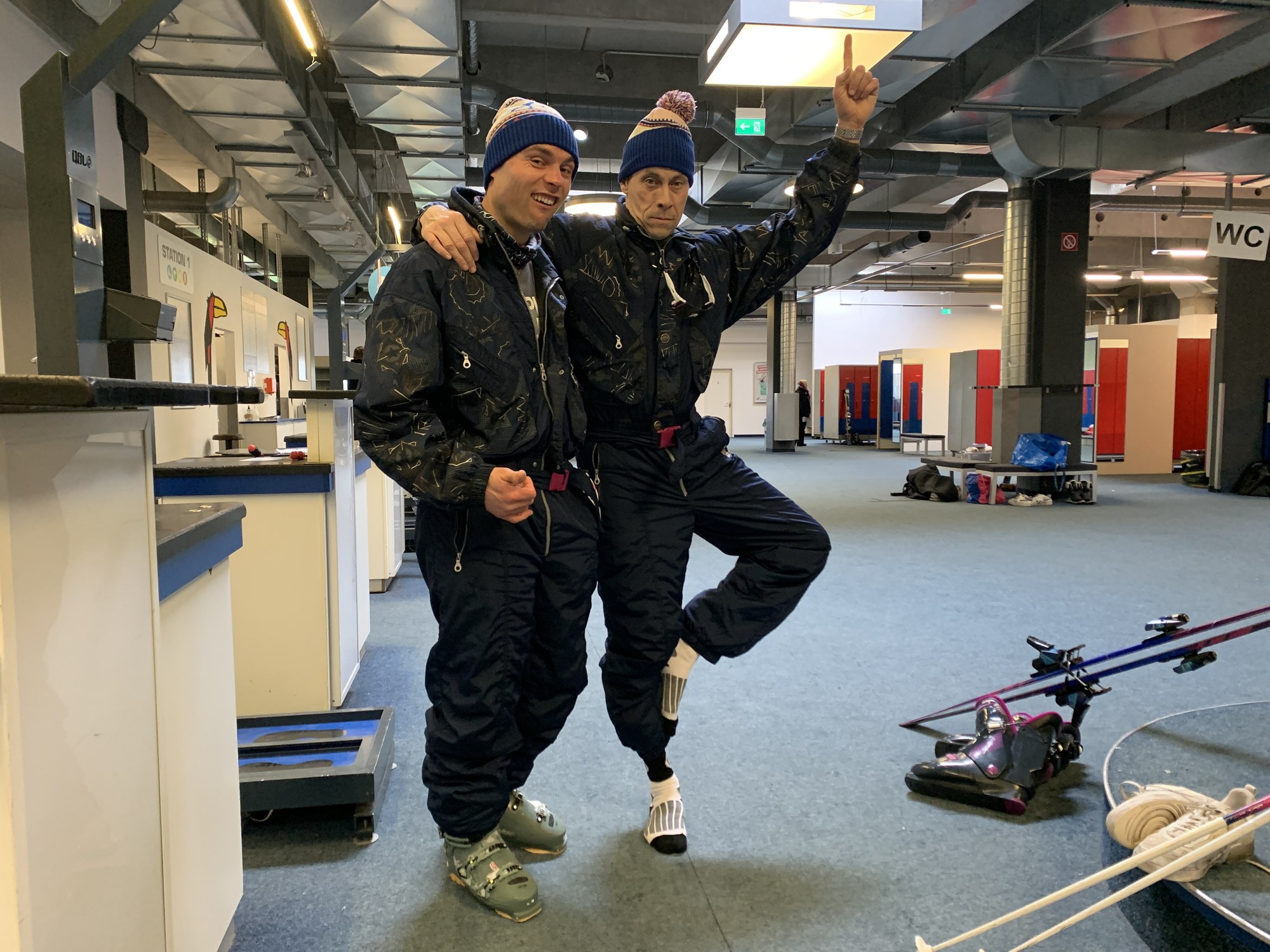
This is not a debunking, it is simply how films get made. A character like Thorsten only works if his abilities look credible on screen — and they look credible when someone who genuinely owns the discipline performs them. The same principle sits behind my work on „Kalte Füße" and „Trautmann".
The atmosphere was fantastic and genuinely funny. „Die Discounter" is a special series: spontaneous moments, scenes the other actor often knows nothing about — which produces natural, absurd reactions you could never write. Some of the people in front of the camera are not trained actors at all; it often felt less like acting and more like people simply being themselves. Very relaxed, very funny. We messed around an enormous amount and had a great time.
What productions can take away from this
If you are planning a series, a spot or a campaign with a skiing element, these are the three things this shoot demonstrates well:
The preparation day is not a buffer, it is part of the shoot. Without a day for the kicker build and rehearsal, the backflip would have cost hours on the shoot day instead of two takes. A prep day saves shoot time, it does not consume it.
Clear brand visibility early. The fact that topsheets can be wrapped but a base cannot has to be known before the shoot day — otherwise the discussion happens on set while the hall is running on the clock.
Deliberately imperfect is the hardest order there is. A character has to look clumsy while the trick still lands: only someone for whom the trick is genuinely repeatable can deliver that. What I ride on skis in front of a camera is listed in my freeski and ski model overview.
Planning a series, film or commercial production with skiing or action, and looking for someone who covers the sport and the camera in one person? Send a booking enquiry.
FAQ
Who does the backflip in „Die Discounter"?
The backflip on skis is performed by Tobi Deckert as the ski double for Marc Hosemann, who plays store manager Thorsten. The scene appears in season 3, episode 4 („Ausflug in den Skidome"). The official clip „Thorsten: Die wilden Jahre" was published on 19 December 2023 on the Amazon Prime Video Deutschland channel.
Where was the ski hall episode of „Die Discounter" filmed?
At the alpincenter Wittenburg, the indoor ski hall on the A24 motorway in Mecklenburg-Vorpommern, Germany. In the series the location is called „Skidome an der A24". It was shot over two days: a preparation day for the kicker build and rehearsals, then the actual shoot day with several scenes inside the hall.
Does Marc Hosemann ski himself?
A ski double performed the backflip — the usual route whenever a role calls for a sporting feat that takes years of training in real life. Marc Hosemann plays Thorsten, I rode the ski scene. The same division of labour sits behind Thorsten's motocross, skateboard and breakdance moments in the series.
Was the stunt improvised?
No. „Die Discounter" works with a shooting script but without fixed dialogue — the scenes and camera angles are planned, only the spoken lines are not. The backflip was in the script from the start, was prepared and rehearsed the day before, and landed on the first take.
Why is indoor snow harder to jump on?
Indoor snow is extremely artificial and differs from natural snow as well as from snow gun output. It is very powdery and compresses heavily, which makes it get hard very quickly. Good for the take-off, bad for the landing. The landing zone therefore has to be broken up again with a shovel so that it stays soft enough.
Why does a different ski logo appear during the flight?
No third-party brand may appear on screen without clearance. My Rossignol skis were therefore wrapped on the topsheet in the retro design. The base cannot be wrapped, so anyone stepping frame by frame through the flight will see the logo there. In the running edit the cut takes care of it.
More posts