Radeberger Commercial 2025: Filmed in Saxon Switzerland - Five Friends on the Elbe Sandstone
Where was the Radeberger commercial filmed, and who is in it? The spot for Radeberger alcohol-free was shot in 2025 in Saxon Switzerland National Park with Bad Schandau as its base - five friends, real vertical sandstone, a mountain rescue team on set. My report from the shoot.
Written by
Tobi Deckert
Reading Time
12 minutes


Who is in the Radeberger commercial? The short answer
If you landed here because you saw the spot and want to know who is hiking across those rocks and where it was filmed: my name is Tobi Deckert, I work as a sports model and on-camera talent — and I am one of the five friends who hike through Saxon Switzerland in the campaign for Radeberger alcohol-free and clink bottles on the rock at the top.
Who is on screen? A group of five friends. No stunt scene, no double — we play exactly what the spot shows: people walking up a mountain together. I am one of them, on camera.
Where was it filmed? In Saxon Switzerland National Park in the Elbe Sandstone Mountains, with Bad Schandau as the base — roughly an hour's drive from Dresden.
Which year? 2025. The prep and fitting day was on 12 May 2025, and the shoot followed immediately after.
Who made it? The agency was Ogilvy GmbH in Berlin, the production came from Bears Calling.
What you do not see in the finished seconds: a regional mountain rescue team that closed off the location and secured the camera crew. A rock face that drops 60 to 70 metres vertically on every side. Crates of Radeberger that helpers carried the entire way up the mountain. And a portable toilet that stood at base camp, a 45-minute walk away. That is what this piece is about.
Client | Radeberger |
Campaign | Radeberger alcohol-free |
Year | 2025 — prep/fitting day 12 May 2025, shoot immediately after |
Agency | Ogilvy GmbH, Berlin |
Production | Bears Calling |
Location | Saxon Switzerland National Park / Elbe Sandstone Mountains, base in Bad Schandau |
My role | On-camera talent — one of five friends, not a double |
Safety on set | Regional mountain rescue team, blockers closing off the location, via ferrata harnesses and rope protection above all for the camera crew |
Notable | Filmed on a rock plateau with a 60–70 m vertical drop, a dedicated beer stylist in the team, a portable fog machine for the B-roll |
Light | Natural, low-angle daylight — no artificial sun rig |
The location: Saxon Switzerland — and why it had to be real
Saxon Switzerland is one of Germany's best-known hiking regions: Elbe sandstone, free-standing rock towers, narrow ladder paths, viewpoints you have to earn on foot. That is exactly what makes it interesting for a beer campaign. Classic beer advertising sells a symbol of freedom, and freedom only reads on camera when something was achieved first. A real, demanding hike, rewarded at the top with an alcohol-free beer — that is the idea, and it only holds if the place is genuine.
So we filmed partly on real, steep, vertical rock and not on a convenient meadow that looks like a mountain from below. The location was real, and it was genuinely dangerous. You can fake that with the right lens, the right angle and a clever camera position — but the difference shows. A face standing on an actual plateau with 400 metres of ascent behind it looks different from a face posing two metres above the car park.
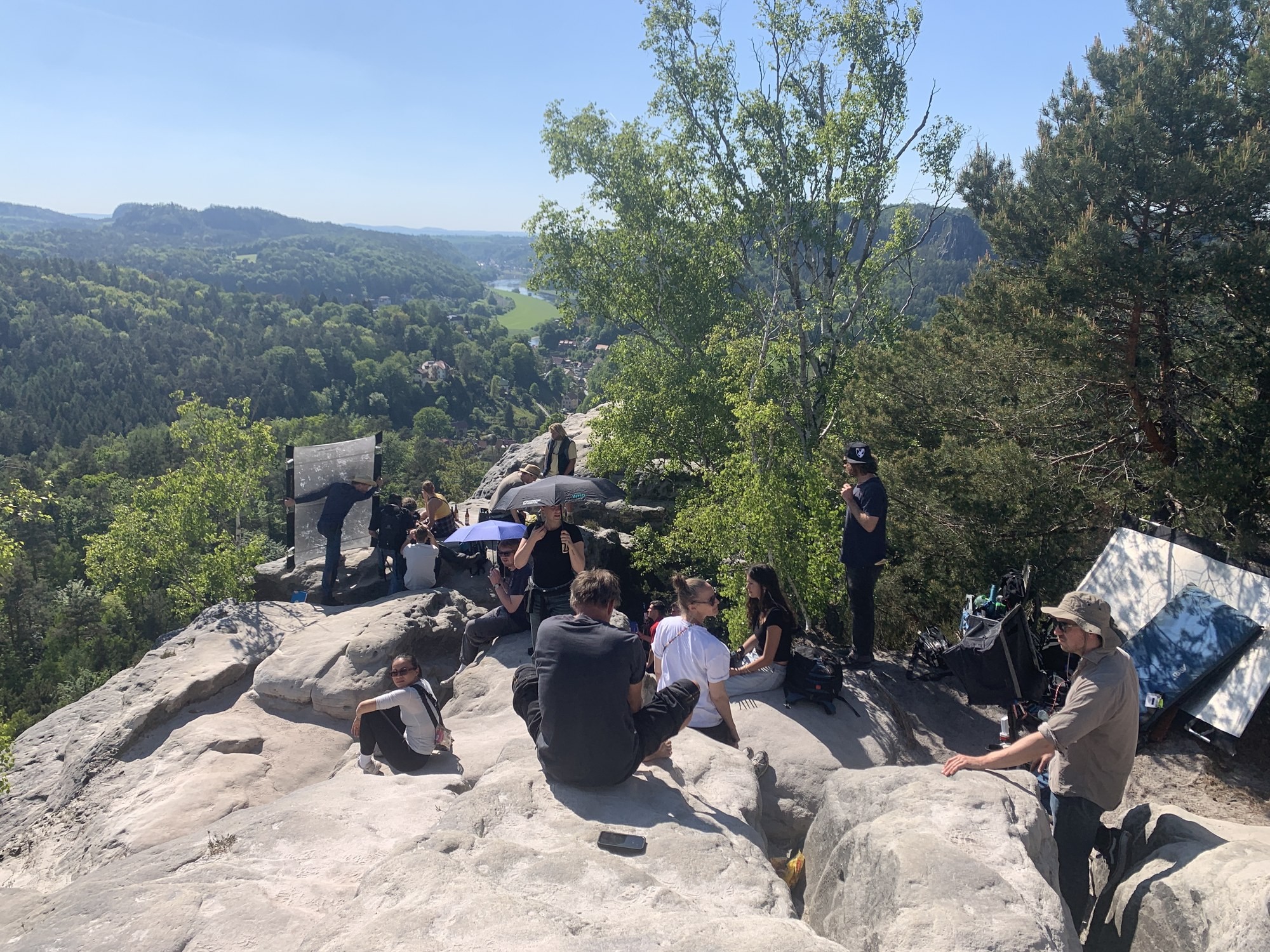
The crew was noticeably smaller than on comparable beer shoots — not to save money, but because these locations simply offer far less space. No twelve-tonne truck parks on a rock plateau, three tents do not fit up there, and every additional person is a person who needs somewhere solid to stand. Even the client's marketing team was present with only a handful of people. How much a set build differs from location to location becomes obvious next to the Bitburger 0.0% cinema spot: there we had a huge rig including an artificial sun, here every kilo counted because somebody had to carry it.
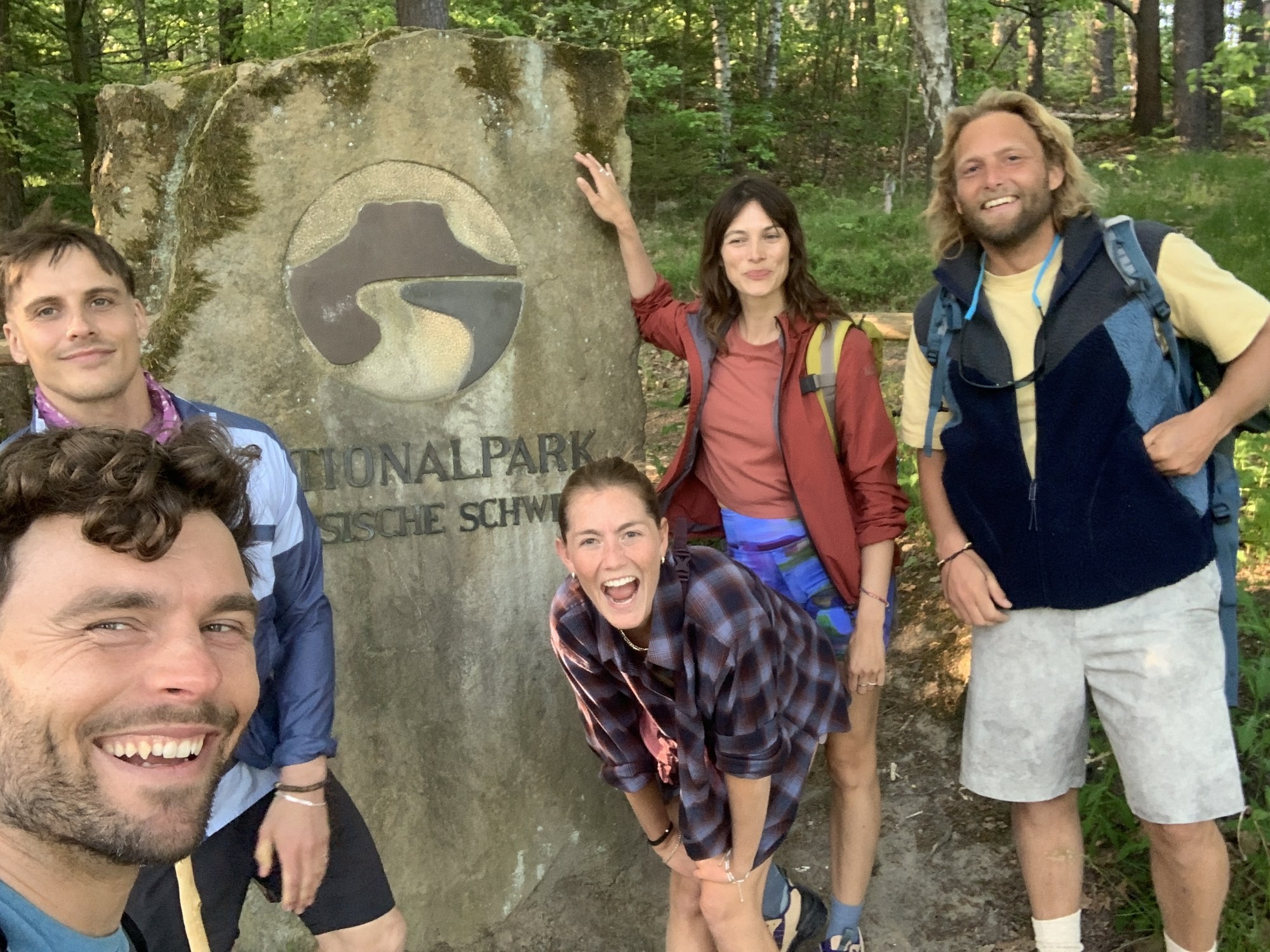
Mountain rescue, blockers and harnesses: who keeps a rock shoot safe
The moment a shoot moves into terrain like this, the schedule is no longer set by the director but by the safety plan. In our case the regional mountain rescue team was with us all day. They inspected the site beforehand, assessed the approach and handled safety during the shoot. That is not a formality or a tick on a form — it is the reason nothing happens on a day like that.
Blockers: the mountain rescue team also provided several people who closed off the location. In a popular hiking region that is necessary — not to annoy hikers, but so that nobody walks into a scene where people are working backwards near an edge.
Rope protection and via ferrata harnesses: above all for the camera crew. Picture an operator fully focused on the frame, walking backwards for a zoom move. That person should not go over the edge. We on camera were looking where we stepped; the camera, by definition, is looking somewhere else.
Permits: a national park is not a place where you simply build a set. Paths, times, headcount, equipment — all of it has to be agreed in advance. What that planning looks like in detail is in my guide to permits, safety and timing on a mountain shoot.
For productions planning something like this for the first time, this is the sentence that matters: safety is not a line item you delete when the budget gets tight. It is the precondition for being allowed to film at all — and it costs a fraction of what an aborted shoot day costs. The full order in which I plan an outdoor shoot is in the complete guide to planning an outdoor shoot.
The race against the light — and the beer crates that had to go up
There was no artificial sun on this shoot. We worked with natural, low-angle daylight, and that decision has consequences: you get a mood no lamp reproduces, and you get a time window that cannot be negotiated. Low light means early or late, and neither lasts long.
So the day was a race against the clock. Everything had to land — the positions, the walk into frame, the continuity, the timing of the group. And it did land. That is the part where a production shows its quality: when the planning was done properly, time pressure on set does not feel like panic, it feels like focus.
Then there was the logistics nobody suspects behind the finished spot. For the payoff scene, helpers and the mountain rescue team repeatedly carried fresh crates of Radeberger the long way up the mountain. A beer on camera has to look cold, full and freshly poured; after a few takes it no longer does. The team even included a dedicated beer stylist — a role that exists purely for the product moment and knows exactly how much foam, how much condensation and which angle make a bottle read correctly. If anyone asks why a commercial shoot needs so many people: that is the answer. Every second on screen has someone responsible for it.
How a group of friends reads as real: prep day, fitting and a shared dinner
The spot depends on us looking like old friends. The truth is: none of us had met before. Five people sitting at the same table for the first time in the morning do not look like a group that has been hiking together for ten years. That is why the day before is not a luxury — it is part of the work.
In our case, fitting and getting to know each other happened a day earlier, on 12 May 2025, with proper time budgeted for it. In my experience that day decides more about the result than any direction given on set:
A prep or fitting day should be paid. It is about the job and about a good performance, not a pleasant evening out. Booking that day as unpaid travel means saving money at exactly the point where the chemistry is created. Why day rates and usage rights belong in separate columns is explained in the article on the model buyout.
A shared meal belongs to it — and the production should cover it, so that talent does not sit alone in separate hotel rooms. In practice, thankfully, that never happens. People get to know each other, and good chemistry appears very quickly.
It matters most when a relationship has to be played — a couple, for instance, who supposedly have known each other for years. Familiarity cannot be directed, only enabled.
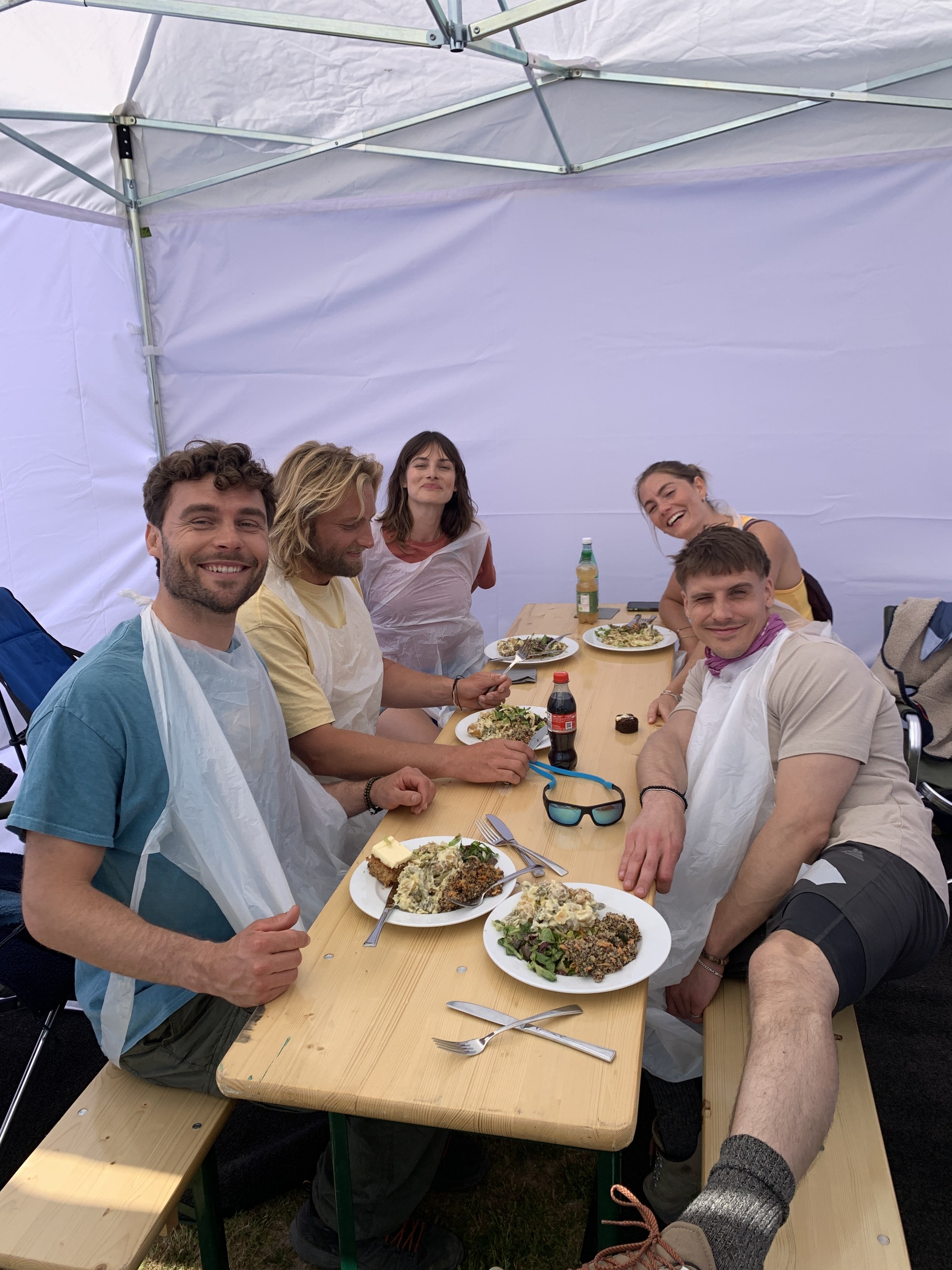
The second factor is who leads the set. Director and DoP set the mood, for everyone. I have been on shoots where the two clashed — it radiates through the whole team immediately, creates unrest and stress, and delivers visibly worse results. Here everything fitted, and you can see it in the material. If you want to know what I deliver as on-camera talent in this kind of setup and where the line to doubling runs, read the comparison of sport double and stunt double.
The most delicate moment: 60 to 70 metres straight down, on every side
Nobody on that day was allowed to have a fear of heights. As a cast group we stood on a rock that dropped 60 to 70 metres vertically on every side. One wrong step would have meant death — that is not dramatic phrasing, it is the plain geometry of the place.
And still the task is to stay relaxed and keep a loose expression. You are meant to embody a feeling of freedom, not concentration. That is the real performance in this scene: sitting on the stone as a group of friends, then standing up and toasting, means constantly making sure you do not get careless and do not misplace a foot — while your face tells the exact opposite story.

Beyond that, the situation was calmer than it sounds. Not many hikers were out that day, and the mountain rescue blockers were in position. There was no moment where things got chaotic. That is precisely the difference between a risky shoot and a dangerous one: the risk was real, but it was organised. Which sports I cover on camera, and where the same principle applies, is in the overview of my disciplines.
The most mundane challenge: a 45-minute walk to the toilet
And then there are the problems no treatment mentions. Portable toilets existed only at base camp by the car park — roughly a 45-minute walk away. Not at the rock, obviously. Saxon Switzerland is no comparison to the Alps, but things like this still have to be planned, otherwise they cost you half a shoot day.
When an entire set needs the toilet at once, it is uncomfortable for everyone and fatal for the schedule. So it took good planning and good timing: which shot gets filmed when and at which spot, when the group is descending anyway, where the break sits. It worked well — but it worked because somebody thought about it in advance, not because it sorts itself out.
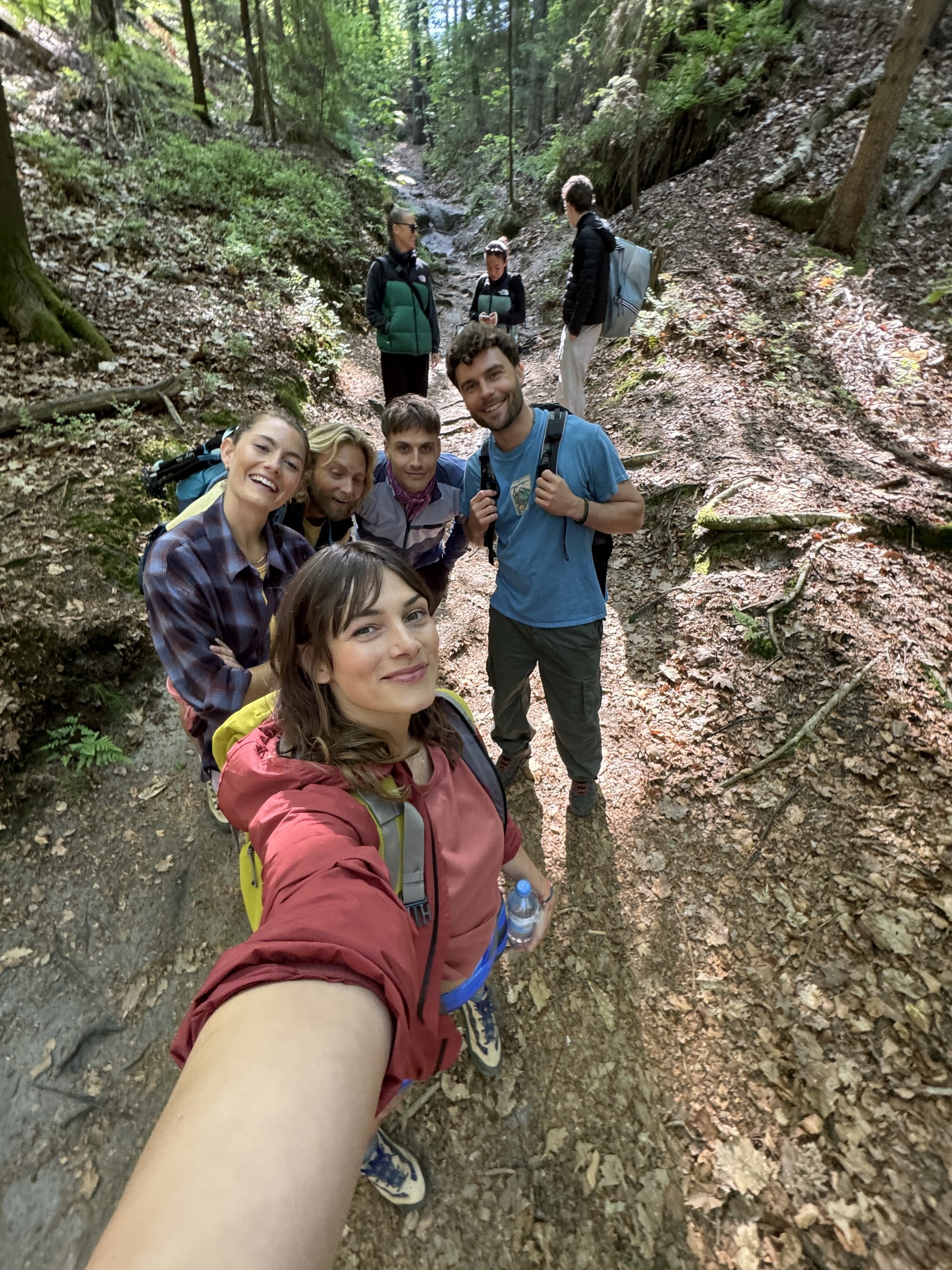
I tell this at length because it is the most honest answer to the question of what makes a mountain shoot hard. Not the climbing section. Not the weather. It is the sum of mundane things that stand three metres away on a normal set and 45 minutes away here: toilet, catering, spare wardrobe, charged battery, cold beer.
The B-roll with the fog machine — and the director's cut
The most beautiful moment of the shoot never made it into the spot. We had B-roll in a gorge with a portable fog machine. The sun came through the leaves in places and threw individual beams onto the hiking trail that suddenly became visible in the fog. An incredible mood, created by the effects team, with an effort you cannot see in the image.
That is probably exactly why it did not make the final clip: it looked almost too unreal for a campaign about genuine effort. On top of that comes the hard economics — on a TV campaign every second costs a great deal of money: production, edit, airtime. There is always the question of what goes in and what does not, and the answer rarely favours the mood shots.
There is, however, a director's cut of the whole situation that contains far more of this material than the broadcast version.
The beer face: why I got to hike for a beer brand a second time
One observation that still amuses me: the payoff scene looks very similar to the one for Bitburger. Same basic idea, same choreography — a group arrives at the top, someone hands out the bottles, everyone toasts, and in that moment a face has to express precisely what the brand wants to sell.
Apparently I have a beer face. I cannot explain otherwise why I was booked for a beer campaign a second time, both times in nature, both times for an alcohol-free product. What actually sits behind it is less funny and quite practical: casting for spots like these looks for people whose activity beforehand is believable. If you look like you really walked up there, you sell the reward more credibly. How the same thought was executed at Bitburger — there with one face instead of three doubles — is in the case study on the Bitburger 0.0% cinema spot.
What a brand should take away from this
My main point from this shoot: get the maximum out of a day like that — and then pay for it.
The plan was to capture several social media clips alongside the TV spot. In the end the schedule did not quite hold and it got hectic: individual cast members were repeatedly pulled out of the main set and filmed by a separate, external camera team for single social ideas. More stressful for us, but workable — and efficient for the brand, because the crew, the location and the light were standing there anyway.
In the end, though, not all of those clips went online, because the production did not want to pay overtime for the models. That is a legitimate commercial decision, and I understand that every hour on a day like that gets calculated. My position is still a different one: when a full team is already standing at a location this hard to reach, it is worth spending the few extra euros and taking significantly more output home. The travel is paid, the permit is paid, the mountain rescue team is there, the light is there. The most expensive hour of a shoot day is the one where you stop while everything is still standing.
The ideas were good. Not much of them is visible now. For the next campaign that means planning social content as its own block with its own time window and its own budget line — including the additional fees that go with it. How to book talent sensibly and what is possible directly instead of through detours is in the article on booking a model: agency or direct.
Planning a commercial in the mountains, or an outdoor campaign with talent who actually walk up the hill? Send a booking enquiry.
FAQ
Where was the Radeberger commercial filmed?
In Saxon Switzerland National Park in the Elbe Sandstone Mountains, with Bad Schandau as the base — roughly an hour's drive from Dresden. Part of it was filmed directly on a rock plateau that drops 60 to 70 metres vertically on every side. The location was deliberately real: the campaign is about a demanding hike rewarded at the top with an alcohol-free beer.
Who is in the Radeberger commercial?
A group of five friends hiking together and toasting at the top. One of them is me, Tobi Deckert, sports model and on-camera talent. We had not met before the shoot — the familiarity you see on screen comes from the prep and fitting day the day before.
What year is the Radeberger commercial from?
The spot was made in 2025. The prep and fitting day took place on 12 May 2025, with the shoot immediately after. The campaign promotes Radeberger alcohol-free.
Who produced the Radeberger campaign?
The agency was Ogilvy GmbH in Berlin, the production came from Bears Calling. The regional mountain rescue team handled safety and access control on set, and the crew also included a dedicated beer stylist for the product moment.
Was the rock shoot genuinely dangerous?
Yes — the risk was real, but organised. The rock dropped 60 to 70 metres vertically on every side. The mountain rescue team inspected the site in advance, several blockers closed off the location, and the camera crew in particular worked with via ferrata harnesses and rope protection. The reason: anyone looking through a viewfinder while walking backwards for a zoom move cannot see where the edge is.
Is there footage that did not make the spot?
Yes. The biggest loss is the B-roll in a gorge with a portable fog machine, where individual sunbeams became visible through the leaves. It did not reach the final clip — on a TV campaign every second costs a lot of money. There is, however, a director's cut with considerably more material from the shoot day.
Credits
Cast: Tobi Deckert (@tobi_deckert_sportmodel) · Liene H. (@liene__lien) · @mawy.c · @frederico_music · @juanmariafederico
Director: Paul Gerwien
DoP: Mathias Schöningh (@mathias_schoeningh)
Photo & social: Sven Jacobsen (@svenjacobsen69)
Casting: Julia Todorow (@todorowjulia) · @bloomcasting
Agency: Ogilvy · Production: Bears Calling
More posts