Bosch Commercial 2022: EXPERT Carbide - Industrial Model and Engineer on a Real Building Site
Where was the Bosch EXPERT Carbide commercial filmed, and who is in it? The product film for the EXPERT Accessory Range was shot in August 2022 on a real building site in Stuttgart-West - directed by Gerd Schneider, produced by emenes. I was one of the four Bosch Experts: commercial model, industrial engineer and product developer. My report from the shoot.
Written by
Tobi Deckert
Reading Time
12 minutes


Who is in the Bosch EXPERT commercial? The short answer
If you landed here because you saw the Bosch film for the EXPERT Carbide accessory range and want to know who is holding the angle grinder: my name is Tobi Deckert, I am a sports and commercial model - and I am one of the four Bosch Experts in that spot.
Who is in it? Four performers - Ruben, Stefan, Dennis and me. Two play the tradesmen whose tool gives up on them, two play the Experts who arrive with the new Carbide accessories. I am one of the Experts.
Where was it filmed? Not in a studio, but on a real building site in Stuttgart-West - an old house stripped back to bare structure during a full renovation.
What year? 2022, filmed from 10 to 12 August 2022.
Who was behind it? The client was Robert Bosch Power Tools GmbH, the production company was emenes gmbh, and Gerd Schneider directed. I was booked through Brodybookings in Stuttgart.
And then there is the detail that sets this job apart from most of my sports bookings: I do not just hold the tool, I understand it. I hold an M.Sc. in industrial engineering and work professionally as a product developer, building prototypes and machining metal, plastic and wood. Early in my career I designed and integrated flight hardware for the International Space Station at EADS Astrium Space Transportation. That is why I get booked for technology, trade and industrial campaigns as readily as for sport - and it is the same logic I described in Sports gear and stylists: function before colour. A frame in which the function is wrong sells nothing.
Client | Robert Bosch Power Tools GmbH |
Campaign | Bosch EXPERT Carbide / EXPERT Accessory Range - product film |
Year | 2022 |
Shoot days | 10-12 August 2022 (three days) |
Director | Gerd Schneider |
Production | emenes gmbh |
Booked through | Brodybookings, Stuttgart |
Location | Real building site / gutted structure in Stuttgart-West |
My role | Performer - one of the four Bosch Experts |
Cast | Four male performers: Ruben, Stefan, Dennis, Tobi Deckert |
Tools on camera | Angle grinders, cutting discs (EXPERT Carbide Multi Wheel, incl. X-LOCK), chisels - Bosch Professional range |
Protective gear | Clear safety glasses, dust mask, ear protection, gloves - throughout |
The brief: no studio, a gutted building in Stuttgart-West
We filmed in an old house in Stuttgart that was in the middle of a full renovation - not a set, a real environment. Several rooms had been stripped back to bare structure, each offering a different application for the tools. On camera were cutting discs, chisels, angle grinders and other accessories from the Bosch Professional range - exactly what working tradespeople actually hold. Nothing from the hobby shelf.
The location has to be understood the other way round from what you might assume: a studio could not have delivered what the real site delivered. The dust in the air, the noise, the half-finished background, the exposed edges and pipes - all of it was real, and that is why it read as credible. That was precisely what Bosch wanted.
In practice the real site was also the easier route. It was a large building with several rooms, so we had enough pipes to cut and enough walls to chase - free choice of takes. No set dresser had to build a building site, because there already was one. The lighting was designed to imitate a site, as if work lamps were running, while still making sure that we as performers and above all the product were cleanly lit.
The core of the campaign was a technical claim, not a feeling. EXPERT Carbide is the professional tier of the Bosch accessory programme: carbide grains are bonded onto a steel body using laser technology. The accessory wears down far more slowly, holds its diameter for longer and therefore delivers a constant cutting performance across its whole service life. Even someone who already owns a professional machine is still choosing between quality tiers - the shapes and fittings match the standard machines, but the professional tier is manufactured to a far higher standard. "Lasts longer, wears less" was the message we had to translate into images.
My role: one of the four Bosch Experts
The story of the film is quickly told and works in any language: two tradesmen are working, the tool stops cooperating, the mood tips towards despair. Then the two Experts arrive - I am one of them - carrying the new Carbide accessories that make the job easier and last longer.
We were four male performers, all of us practically skilled. With this kind of casting that is not a nice-to-have but a requirement: four men operating running machines for three days all need to know what they are doing. A performer who is only pretending holds up the entire schedule - more on that further down.
My job on camera was to be the composed one: the figure who brings calm when nothing is working. You play that through body tension and timing, not through dialogue - and it collapses instantly if your hands look uncertain the moment the disc touches the material.
How professionals spot an amateur holding a power tool
Anyone who works with these machines for a living can tell within a second whether someone has done it before. It comes down to two things:
The angle of approach - and calm combined with force. A professional works with the right pressure points in the right place. He does not push against the material, he guides the machine. An amateur shoves, corrects, jams the disc and starts again.
Where you stand relative to the machine. An angle grinder has a guard that directs removed material and sparks in a defined direction. Standing in that exact spot and letting it spray you is not merely unpleasant - it is a health hazard. You recognise professionals by where they position themselves before they switch on.
I learned this myself, the unpleasant way. During the practical part of my engineering training, in a welding course, I was working with a wire brush attachment - and despite safety glasses a bristle flew into my eye and lodged there. The company doctor pulled it out. I have not debated protective equipment since.
When an amateur operates one of these tools for a photograph, the risks are not theoretical. High forces and high rotational speeds act between workpiece and machine. Someone who jams the disc and wrenches their wrist gets hurt - on set, with witnesses, with insurance involved and with the whole crew standing still.
One aside, because it comes up every time: in German, "Flex" is a brand name. The correct generic term is angle grinder. For a brand selling into exactly that segment, that is not a trivial detail.
How I got the job: an e-casting with an angle grinder
I was booked through Brodybookings in Stuttgart. The agency has known me for years, knows what I can do, and we talk directly - which is the most pleasant way to work, because the shortlist actually fits. What the practical difference between an agency booking and a direct booking looks like is in Booking a model: agency or direct.
Even so, an e-casting was required, as it almost always is today. You act out the scene yourself on video. So I had to film myself operating an angle grinder, plus a cordless drill and a jigsaw. In my submission I deliberately worked several different materials instead of making one demonstration cut on a pipe - because that is what answers the question the production actually has: can this man do it, or has he practised it once?
The second half of the answer is on paper. I hold an M.Sc. in industrial engineering and work as a product developer. I build prototypes, which means using a range of tools on a range of materials - daily work, not a weekend hobby. Early in my career I worked at EADS Astrium Space Transportation, designing and integrating flight hardware for the International Space Station. Many of the small parts there I assembled with a magnifier and tweezers. That kind of work shapes manual precision, and in a casting it is an argument no six-pack replaces.
For brands the takeaway is simple: a technically literate model is not a lucky find. You can filter for it - in the brief to the agency, in the e-casting and in the CV.
Application shots and packshots: two modes, two visual languages
We separated the two cleanly during the shoot, and with tool campaigns that separation is half the job:
Application footage and stills: the real thing. Machine running, material being cut, sparks, dust, body tension. What matters here is that the handling is correct.
Product shots and packshots: the product out of the machine, held straight to camera so attention lands exactly on it. What matters here is that the hand does not cover the product and the angle shows the printing.
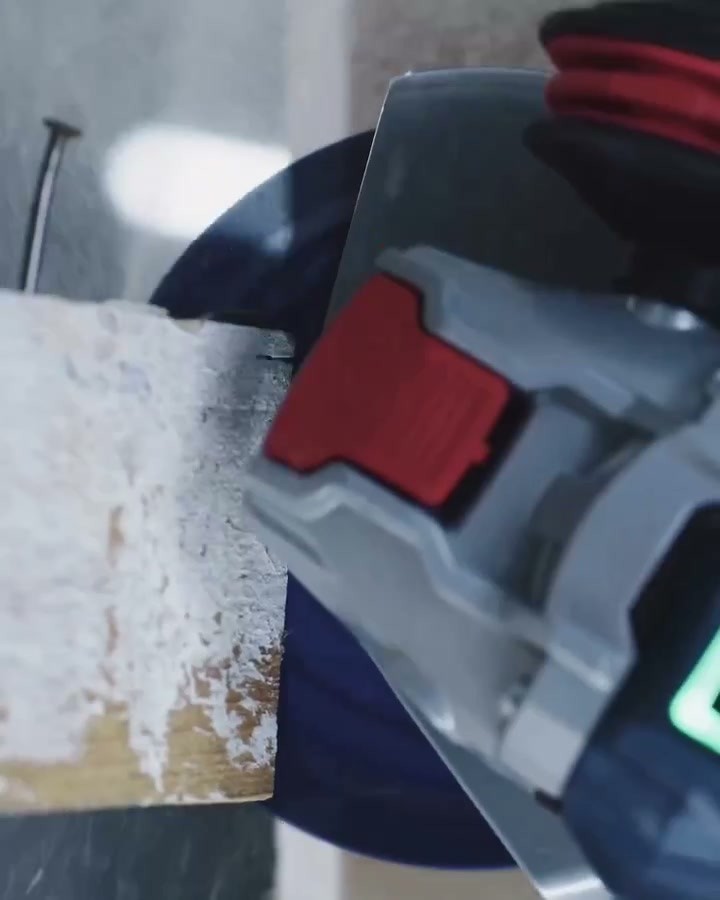
Technically there was no alternative: on a rapidly spinning cutting disc inside an angle grinder, nobody can read which logo is on it. Show the brand message only in application and you have effectively not shown it at all. That is why every tool campaign needs both modes - and both need a performer who knows which one he is currently in.
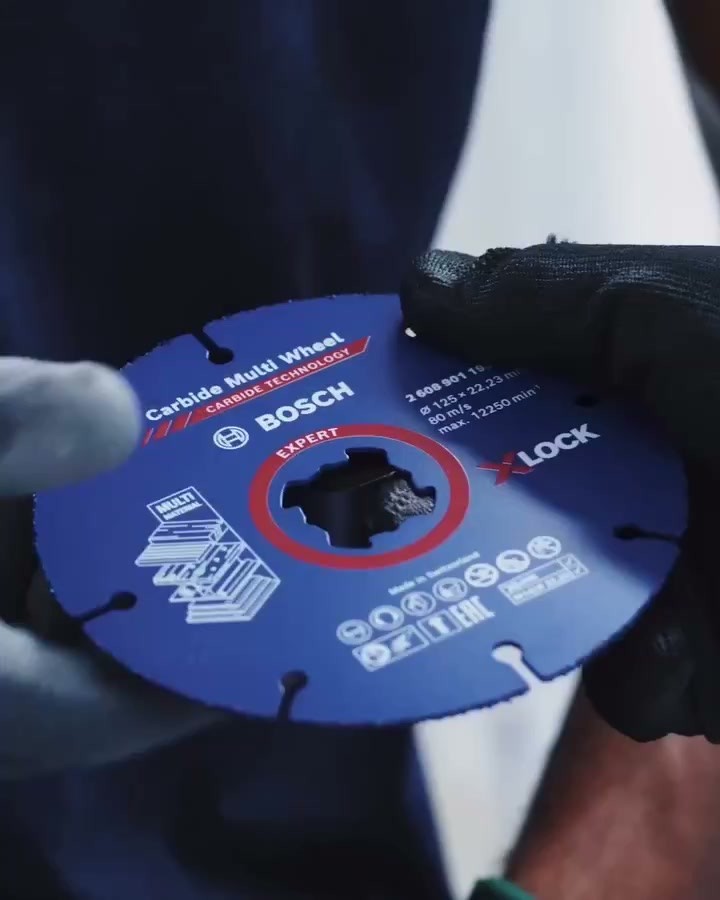
For the usage side that was decisive. Because this campaign is about the tool above all, the packshots led. The film was designed as a one-off social media push - a short reel to introduce the new Carbide range in the first place. The audience is working professionals, and they do not need an emotional face selling them a feeling; technical detail and facts matter more to them. Why usage type and term belong in the deal before the shoot day, and why they should be costed separately from the day rate, is in Model buyout explained.
Protective equipment: uncompromising - and not the same everywhere
On protective equipment this shoot was completely uncompromising, and rightly so. We wore safety glasses, gloves, ear protection and a mask throughout. One detail you only notice if you look for it: the safety glasses were clear, not mirrored. Mirrored lenses look tougher on camera - but then you cannot see the eyes, and without eyes there is no face for anyone to identify with.
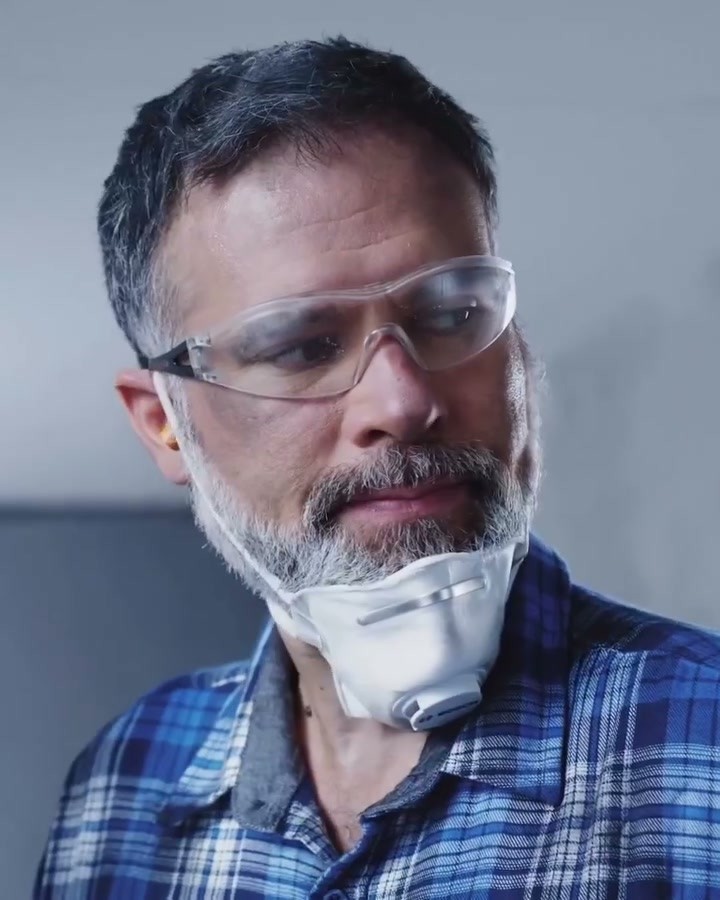
Bosch also carries a duty to set an example here: a brand addressing professionals has to show maximum protective equipment, otherwise the image normalises the opposite. From my own experience I can only endorse it, and I wear it when no camera is present too.
But be careful - protective equipment is not the same everywhere. I once shot in a wood workshop at a pillar drill. There it is explicitly forbidden to wear protective gloves, because the bit can catch the fabric and drag the hand in - which makes the injury worse, not smaller. Anyone who does not know that rule builds a mistake into the frame that every professional in the target audience spots immediately. In a trade campaign such a mistake costs more than a soft focus: it costs credibility.
Why a commercial model and not an actual tradesman
The obvious question about a project like this: why does Bosch not simply book four real tradesmen? The answer has two parts.
First, as a model you are the product, and it is always a question of type: whether face, presence and bearing fit the product, the brand and the persona - meaning the target audience. Being listed with an agency as a sports model does not mean I only do sport. I am equally a commercial model and have advertised very different products, from beer campaigns to dairy for Landkäserei Herzog. Where exactly the line runs between performer, sport double and stunt double is sorted out in Sport double instead of stunt double.
Second - and this is the part brands underestimate: real tradesmen operate the tool perfectly. But do they have presence on camera, and do they know how to behave on a set? It starts with small things, such as not looking into the lens - which amateurs reflexively do the moment they feel uncertain. I see it regularly. And the mood turns quickly when a photographer or director first has to explain the job to a supposed model.
In a commercial shoot the mood is the decisive factor, because the audience is meant to recognise itself in it - in a fashion shoot the model deliberately holds an emotionally flat expression. Two entirely different crafts, which is why "model" on its own is not yet a qualification for a trade campaign.
What it costs a production when someone cannot handle a set
I like to spell this out in concrete terms, otherwise the argument sounds like vanity. When a performer cannot handle a set, this is what happens:
Best case: several additional takes and overtime for an entire crew.
Middle case: a tense atmosphere on set until the shoot has to be paused. Tension is contagious, and it is visible in every face.
Worst case: the images never happen. The mood is not embodied, the persona does not feel addressed - the marketing objective is missed, after a fully paid shoot day.
A photographer or director cannot teach a performer on set how all of this works. He can give pointers and steer, and that is it. The fundamentals have to be brought along - practical as well as performative.
And there is one point that gets underestimated most often on technical shoots: the brand's own technicians need to be on set. A practically skilled model picks up a machine quickly - but you still need someone who gives a proper briefing and is immediately available if something goes wrong. If only the crew, the performers and the marketing department are on location and the machine throws an error, the entire set waits for a technician who first has to travel in. That costs overtime and, in case of doubt, another shoot day for everyone. On our shoot this was covered, and the days ran as planned.
Which technical environments I am credible in
Because this is exactly what clients ask, here is the honest inventory. I am an all-rounder with a broad grounding:
Precision mechanics - small components integrated and assembled with magnifier and tweezers, daily during my space hardware years.
Metalworking - time in a metal fabrication shop, fundamentals on the lathe, operating milling machines.
3D printing - used independently in my own prototype work.
Materials testing - certified to operate testing machines, including hardness testing and tensile testing.
Automotive and mechanics - I do my own repairs privately and could portray that credibly on camera.
And the honest limit, because it is part of being credible: I have not operated heavy construction machinery over any length of time - no excavator, and I have never torn up a road with a jackhammer. I would trust myself to do it after a short briefing; I would not claim it beforehand. The disciplines I do cover reliably are listed in the overview of my sports in front of the camera.
Personally this job was a perfect match - I use Bosch Professional tools myself. I even asked at the end whether I could keep the accessories; on shoots that is often possible once they have been used. Not here: these were pre-production models that were still needed.
Planning a tool, trade or industrial campaign and need a performer who can genuinely operate the machine? Send a booking enquiry.
FAQ
Where was the Bosch EXPERT campaign filmed?
On a real building site in Stuttgart-West - an old house stripped back to bare structure during a full renovation, not a studio. Several rooms were available, with enough pipes to cut and enough walls to chase. The lighting was designed to imitate a site, as if work lamps were running. The real location was a deliberate choice: dust, noise and a half-finished background cannot be rebuilt convincingly in a studio.
What year is the Bosch EXPERT Carbide spot from?
It was filmed from 10 to 12 August 2022. The client was Robert Bosch Power Tools GmbH, the production company was emenes gmbh, and Gerd Schneider directed. The booking came through Brodybookings in Stuttgart.
Who is in the Bosch EXPERT commercial?
Four male performers: Ruben, Stefan, Dennis and me, Tobi Deckert. Two play the tradesmen whose tool fails, two play the Bosch Experts who arrive with the new Carbide accessories. I am one of the Experts.
What does an engineering degree have to do with a commercial shoot?
On a tool campaign, a great deal. I hold an M.Sc. in industrial engineering and work as a product developer building prototypes; early in my career I designed and integrated flight hardware for the International Space Station at EADS Astrium Space Transportation. That is why the approach angle, the pressure point and my stance relative to the machine are right on camera - exactly the details by which a professional audience spots an amateur instantly.
Why does a tool brand book a model rather than a real tradesman?
Because both skill sets have to meet. A real tradesman operates the tool perfectly but rarely has camera presence and set routine - not looking reflexively into the lens, for example. A model without tool experience produces handling errors that professionals notice immediately. So the ideal booking is someone who brings both.
What should an industrial brand settle before the shoot day?
The most frequently underestimated point: the brand's own technicians need to be on set - for the briefing and as an immediate contact if something goes wrong. Without them, an error message leaves the entire crew waiting for someone who first has to travel in. That costs overtime and, in case of doubt, an additional shoot day.
More posts