Eddie the Eagle: Ski Stunt Double for Hugh Jackman & Taron Egerton
How the ski jumping crashes in Eddie the Eagle were really filmed: training in Klingenthal, 1970s alpine skis, the CGI night jump with a real landing – and a very grounded Hugh Jackman.
Written by
Tobi Deckert
Reading Time
7 minutes



How the job came about
Eddie the Eagle was not the most gifted ski jumper, and in many scenes he quite literally crashed on his face. It was clear early on: this needed a stuntman who could recreate crashes on skis safely and convincingly – and my career as a professional freeskier, with plenty of crashes of my own, helped enormously.
The request came through my stunt crew Face Off (Stunts & Rigging) from Lake Starnberg, with whom I have worked for many years. Second unit and stunts were run by Vic Armstrong – the living stunt legend, Harrison Ford’s double in Indiana Jones and James Bond among much else. He knew exactly how he wanted the crashes: as real as possible, the way they actually happened back then – original footage exists, and it was to be recreated as closely as possible.
Why a stunt double instead of a real ski jumper
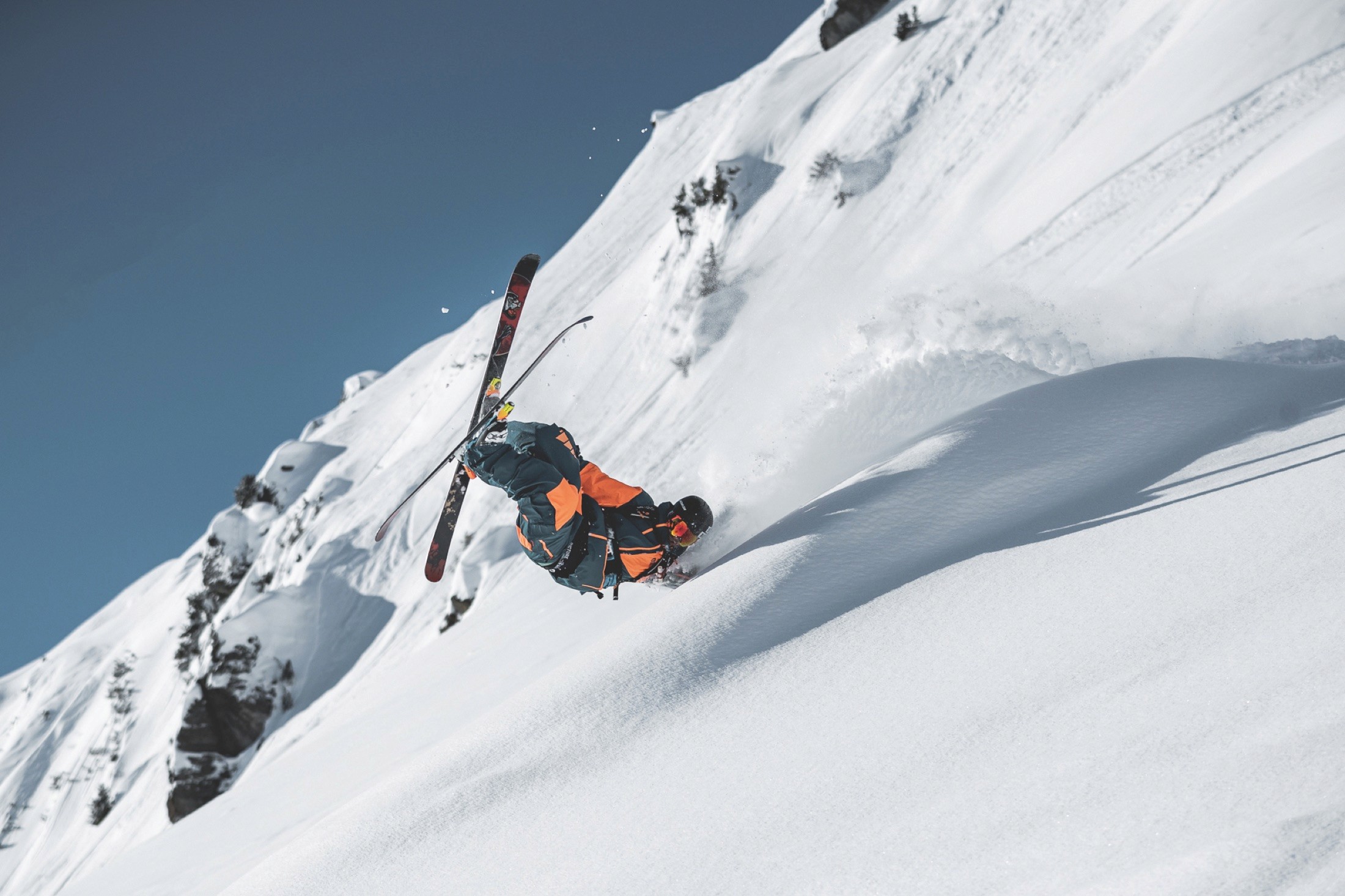
I had jumped plenty of kickers – in the park, on the slope, many self-built. But crashing all the way down a ski jumping hill was new even to me. Even professional ski jumpers are not the best choice for deliberate, repeatable crashes – that is stunt craft. And it was obvious: this would take training and preparation.
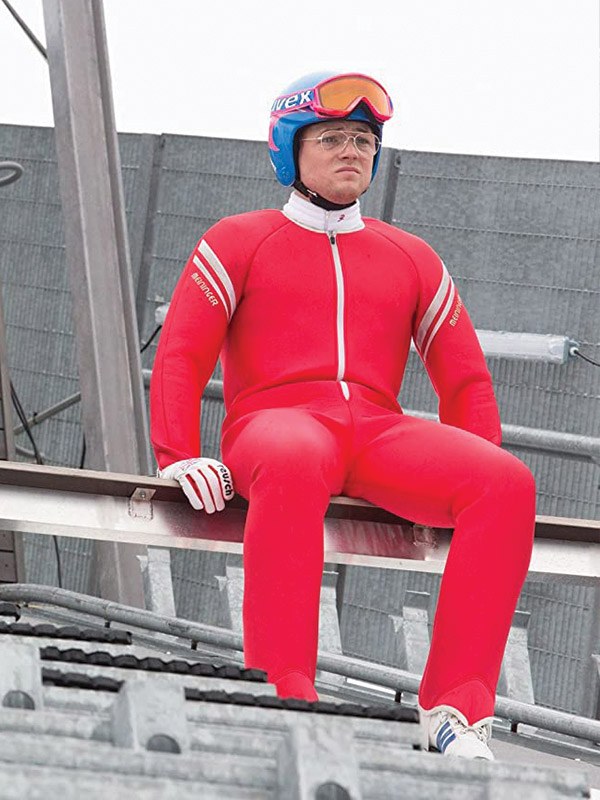
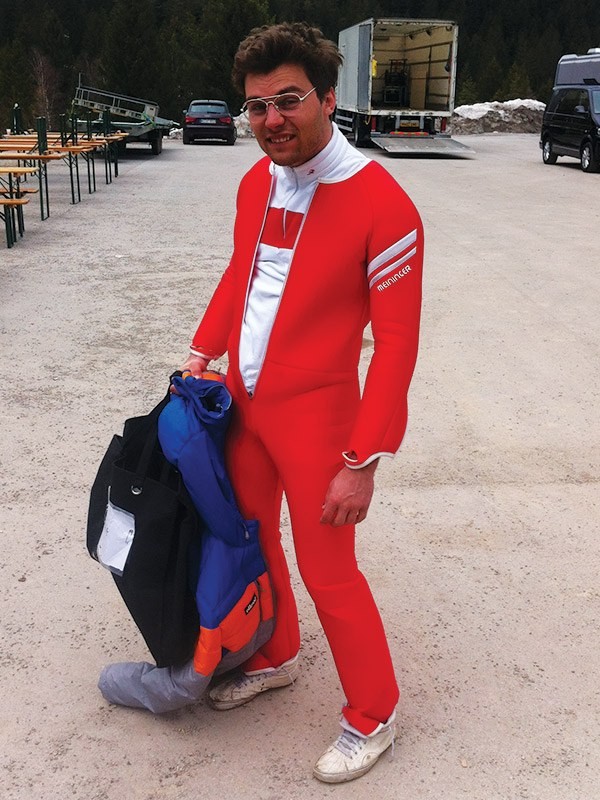
Training in Klingenthal
As in real life, you start small. Since I was used to kickers, the small jumps were easy – but clean jumping had to be solid before we moved to crash techniques: different speeds and falling patterns, initially short skis with easy-release bindings, mats after the takeoff, plenty of protectors. We even considered laying a wooden bar into the in-run to get catapulted off the hill – too extreme, and it stopped looking real.
A detail about air control: real ski jumpers use hands and arms like a tailplane to correct in the air. My job was to make the crash look right – so at takeoff I would let myself sag backwards or tip forward. Eddie really did sag backwards once: just before takeoff comes a compression – if the legs miss the timing, you slide over the knoll on your back. Crucial for everything: a steep landing prepared soft – the snowcat keeps pushing fresh snow in and churns it soft on the winch.

Equipment: 1970s alpine skis and an angle grinder on set
Back then, Eddie jumped on regular alpine skis because he had no jumping skis – and that is exactly how the film wanted it. So my first jumps were on alpine skis from the 1970s, with steel edges. The catch: the in-run tracks of that era (galvanized steel) are stainless steel today – and my harder steel edges bit into the track. That braked hard and was not exactly safe. So on set we ground my steel edges off completely with an angle grinder and specially prepared the bindings.
These are exactly the jobs nobody does for you – not props, not styling. You are responsible yourself for equipment and safety; a stuntman is often half engineer, delivering the technical quick fix. More on that in Sports Gear & Stylists.
The critical take
The trickiest moment was the main crash scene: Eddie flying head first, always onto the same shoulder. We were several stunt performers taking turns. The hard part: we jumped on real ski jumping skis – light and wide, but quick to break. A ski snapping in the landing and whipping past your face gets dangerous fast. It also got tight with camera gear: a Blackmagic stood mid landing slope – I collected it once with a ski and it rolled all the way down. Unplanned things always happen; that is why preparation and breaks matter – bruises are part of the deal.
Doubling two actors – and a mullet
The shoot ran over several weeks on a fixed schedule, make-up included. In between we doubled other characters too, like the Norwegian ski jumpers. I even had a mullet cut. A business detail on the side: when hair or beard get changed drastically for a shoot, they do not simply grow back for next month’s job – that gets compensated separately, because your look as a “product” is temporarily off the market.
For Hugh Jackman there is the scene where, as the coach, he runs up the hill at night and jumps – no helmet, black shirt, cigarette in his mouth. Nobody was allowed to jump at night, and nobody could do the full jump anyway: it was solved with CGI. But from the landing on, it is me – we built a small kicker into the landing hill, and the final meters of flight plus the landing are real. Above all the close-up of the perfect landing would never have felt authentic in CGI.
“Stay down until cut” – and the Jackman moment
Something few people know: after a crash on set you stay down until the director calls cut – the camera keeps rolling. For the stunt coordinator that is one of the most critical moments, because he cannot know if you are truly okay. I had a continuity shot where Hugh Jackman, as the coach, runs over to me – in the film and in reality. When “cut” came, he genuinely asked whether I was okay. That showed me a Hollywood star who stayed completely grounded and cared about the human being. We had some really good conversations. A lovely touch: Eddie himself visited the set and has a small cameo at the bar in the film.

What a client takes away
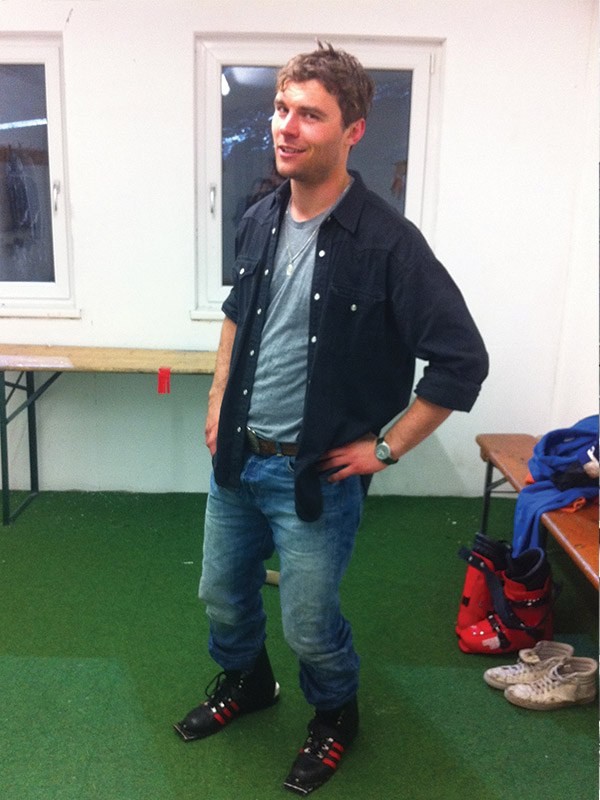
Real freeski skill means safe, authentic crashes without a CGI break – especially in the close-ups, where CGI does not convince. Add a well-rehearsed crew (Face Off), thinking along in front of and behind the camera, and the half-engineer quick fix on set. How such jobs are priced is covered in the risk matrix article. Credits: IMDb – Tobi Deckert. Send a booking request.
FAQ
Who really jumped in “Eddie the Eagle”?
The crash scenes and many jumps were done by stunt doubles – I was one of them, doubling Taron Egerton and, in one scene, Hugh Jackman. The full night jump was CGI; the landing and close-up are real.
How do you film a ski jumping crash safely?
With staged training: clean jumping first, then crash techniques at increasing speed – easy-release bindings, mats, protectors and a steep landing groomed soft.
Why not use a real ski jumper as a double?
Pros jump perfectly – but deliberate, repeatable crashes on command are stunt craft and need crash experience, which freeskiers bring.
Project facts
Film | Eddie the Eagle (2016) · second unit/stunts: Vic Armstrong |
My role | ski stunt double for Taron Egerton & Hugh Jackman (+ side characters) |
Crew | Face Off Stunts & Rigging (Lake Starnberg) |
Locations | Garmisch-Partenkirchen · training in Klingenthal |
Credits |
More posts