Kalte Füße: The Wheelchair Ski Stunt on Ice
Steering a modified wheelchair down a frozen road behind a car, straight onto a kicker: how the ski stunt in „Kalte Füße“ was really done — and why trust in rigger Bastian Volkmer decided everything.
Written by
Tobi Deckert
Reading Time
6 minutes



How a wheelchair becomes a stunt rig
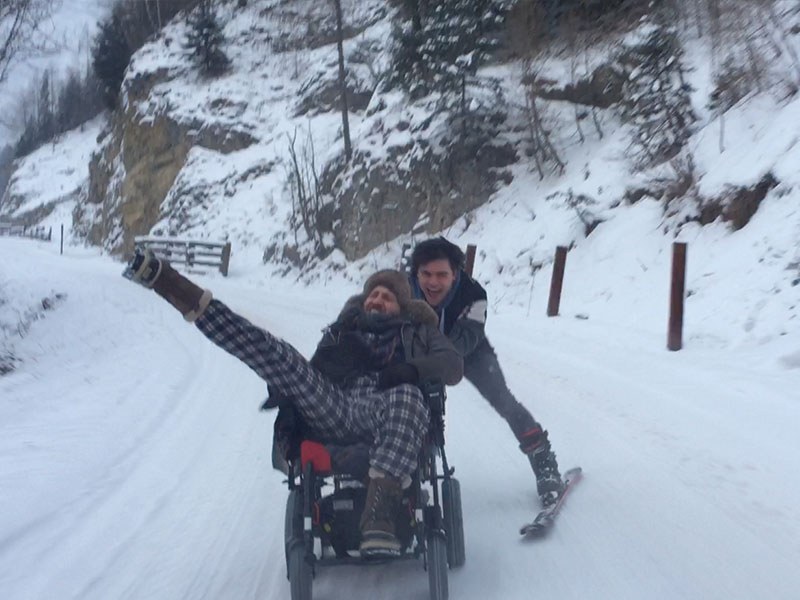
The job came, once again, through my stunt agency Face Off: because several stunts happened on skis, I was brought in as the ski expert. When I heard we would ride a wheelchair down a frozen road, I could picture it immediately — and knew right away what it needed: short skis, so I wouldn’t touch the wheelchair’s tyres and could still steer from behind at the handles.
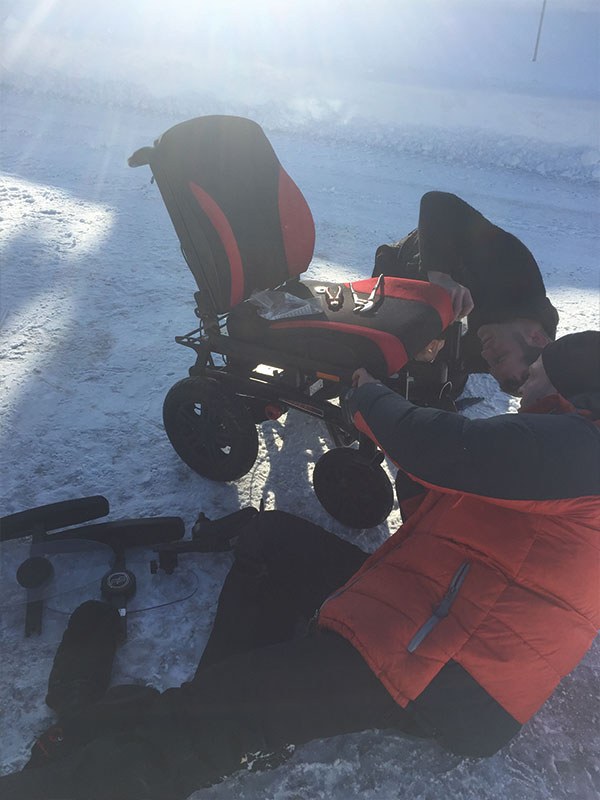
Bobsled brakes instead of disc brakes
I steered by leaning left and right. Bastian Volkmer had welded on two separate brake handles — like on a bobsled: in an emergency he could pull separately, take out speed and defuse the situation. At the same time he had removed the disc brakes, because they were useless in snow and only added weight. Exactly this engineering mindset is what makes a good stunt safe — not courage.
A real car, a Russian Arm, an octocopter — and a kicker
It all had to be real: we followed a real car, with several cameras and in several takes — one car with a Russian Arm — a camera crane mounted on the roof — and a large camera drone (octocopter). And I had to steer precisely, because the final scene had a kicker I needed to hit at high speed — with enough momentum to fly through the air, but without hurting ourselves on the crash. In the air we needed room to push everything away from us, invisibly in the film.

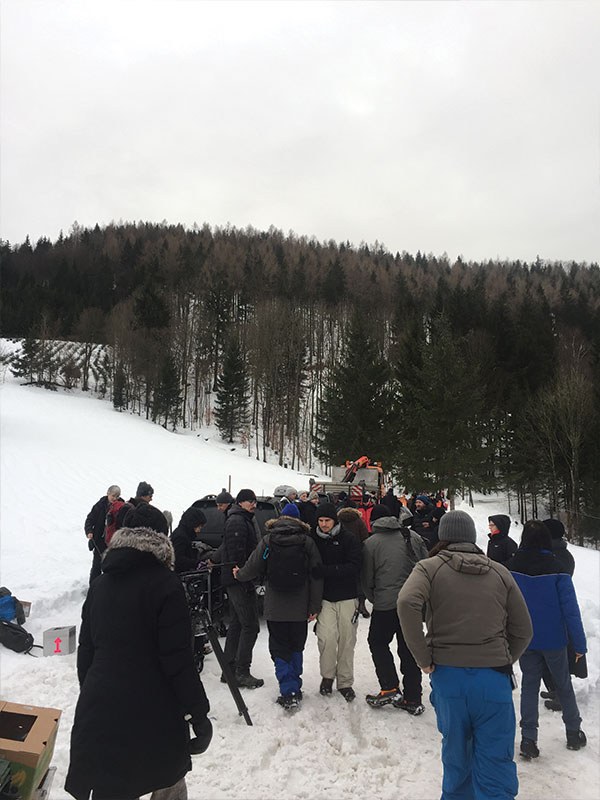
For the snow, Filmservice Petters with Wolfgang „Wolfi” Petters did huge work: transport, quad trailers and trucks loaded with snow. The kicker got a wooden base so it stayed stable through changing weather, the surroundings were prepared with the snow blower and the landing kept soft. One pro trick came from Fuzzy Garhammer: build a small snow wall on the kicker so the snow sprays even more as you fly over it. After a few rehearsals everything sat — and we had the scene perfect on the first take.


Trust — the reverse of the Trautmann stunt
On the ratchet stunt for „Trautmann” I put my life in Bastian’s hands when he fired the ratchet. Here it was exactly the other way around: Bastian sat in the wheelchair and I steered him. We have known and trusted each other for many years — he recognises my ski skills, I his technical ones. Through many rehearsals beforehand on the road, under different conditions, we could ease our way in. Bastian doubled Heiner Lauterbach, who in the film is paralysed after a stroke and can only fire the rifle. The loud shots and the bang were an extra distraction for me — and we were being shot at too (blanks), certain scenes had to match, like the shot-out rear window. The real location also had a steep slope: I focused only on the dangerous curves and the speed, Bastian on the rifle action. With several degrees below zero, staying warm between takes mattered — concentration is everything on a stunt like this.
Two actors who can do exactly the opposite
The funniest part was the irony of real ability: Emilio Sakraya can’t ski in the film but very much can in real life — and Sonja Gerhardt can ski well in the film but can’t in real life. So both had to be doubled. That is exactly the point I make in Agency or Direct?: look and real ability are two completely different things. Telling too: as the lead, Sonja was not allowed to do her own stunts, even though she skis well — the injury risk would have been too high, and an injured star halts the whole shoot. How that risk is calculated cleanly is in the risk matrix.
Make-up, night and deep snow
With Emilio I had more scenes — piggyback skiing, riding into a tree and more, all routine. A night ski descent in deep snow had to look as real as possible; with the camera team that was genuinely fun. And yes — as a stunt double you get made up again and again to be indistinguishable from the actor.
What a client takes away
For bookers the message is clear: I don’t just ski well, I deliver exactly what the script calls for on camera — and that is often not normal skiing. Riding into a tree at night in deep snow has nothing to do with clean carving on a groomed slope. It is a mix of ski skill and stunt craft: skiing is the base requirement, the falling and the technical know-how come on top — exactly as I describe in The Sports I Perform on Camera. Real, safe crashes without a CGI break are also the core of my Eddie the Eagle work. Planning an action or winter production? Send a booking request — credits on IMDb.
FAQ
What was Tobi Deckert’s role in „Kalte Füße”?
Ski stunt double for Emilio Sakraya — among other things in the modified wheelchair racing down a frozen road behind a car, and in ski scenes like a night deep-snow descent.
How is a wheelchair stunt on ice made safe?
Through training, short skis for steering and engineering on the rig: welded-on bobsled brake handles for separate braking, removed disc brakes (useless in snow) and a soft, wood-based kicker.
Why double actors who can ski themselves?
Because the injury risk endangers the whole shoot — and because script-precise action (night, deep snow, into a tree) is stunt craft, not normal skiing.
Project facts
Film | Kalte Füße (2019) · director: Wolfgang Groos |
My role | ski stunt double for Emilio Sakraya |
Cast | Heiner Lauterbach · Emilio Sakraya · Sonja Gerhardt |
Crew | Face Off Stunts & Rigging (Bastian Volkmer) · Filmservice Petters (snow) · Fuzzy Garhammer |
Credits |
More posts