How I Stay Fit and Healthy: Training, Recovery and the Cushion I Invented Myself
How does a sports model stay fit? My morning routine, proprioceptive training, recovery, sleep, nutrition and supplements, told openly and with a clear disclaimer. Plus the reason I am not a neutral user of the recovery tool I work with every day: I invented it myself.
Written by
Tobi Deckert
Reading Time
15 minutes


The body is the tool, not the goal
I do not go to the gym to bulk up and look athletic. For me the order runs the other way round: sport comes first, then the passion for it — and the body is the tool that makes it possible. I train regularly to keep my joints supple, to protect myself from injury and to stay fit. So that I can do the sports I love, and operate the equipment those sports demand.
That is not an attitude, it is simply the job. As a sports model, my body is the product that gets booked. Which body type fits which campaign, and why the word “fitness model” in a briefing is almost always too vague, is a topic of its own: fitness model, bodybuilder or sports model?
Every sport loads different muscle groups. Finding a balance and working on it deliberately matters — otherwise you drag imbalances around with you that get expensive later on.
One thing I should make clear right away, because I do not want to disappoint anyone: I do not plan my training week strictly by the book. I let a lot of it come to me. And I decide by a variable that appears in no training plan — the weather.
My training plan is called weather — and what goes missing over the year
The basic logic is simple:
Good thermals and sunshine → paraglider. I hike up the mountain with the wing in my backpack and fly down instead of walking down. Exercise, experience and adrenaline in one — a wonderful combination.
Föhn wind, so not flyable but windy → kitesurfing.
After rain, once the ground has dried out → onto the bike, a bit of trail.
What surprises most people is how well some of it pairs up: skiing and kitesurfing complement each other beautifully. The muscles involved are very similar, even though it does not look that way from the outside. Kiting adds more core and foot work, plus the arms; skiing leans harder on the thighs.
More interesting, though, is what goes missing — because that is exactly what I have to fill in deliberately. In winter, when I am on skis a lot, chest work drops out. In summer I do a lot of leg work in the gym to keep ankles and knees ready for the impacts and landings of winter. And in winter I train shoulders and rotators specifically, so that in summer I can hold the bar through long sessions.
In principle I would rather do any sport that gives me something than grind out one isolated exercise on a machine. But sometimes the machine is exactly what is needed. Spread across a year, it looks like this:
Building block | When | What it is for |
Morning routine (fascia, tabata, stretching, breathing) | daily, 45 to 60 minutes | deep core muscles, mobility, a clear head before the day starts |
Paragliding | good thermals and sunshine | endurance on the way up, concentration in the air |
Kitesurfing | windy days when flying is out | core, feet, arms, sustained pull on the bar |
Mountain bike, trail | once the ground has dried after rain | legs, endurance, riding technique |
Gym: chest and upper body | winter | balances out what the ski season does not deliver |
Gym: leg work | summer | ankles and knees for hard landings in winter |
Shoulders and rotators | winter | preparation for holding the kite bar in summer |
Bouldering gym | all year as a wildcard | covers a lot of muscle groups in one go |
Stretching, passive recovery | after every larger load | lengthen the muscle, push fluid out, let nutrients back in |
Which of these sports I also ride at camera level rather than purely for fun is in the overview of sports in front of the camera. Trail running, incidentally, is the building block I underestimate most often — it is the most honest base endurance work I know.
The morning routine: 45 to 60 minutes, every day
What always happens, whatever the rest of the week looks like: every day after getting up, my body and my head get at least three quarters of an hour, often a full hour. Four modules:
Fascia ball or fascia roller. Loosening and breaking up stuck muscle tissue — especially when the previous day carried a heavy load.
A short tabata or HIIT block. A brief, intense unit that drives the pulse up and wakes the whole body. I do this daily with the inflatable training cushion I developed myself, built for exactly that purpose. The focus is on the deep muscles.
A short stretching session, usually a yoga sun salutation. Again with the cushion as support.
A short breathing exercise, to settle the mind before the day starts.
Which modules actually happen depends on what the previous day did to me and what I need right now. But one thing is certain: I start the day with a completely different level of energy. And on a shooting day this routine is often the entire preparation — more on that in preparing for a fitness or sports shoot.
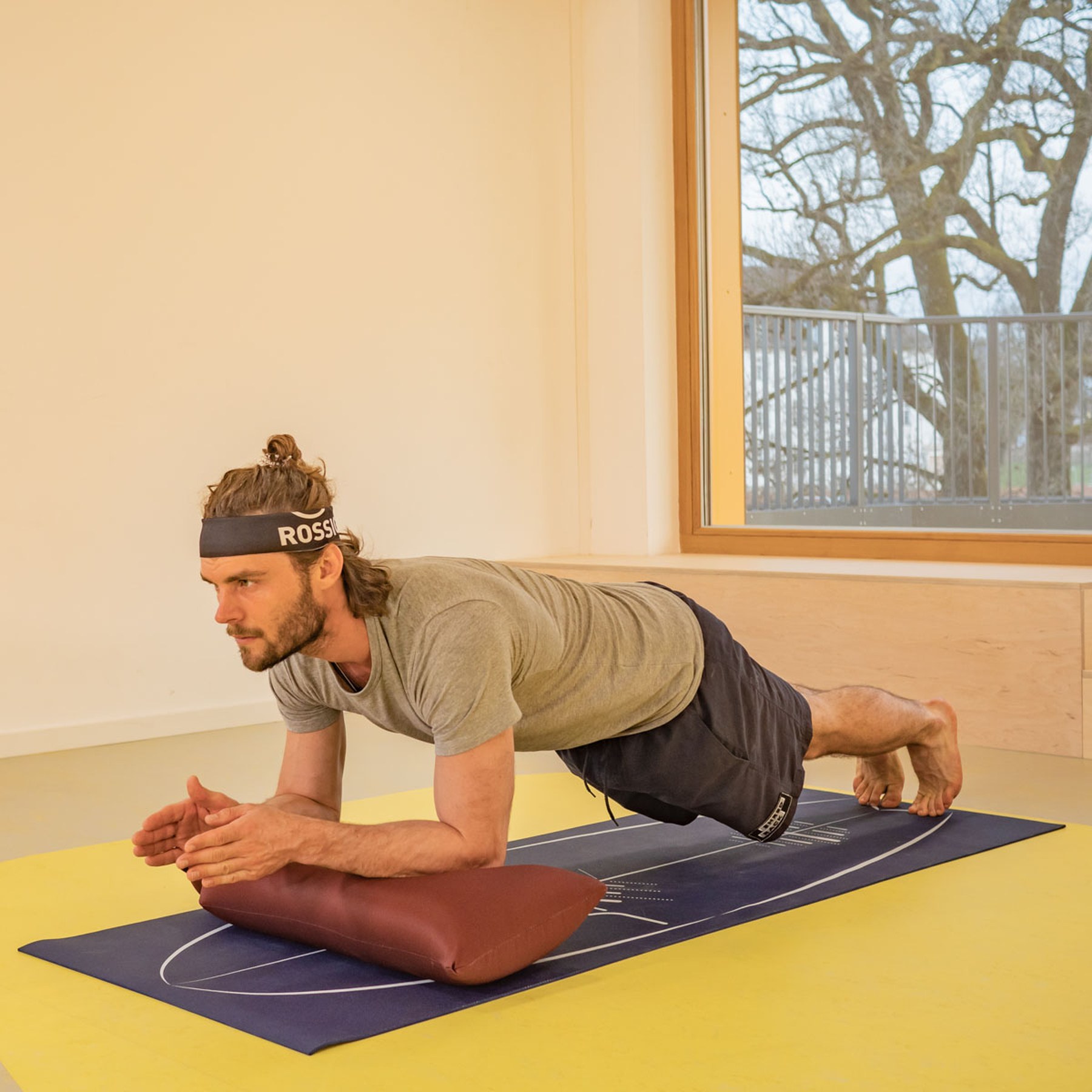
Proprioceptive training: why an unstable surface demands more
Above all of it sits proprioceptive training on the inflatable cushion. And because that can sound like marketing very quickly, let me say it plainly: the cushion is my own product. It is called BOLSTair, I invented it, and it comes out of my own company. Anyone who wants to look at it will find it at bolstair.com. So I am not a neutral user here, I am the developer — and that belongs at the top of the article, not in the small print.
The principle behind it is independent of any brand and can be reproduced on any unstable surface. With air inside, the cushion is an unstable base. The body — more precisely, the head — does not know which direction it needs to compensate in. That is exactly what makes the demand maximal. It reaches deep into coordination, and a lot of muscles are needed simply to produce that balancing movement. You can work with your own body weight in practically every position — very efficient and very balanced.
That makes my approach a completely different one from “walk into the gym with a fixed plan”. I got it above all from my network of experts who helped develop the cushion: physiotherapists, Pilates instructors, yoga teachers. At the core, in my view, it always comes down to giving the muscle a new stimulus. Only a new stimulus makes it grow, or moves you towards your goal — whether that goal is building muscle or losing fat. Do the same exercises forever and never change the plan, and the body adapts to the load. Then nothing moves.
My goal is explicitly not to inflate myself or train one-sidedly for looks, but to stay fit and agile. I see so many people in the gym who train only upper body and arms and end up with matchstick legs. And on the other side road cyclists with horse thighs and T-rex arms. In competitive sport that is normal and even a prerequisite for top performance — my ambition is a different one: have a healthy body and enjoy what I do. Sport is the energy source that pushes me forward, not the discipline that drains me.
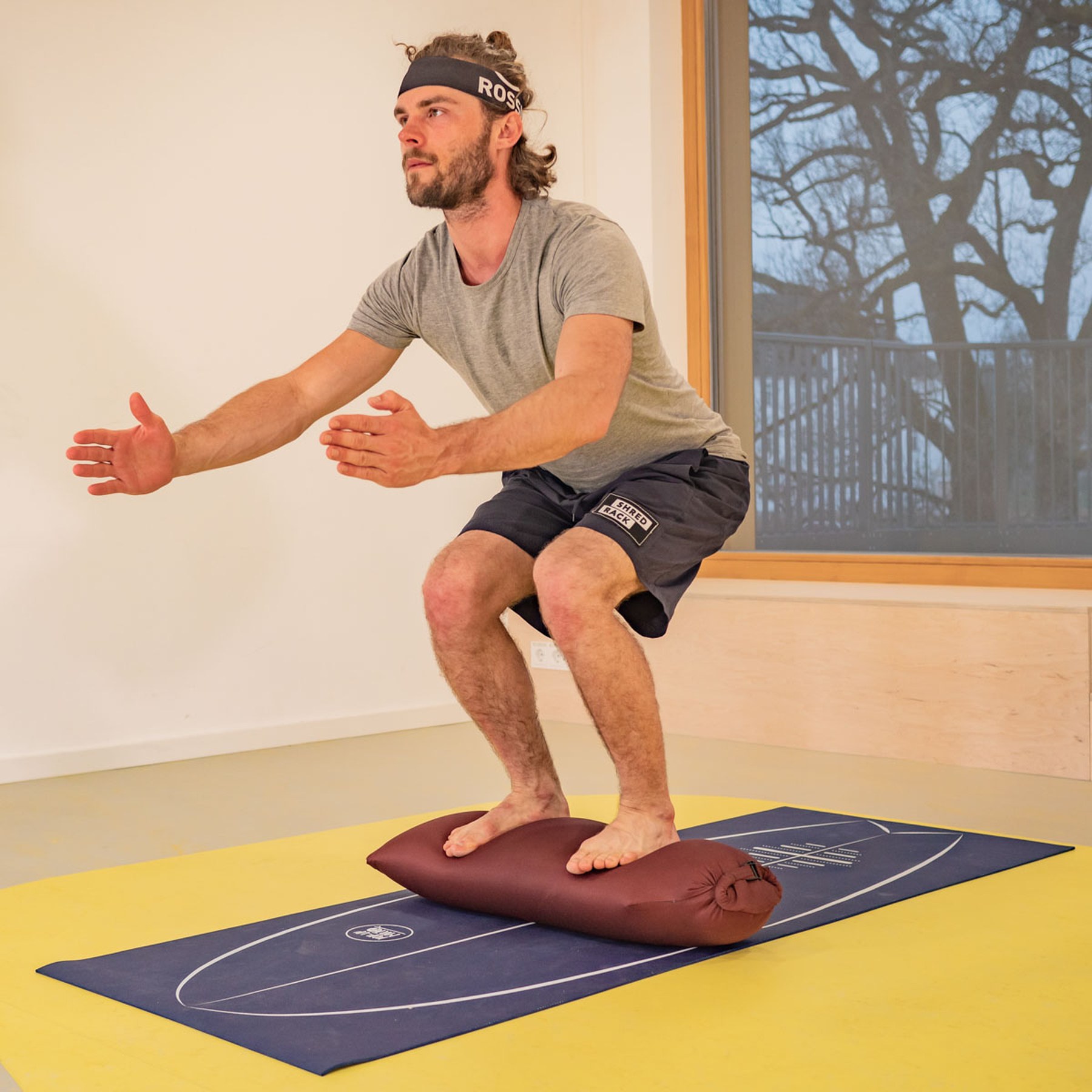
How BOLSTair came about: a yoga network, Mauritius and a crash
The push did not come from the gym, it came from my circle of yoga friends. A few of them, yoga teachers, said the ShredRack — the inflatable roof rack my company had developed earlier — worked perfectly well as a yoga bolster. And that classic bolsters were fairly heavy and impossible on price. Made of air — that was the key. I developed the cushion together with Marcus Mann as well as physiotherapists and sports scientists.
In parallel, something happened that I would rather have skipped. I was on holiday in Mauritius, I love that island, I was completely motivated and wanted to go full throttle immediately: surfing, kiting, flying. And on the famous day three I got cocky. No rest day, the muscles were not there yet — I crashed my paraglider and hit the beach very hard. Fortunately I “only” broke off spinous processes in my back.
Had I eased into it or trained better beforehand, it almost certainly would not have happened. But office fitness — far too little preparation — simply did not carry it. Ever since that day, which was around 2017, I had been looking for a small, mobile piece of training equipment that I could take anywhere and that would build my inner musculature efficiently.
The first attempt went in a completely different direction. I was working on a suspension trainer with a vibration element you could hook in so that the whole trainer vibrated — a project I did together with the company Blackroll. We patented it as well. By the time it was almost finished, the inflatable cushion had picked up far more momentum. Together with friends, Pilates instructors and course leaders — Sabrina Schmitt among them, who helped develop the shape of the cushion — it became clear that this thing did exactly what mattered: efficient training for every muscle group without eating up space. And then it all took off.
That I think about sports equipment and cameras in the same way is no accident, by the way. I also build my own camera rigs — the reflex to translate a problem into a component is the same one.
What the cushion does, and the patent behind it
The inflatable yoga and training cushion is not a fascia roller and not a stable cushion. It deliberately sets itself apart from both, and that is exactly where the benefit sits:
Sitting and meditation. You can sit on it in various positions and it works as support — but it stays an unstable base, which you can turn to your advantage.
Rolling. It is round, so the body can roll over it. Example: go into a plank position, place the bolster against the shins and roll forwards and backwards. That hits the shoulders and the entire core hard. Variation: lift one leg and asymmetric instability comes on top.
Scaling via air pressure. Let a little air out and the cushion becomes more unstable — intensity goes up without a second piece of equipment.
Lunges and stretches. As a base, for instance placed under the knee and rolled across. That extends the range of motion when stretching. Or it simply replaces the yoga block as a prop.
Push-ups, the classic case. Put the bolster under your hands and you feel immediately that the push-up gets considerably harder and more demanding, because the body has to compensate. That is precisely what pulls the deep muscles in, and chest and shoulder get trained more broadly and more deeply.
The part I spent longest on is the part you see least: the integrated hand pump. I tinkered with that patent for more than half a year. My personal requirement was clear — no tools, no separate pump, no extra component; fast and simple; and hygienic, because inflating by mouth was never an option for me.
What came out is a hand pump that pushes air in very quickly through a specific geometry. The clever bit is that same geometry: the valve blocks itself automatically as the air fills up. The more air goes in, the rounder the cushion gets — and it presses on its own valve and closes it. An additional hook-and-loop fastener secures it against the last bit escaping, and finally the whole thing is rolled up like a dry bag. Then it is completely airtight. The mechanism originally comes from the inflatable roof rack and works reliably on both products — at trade fairs it produces a wow effect every single time.
One more point about manufacturing matters to me. The premium version is sewn, assembled and shipped in the Caritas workshops in Wendelstein in the Chiemgau region. I have been working with facilities like these on and off since 2016, and I can see how much the people there enjoy doing meaningful work instead of producing standard items nobody actually needs. For a company just starting out with a product idea, a group-based workshop production is also the right kind of extended workbench: it can react flexibly to seasonal swings, and the processes can grow along with the business. The mechanism works just as reliably on the ShredRack as on the bolster — and I can well imagine the pump being useful for other products too. I am open to licensing deals.
What has to be equally clear: somebody has to pay for that setup and that price in the end. So we let the customer choose deliberately — the PREMIUM version with fabric made from recycled PET bottles, produced in Germany, and the BASIC version made from comparable material in industrial series production. In benefit and quality they barely differ. Anyone who wants to support the former can — nobody has to.
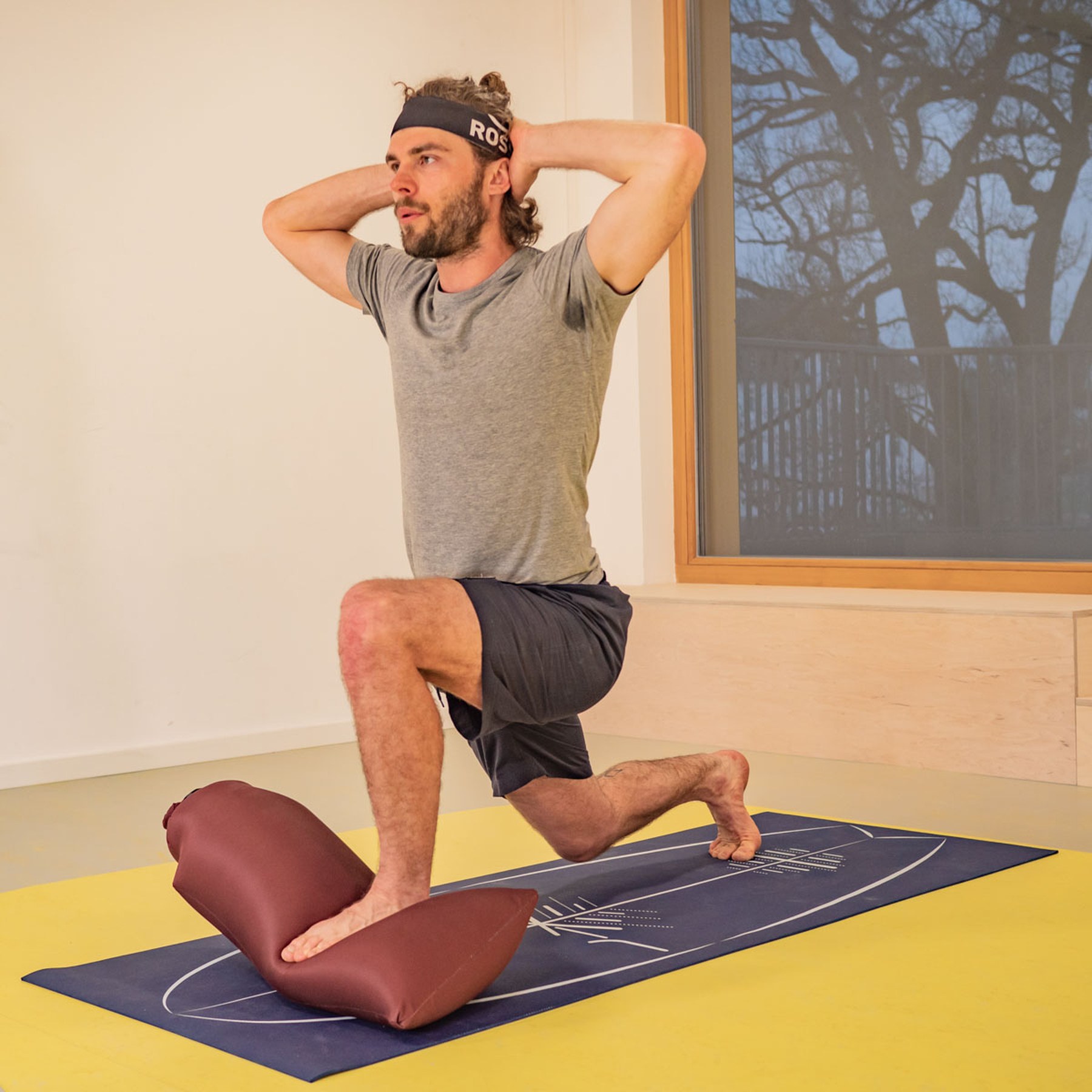
Nutrition: simple principles instead of hard rules
First, because this is where things go wrong fastest: I am not a nutritionist and not a nutrition expert. Everything here describes only what I do for myself and what I notice in my own body. It is not a recommendation and not medical advice.
I try to eat consciously, and I notice the difference in my body directly. When I am at trade fairs or travelling a lot and simply grab whatever is quick, you can see it in my body fat straight away. When I am at home and can pay attention, I usually start the day with a healthy smoothie — which, for my feeling, gives me an energy reserve for the rest of the day.
I keep my principles deliberately simple. Because once the rules you set yourself get too hard, keeping them becomes too much effort:
More carbohydrates at lunch, more protein in the evening.
Listen to the body. If I have done sport, I need to put more back in.
Leave out sweets and sugar as far as possible. With a bit of discipline that works well — above all if you do not start in the first place.
The basic calorie equation. What you take in over a day should roughly match what you burn. Several days ski touring means a lot burned, so a lot goes back in. Several days at a desk means less appetite and smaller portions.
The interesting bits are logically the transition phases between those periods — coming back from a ski touring week to the desk, or the other way round, going from an office winter straight into a shooting day in the mountains. That is where I misjudge it most easily.
Supplements: what I take when there is a reason — and what I do not claim
Once more explicitly, because otherwise this section is worthless: this is my personal experience, not a recommendation, not a promise of any effect and not medical advice. I am an engineer and a sports model, not a doctor. Anyone who wants to try something should discuss it with someone qualified to judge it.
I approach it with common sense and take nothing permanently, only when there is a reason:
Vitamin D3 — when the sun has not been out for several days. On shoots you are often in a studio for days on end and see no daylight, so for me it follows logically.
Ginkgo, ginseng, vitamin B complex — on longer office days when I have to concentrate.
Rhodiola — when my mood is not great or several very demanding, stressful days stack up.
Shilajit — a fascinating mineral resin, where I personally notice more energy.
Turmeric and ginger — at trade fairs, in crowds or on set, where you deal with gatherings in which not everyone is a hundred per cent healthy, because the job has to get done.
Coffee alternatives such as açaí or matcha, combined with MCT oil. For my perception that slows the effect down and stretches it out at the same time.
Iron and magnesium — when I do a lot of endurance sport. That one I notice immediately: if I skip it, I get headaches up to migraine level.
You can of course overdo all of this. But you do not have to take everything every day — you listen to the body and take what is actually needed. Overall I am fairly relaxed about it: even if a supplement does nothing for me, it simply gets excreted again. Then it is a pity about the money, and everyone can decide that for themselves. What also has to be logical, though: if I shovel in ready-made, highly processed food because it is fast, that cannot be the healthier alternative.
Recovery and sleep: the part I have to force on myself
Recovery is scientifically established as at least as important as active training itself. Ten years ago it barely felt like a topic — the company Blackroll in particular set a new industry standard here and opened the subject up all over again. The whole industry benefits from that, myself included.
And this is where I have to discipline myself most. On holiday, when the wind is great, the snow is great or the swell is great, I regularly catch myself taking no breaks at all — neither during the day nor across several days. Adrenaline wins, but in the end you keep draining the muscle and the injury risk climbs. That exact mistake cost me my back in Mauritius.
With sleep I pay concrete attention to sleep cycles. You can train yourself into that with habits, and there are apps that help. Anyone who wants to go all in can use products that monitor further body functions — at some point that gets too technologised for me, even though as an engineer I am very drawn to technology. I would rather sense my body the natural way. As long as that works, I am very happy. Concretely: I almost never have to set an alarm, and when I do, I very often wake up five minutes before it, even when the shoot starts early.
That comes with an admission that is not always popular on set: I do not sit around with the whole crew until late at night over dinner or at the bar. I try to time my sleep cycles so that at call time the next morning I am not just punctual but rested and fresh. The worst opposite would be numbing yourself with alcohol before a shooting day — it is no secret that you can see it later. Sure, make-up can do a lot, but I always think: what for?
Recovery for me also includes regular stretching: properly lengthening the muscle so that the fluid gets pressed out and the muscle can then soak itself full of nutrients again and recover. I deliberately distinguish between active and passive recovery. With that concept I get noticeably more out of it — and I also use things that have nothing to do with my own product, for instance a memory foam pillow that measurably improves my sleep quality because it takes the load off my neck.
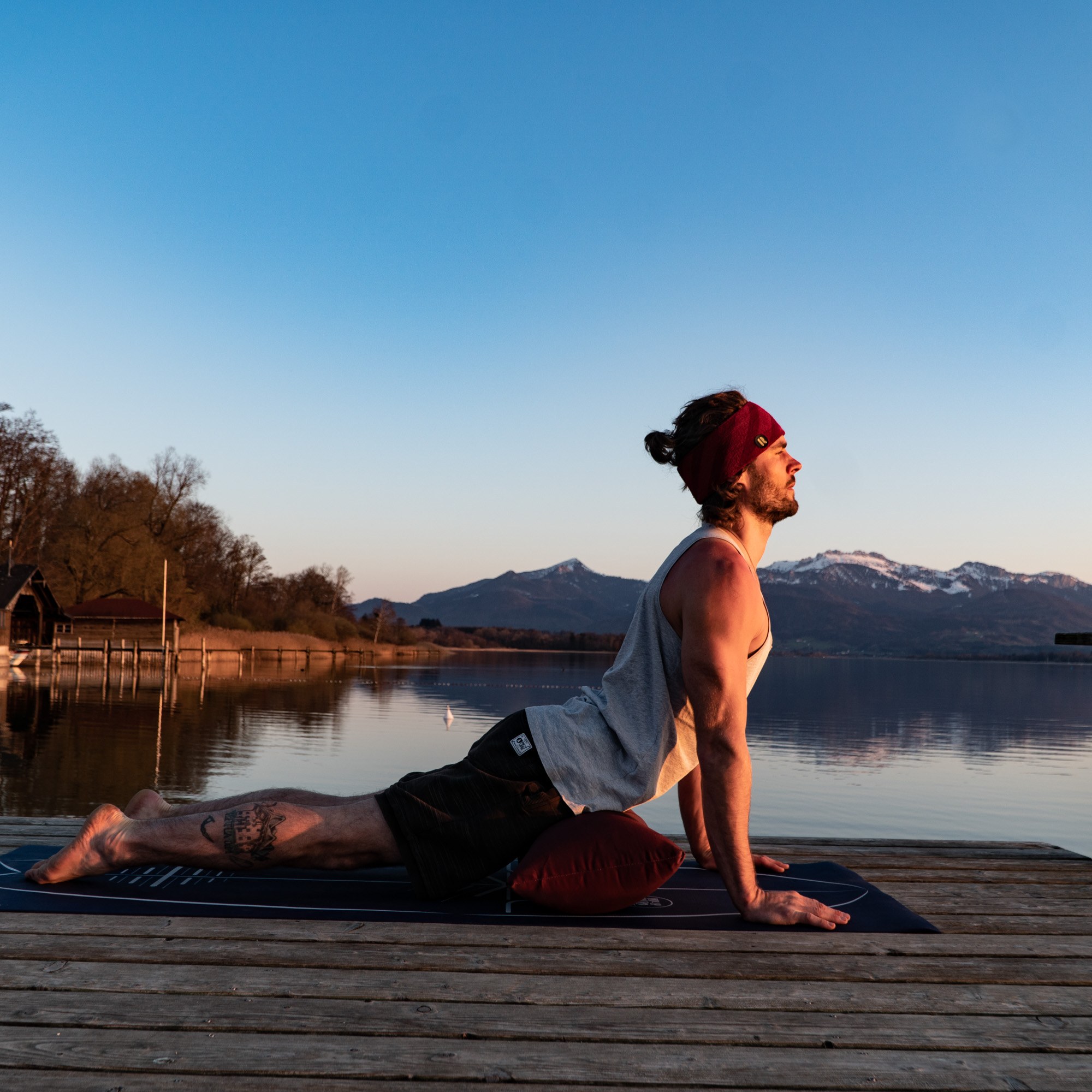
Beauty standards, a tattoo and a scar
The thing that actually causes the most discussion is the tattoo: a colourful piece on my right calf carrying an entire outdoor sports world — paragliders, flying, kitesurfing, skiing. Logically that does not suit every shoot and every product. On the other hand I keep noticing that tattoos have become established in our society. And retouching one in post is hardly any effort these days, should it really become an issue.
On beauty standards, a lot has shifted in recent years. It is not that long ago that female models had to be very thin and men fully packed with muscle to match the general standard. Today there is far more demand for naturalness, and I get asked for exactly that regularly. I have genuinely been turned down because I was too muscular — even though my sense of it is that I carry a perfectly normal build. It is not only me: clients consider balance important too. You should be healthy, but it does not always have to be a six-pack.
On the other side, hotel shoots in particular come with sauna or spa scenes where the body is visible and matters. In the end you are the product yourself and you are meant to embody a persona — if a sports and wellness hotel wants to attract healthy, fit guests, a model fits in there well. But I would never go so far as to train deliberately in one direction just to chase a particular ideal. My premise stays the same: live relaxed and healthy, and keep enjoying my sports.
About the scar on my collarbone, since it sometimes shows up on polas: I have broken my collarbone twice. That was around fifteen years ago, during my competitive phase. And I admit it: there was recklessness involved, wrong decisions — and not yet the experience I have today.

Fitness is operational safety: what that means for a production
This is the point where a private subject turns into a commercial one. I also work as a stunt performer, and many productions worry that this makes it more likely I turn up injured for the shoot. In reality the opposite is true. I train very deliberately for the scenes I am asked to deliver, I eat consciously and I keep myself healthy and fit in order not to drop out.
So far I have never missed a shoot — and that is exactly why I work hard on keeping it that way. It is part of the job: you and your body are the product. And the product should be good. Accidents and sports injuries are of course never fully excluded, there can always be a stupid moment — but you can reduce the probability drastically. Sleep, experience and the right mindset all feed into that.
Staying mentally fit matters just as much. When I am not fit, ill or tired — for whatever reason — risky elements have to move, or I allow myself a break. In every case the rule is open, honest communication and transparency, and early. When a specific sports shoot is planned, I can give planning estimates well in advance: how much preparation time it takes, whether rehearsal days are needed, whether several takes have to be scheduled. Since I also stand behind the camera regularly, I can be fairly precise about it. How that folds into a realistic shooting plan is in the complete guide to planning an outdoor shoot.
And because the question comes up regularly: the cushion is always with me, it weighs only around 300 grams and gets in nobody’s way in a backpack. But I do not have to be more Catholic than the Pope. It is completely fine if a morning routine drops out once, or if I catch it up after the shoot. I am a big fan of the book “Miracle Morning”, because you get a lot done early — realistically, though, on set I do not get to bed all that early either, because the evening before is spent planning the next shooting day. That is entirely normal. Nobody can conjure.
Planning a campaign where a model genuinely has to operate a sport or a piece of training equipment — and wondering how much preparation that realistically takes? Send a booking request.
FAQ
How often do you train per week?
Every day, at least 45 to 60 minutes of morning routine — fascia work, a short tabata or HIIT block, stretching, a breathing exercise. On top of that comes whichever sport the weather allows: paragliding in thermals, kitesurfing in wind, biking on dry ground. I go to the gym specifically for what the season does not cover — chest in winter, legs in summer.
What is proprioceptive training and what does it do?
Training on an unstable surface. The body does not know which direction it has to compensate in, which makes the demand maximal. It reaches deep into coordination and activates the deep muscles, because a lot of muscles are needed for the balancing movement. A simple example: a push-up with your hands on an unstable base is considerably harder than on the floor.
What is BOLSTair and what is your role in it?
BOLSTair is an inflatable bolster and training cushion for yoga, stretching, workouts, prevention and recovery. It is my own product: I invented it, the integrated hand pump is patented by me, and it comes out of my own company. So I write here as its developer, not as a neutral user. More at bolstair.com.
Which supplements do you take?
Occasion-driven rather than permanently — for example vitamin D3 on days without sun, magnesium and iron during heavy endurance phases, turmeric and ginger at trade fairs. Important: this is my personal experience, not a recommendation and not medical advice. I am not a nutritionist.
Does injury risk go up when a model also performs stunts?
In my experience it is the other way round. I train specifically for the scenes required and keep myself fit precisely so I do not drop out — so far I have never missed a shoot. Part of that is postponing risky elements when I am tired or ill, and communicating that early and openly.
How exactly do you prepare for a shooting day?
In most cases with nothing beyond my normal morning routine. The bodybuilding recipe circulating online — water loading, dehydrating, cutting salt — is in my view wrong, because a shoot is not a competition; it has to suit the client. The long version is in preparing for a fitness or sports shoot.
More posts