Camera Angles & DIY Rigs: The Engineer Behind the Shots
POV, FPV drone, 360° or chest cam? A practical guide to which angle creates which effect – and the self-built rigs behind it, from heated helmet cams to egg-timer timelapses.
Written by
Tobi Deckert
Reading Time
6 minutes


Mindset: an engineer who loves to build
I am an engineer, and tinkering is my passion – and it produces great camera angles. Much of what you can buy off the shelf today had to be self-built back then. Exactly that separates a performer who understands visual language from one who merely stands in front of the camera.
The first DIY rigs – before the GoPro era
It started with skiing: we sewed cross-braces into a backpack and mounted a bent aluminium pole that reached over the head and filmed the body from the front. GoPros did not exist yet – a helmet camera sat at the front, cabled back into a camcorder in the backpack. The problem: the exposed lens froze in cold and wind and kept failing. So we added a heating pad with an extra battery. Things only got better in the GoPro era – though the first GoPros regularly died at −20 °C in Finland.
During my Erasmus semester in Helsinki – deliberately chosen for its urban skiing over metal rails and small cliffs – my friend Jakob Reinhardt and I produced an edit shot entirely on GoPro – watch “Northern Impressions” on YouTube.
Refinement: the lipstick cam construction
The challenge: the mass at the tip of the pole and its inertia – jumps create extreme leverage forces. Over the years I refined it, ending with a carbon firefighter harness (built to carry an oxygen tank on the back) with an aluminium pole construction bolted on instead of the tank. Unique at the time – today several companies sell versions of it as a product. Combine the old construction with a 360° camera and you still get remarkable footage.


The engineer's playground: from egg timers to worm gears
GoPro on the surf mast, hung into the kite lines with a custom mount, or on a long pole for partner shots – angles that turned heads then and partly still do.
Egg-timer motion timelapse: egg timers as drives for moving timelapses – sometimes two timers on two axes.
Fischertechnik worm gear: for extremely slow camera moves pulled on a string along a rail – painstakingly built into the Tobago video of the Chiemsee world trip. Today I would 3D-print all of it.
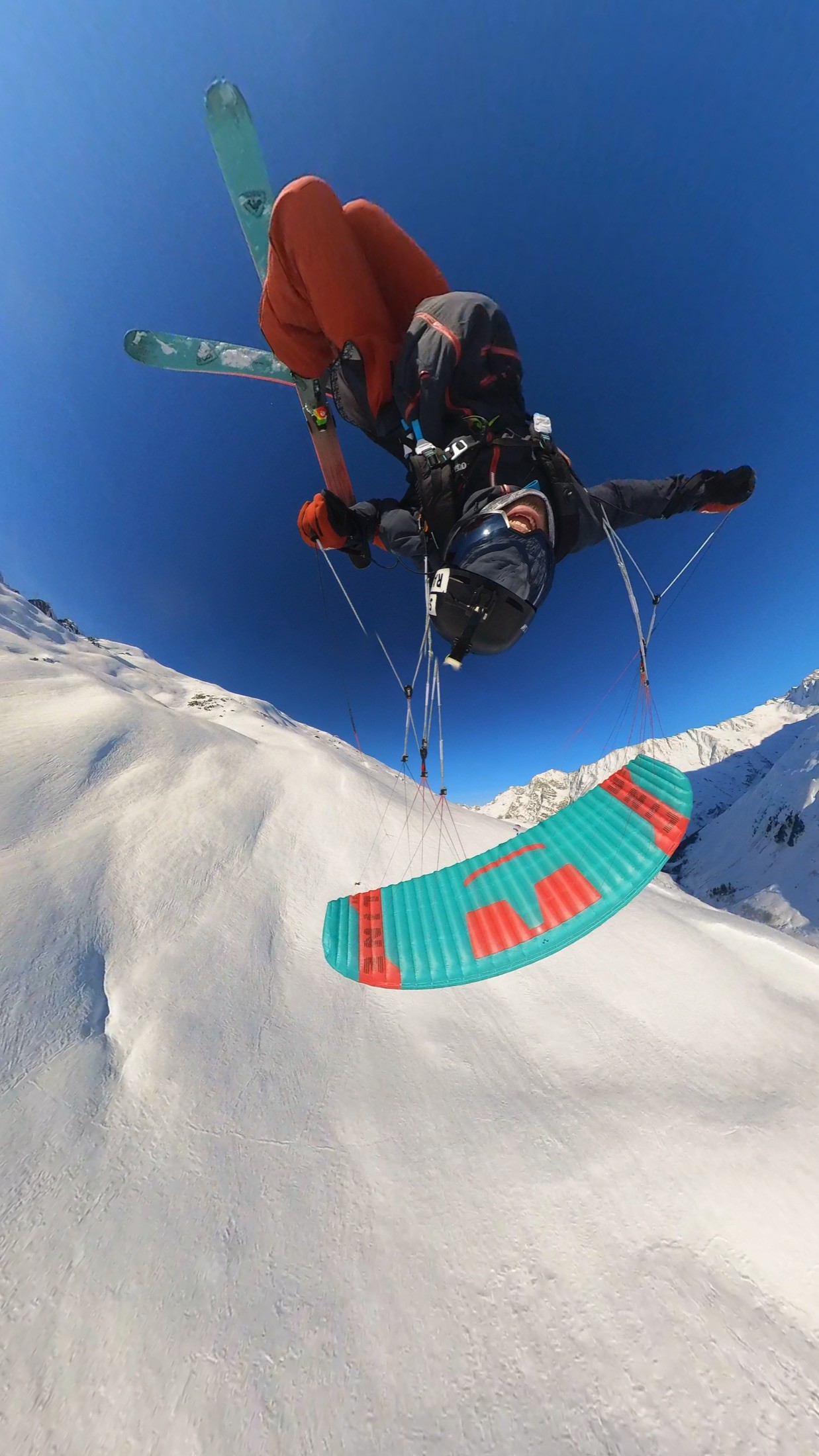
Paraglider rigs: GoPros held by magnets inside the wing – or a flying ski pole with a tailplane, swinging behind the glider on strings and pulleys.
Which angle for which effect – the directing guide
POV: triggers adrenaline – but relations get lost; steepness and height look smaller.
FPV drone: shows the full-on action best. A cliff drop looks only a third as high in POV as from an FPV drone showing the whole jump – like the chase shots in the Yodobashi shoot.
Classic drone/distance: for steepness, scenery and context – the whole picture.
360° cam: the “lazy compromise” – films everything, but with distortion and quality loss. Its strength is special angles: on a short pole off the backpack you get a third-person view like in a video game; on the helmet it captures emotion and surroundings – in powder face shots the snow practically sprays into the lens.
Product logic: advertising a ski? Then the action cam belongs at chest level – the ski is always in frame. On an FPV drone shot it would barely register.
When POV started looking the same everywhere and the market was flooded, it was exactly these considered angles that stood out. How much the angle shapes the effect also shows in a Killtec shot in the reel further up: a small drop right next to a hut that looked wild enough to make it onto the trade fair poster. The same experience runs through my self-produced Norway film and the motion-blur technique of the Diamant night shoot.
What a production gets out of it
I am happy to advise productions on angles, provide my rigging systems to the camera team and contribute ideas – a performer who speaks the visual language and thinks the angles along. Send a booking request.
FAQ
Which camera angle works for which effect?
POV for adrenaline, FPV drone for the full action dimension, classic drone for scenery and context, 360° for special angles and emotion – and for product shots, an action cam positioned so the product is always in frame.
Why do cliff drops look so small in POV footage?
The ego perspective lacks reference points: without horizon and surroundings, a drop looks only about a third as high as from an FPV drone showing the whole jump.
What is the value of a model who brings their own camera rigs?
Angles you cannot buy, faster setups and a performer who plans with the camera team at eye level – visual language included.
Facts
Topic | camera angles & DIY rigs for action sports |
Background | engineer · filming & editing since childhood |
Systems | lipstick/pole rigs · 360° setups · kite/paraglider mounts · motion timelapse |
Use | consulting + own rigs for productions |
Visual language is phase 6 of the production chain: the full chain from casting through permits and safety to usage is in the guide Planning an outdoor shoot.
More posts