Who is who on a stunt set: coordinator, rigger, performer, double and safety
Who does what on a stunt set, who books whom and who is answerable if something happens. The stunt coordinator, the rigger, the performer, the double and the safety — with the radio-channel detail no glossary mentions, the paperwork that goes to the insurer, and a table you can budget from.
Written by
Reading Time
14 minutes


| Insignificant 1 | Minor 2 | Significant 3 | Major 4 | Severe 5 | |
|---|---|---|---|---|---|
| Almost certain 5 | Medium 5 | High 10 | Very high 15 | Extreme 20 | Extreme 25 |
| Likely 4 | Medium 4 | Medium 8 | High 12 | Very high 16 | Extreme 20 |
| Possible 3 | Low 3 | Medium 6 | Medium 9 | High 12 | Very high 15 |
| Unlikely 2 | Very low 2 | Low 4 | Medium 6 | Medium 8 | High 10 |
| Rare 1 | Very low 1 | Very low 2 | Low 3 | Medium 4 | Medium 5 |
The same activity moves through the zones depending on conditions — weather, surface, light and daily form shift the rating.
Why stunt set roles get confused all the time
"We need someone for the stunt" is one of the most common sentences in production enquiries — and one of the least precise. It can mean almost anything: an athlete riding a descent. A double who has to look like the lead actor in a close shot. A performer who gets ripped out of frame by an explosion. Or a whole team with a coordinator, riggers and safety, because the scene simply cannot be shot without a rig.
The difference is not pedantry. Budget, prep time, insurance and liability all hang on it — and so does the question of whether a scene works on the shooting day or gets cut. This article therefore walks strictly through the roles: who does what, who books whom, who is answerable if something happens, and who has the final word on set.
I write this from the performer's side. I have worked in front of the camera as a sport double and stunt performer for years, I work through a stunt agency and I also get booked directly by productions. What the individual actions technically are, I have described separately: What is a ratchet stunt? explains the technique behind the pull, and Sport double or stunt double? explains why one face is often cheaper than two. This one is only about the people.
The roles at a glance
The table is deliberately built so a production can use it while budgeting: who does what, who books that person, and what they are answerable for.
Role | What this person does | Who usually books them | What they are answerable for |
Stunt coordinator | plans and choreographs the action, selects and trains the performers, briefs the director and production management, gives the signals on set | the production, usually early in prep | the safety of everyone in the stunt scene; risk assessments and stunt reports for the insurer |
Stunt rigger | builds the hardware: lines, pulleys, block and tackle, anchor points, invisible harnesses for actors | the coordinator, invoiced through the production | the rig and its load capacity — he does not decide whether the action runs |
Stunt performer | executes the action: fall, pull, hit, impact, jump — including as an extra with an extended task | coordinator or agency, sometimes directly by the production | their own execution; they may and should call it off if something is wrong |
Stunt double | the same as the performer, plus resemblance to the actor: build, hair, beard, costume | production or coordinator, cast against the actor | the execution and whether it cuts together with the actor's shots |
Sport double / sports model | rides the sport for real and at level, without it being a prepared stunt | production, agency or direct | the athletic execution — not for special rigs |
Safety | watches the scene from outside, double-checks rig and sequence, keeps the objective eye | the coordinator; on smaller setups filled from within the stunt team | the double-checking — the specialist judgement a medic cannot provide |
Second unit director | directs the action scene independently and delivers those images separately | production, at the main director's request | the creative decision on the action scene |
If you take away one line only: the rigger builds, the coordinator decides, the performer executes — and all three listen to the same voice on set.
The stunt coordinator: the link between the role and its execution
In my view the coordinator is someone who is a bit older and has experience. That is not politeness, it is the job description: he is the link between the role and its execution. He reads a script and immediately knows how he would build the scene — and he has a network of specialists and performers from which he pulls exactly the person who fits this one requirement.
This matches the official definition: the stunt coordinator plans, coordinates and supervises all stunt sequences, selects the stunt people and trains them. He is considered a safety expert and action choreographer in one person and is responsible for the safety of everyone involved.
His work starts long before the shooting day. In prep he thinks along — what is feasible, what needs a rig, what needs training, what can only be solved with a trick or in the edit. During the shoot he is the mouthpiece between the director and the stunt team.
"He protects the performer from the director"
This is the part of the role you rarely see from outside, and the one that matters most when it counts. The coordinator carries shared responsibility and knows exactly what the performer can and cannot do. And he protects the performer from spontaneous new ideas on the director's side.
A concrete example: on set the idea comes up to do a double backflip instead of a single one, because it looks bigger in frame. The coordinator can step in directly and say that it does not work — or that it needs more training, more prep and a different rig. That is not obstruction, that is his job.
And it runs in both directions. The performer can just as well tell the coordinator that something is off — that the run-in is too short, that the surface behaves differently than in the test, that the light is blinding, or that the action feels wrong on the third repetition. A coordinator with whom that return channel does not work is the actual risk factor on set.
How this feeds into the booking — which risk justifies which fee, and where the line between sports action and stunt runs — is covered in Action, adrenaline and risk: how bookings work.
Risk assessment, stunt report, insurance — the coordinator's paperwork
Something that almost never comes up in conversation, but is the reason a production needs a coordinator at all: he produces risk assessments and stunt reports that are submitted to the insurer. Without those documents, an action scene stops being a calculable risk for the production and becomes an open one.
Then there is the rulebook. In Germany, the DGUV regulations and the trade association safety rules for stunts and pyrotechnics apply on set. That is the frame the whole plan moves inside — and the reason why "let's just do it quickly" is not an available option for a stunt scene.
For productions that means one very practical thing: the coordinator belongs in prep, not in the shooting schedule. Book him only for the shooting day and you are paying a very experienced person to stand on location and tell you the scene does not work like that.
The radio channels: the detail no glossary mentions
The coordinator stands next to the director. The director coordinates the whole scene and holds contact with the individual departments — special effects, for instance, who often work particularly closely with the stunt team.
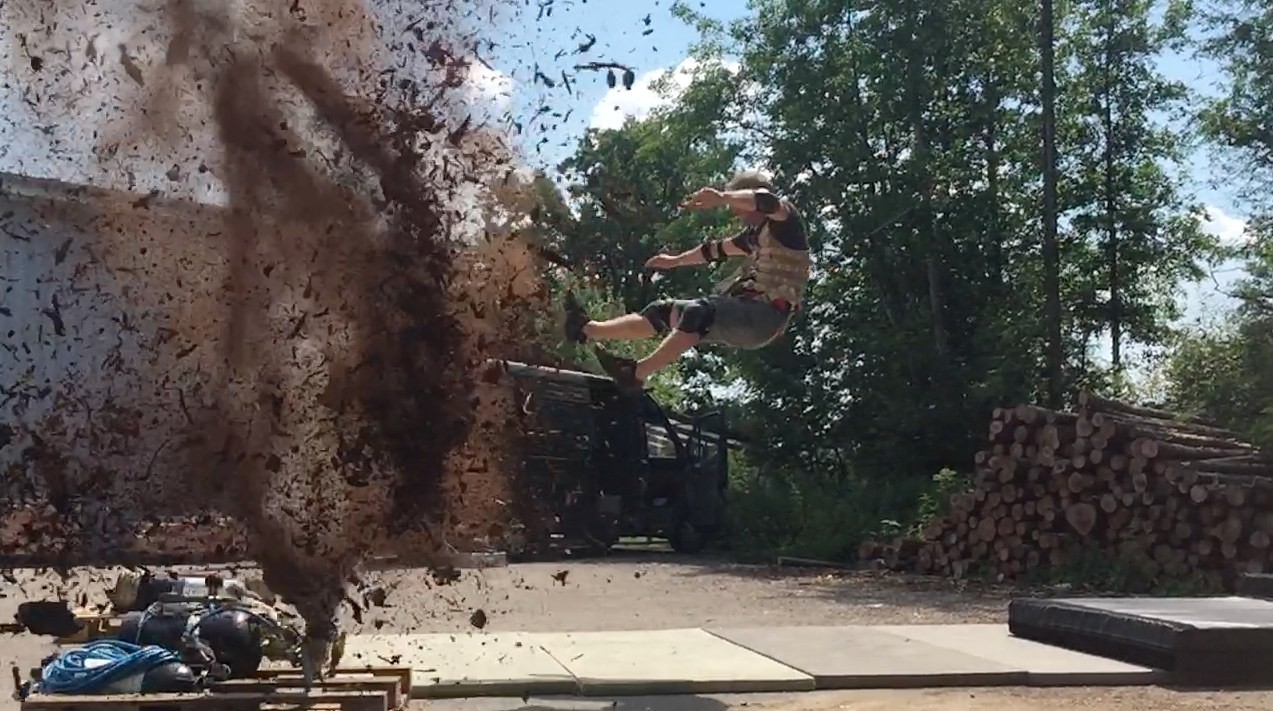
That is why radio channels on set are structured to mirror those dependencies: every department normally has its own channel, and the coordinator can listen in — on when special effects fire an explosion, for example. Only that lets him cue the stunt team cleanly against a trigger he does not control himself.
It gets particularly relevant when several stunt performers work simultaneously and have to time their actions against each other — with stunt drivers it is half the job. There, less than two seconds often separate "looks great" from "goes wrong", and those two seconds are not coordinated by shouting but through a planned radio structure.
How tight that interplay gets with a real detonation, I experienced on Trautmann: the pull on the ratchet and the ignition have to sit in the same instant, otherwise you can see in the image that two things happened one after the other.
The rigger: he builds, the coordinator decides
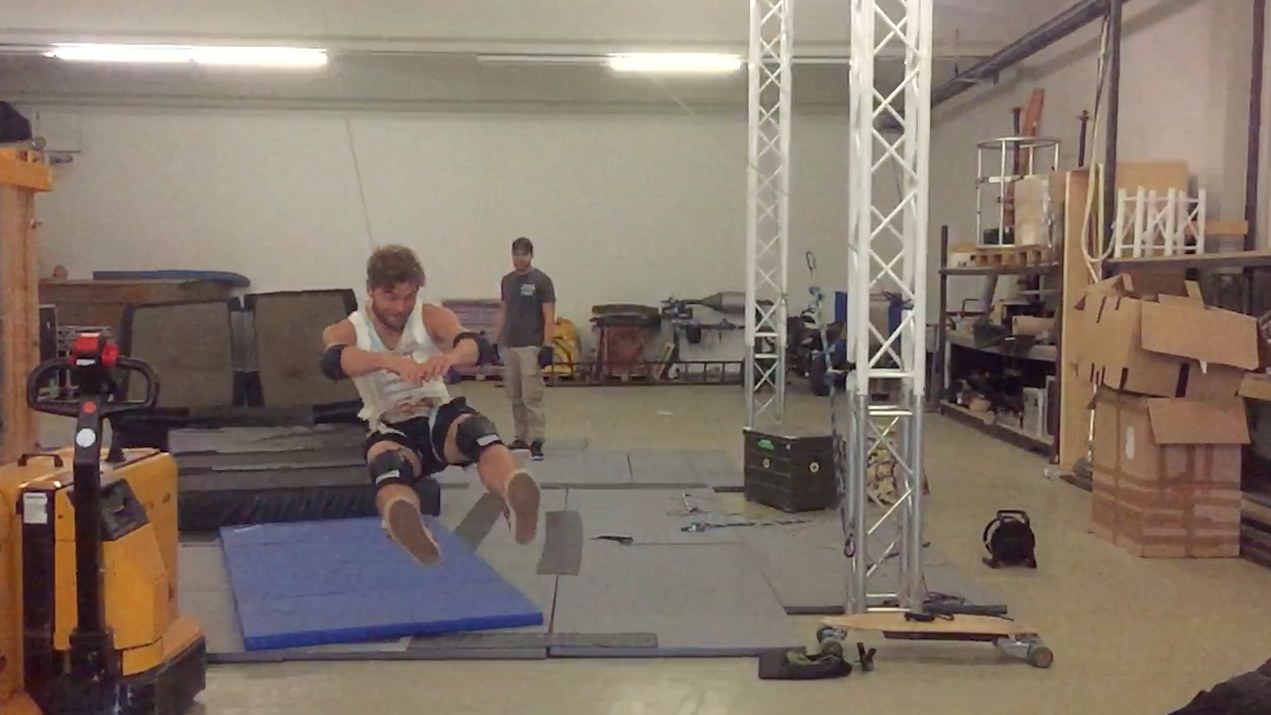
The rigger is the technical side of the stunt team — and his sentence is: the rigger builds, the coordinator decides. He does not determine whether an action runs. He makes sure it can run at all.
His most visible job is securing the actors. When a performer is meant to play a dangerous scene themselves — on a roof, on an edge, on a narrow ledge — they get an invisible chest or hip harness and are secured on thin black lines. The rigging team builds the pulleys for it and sets the anchor points. None of it shows in the finished image; the lines either disappear into the contrast or later in post.
Otherwise the rigger works in the background and quite literally pulls the strings: using block and tackle and constructions of rope and pulleys, riggers fly performers through a scene, lift them, decelerate them or hold them in a position that would be impossible to hold without a rig.
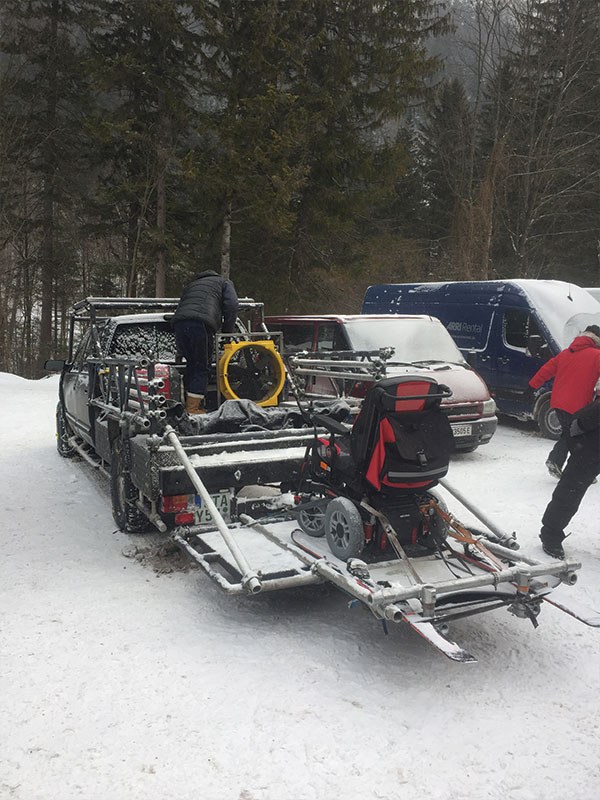
How far that can go is shown by the wheelchair stunt on ice: there the real effort was not the action but the rig that made it repeatable. And the technical explanation of the most frequently used rigging tool is in What is a ratchet stunt?.
And this is the crucial part, because everything on set hangs on it: both the director and the stunt performer listen to the stunt coordinator's signals. Not the rigger, not the camera, not the first AD. One voice.

Stunt performer and stunt double — one does not exclude the other
These two terms get swapped most often, although the distinction is simple: stunt performer is the occupation, stunt double is the function in one specific production. You can be both at the same time — in practice you usually are.
As a double, what matters to the production is that you genuinely look like the actor: same hair length, same costume, roughly the same face, beard included. Only then can the edit solve it so the double takes the fall, the hit or the explosion in the action scene and the actor is back in frame afterwards. What that means for your own look — and what it costs when a production asks for a beard or a haircut — is in Beard, hair, body.
A stunt performer can just as well take an extra's role — essentially an extra with more responsibility and more tasks: the person in the background who gets ripped away by an explosion, shot, or hit by a car and thrown. It does not always have to be the lead. In many scenes the action in the background is what makes the scene believable in the first place.
The safety — and the most important sentence about safety
The safety is usually a separate person: someone who watches the scene from outside, double-checks the rig and looks only at safety while everyone else looks at the image. On the productions I have worked on, that role was generally filled from within the stunt team — on smaller setups that is the norm; on large productions it is a position of its own.
There is of course also a medical team. But it does not replace the safety: a stunt requires specialist expertise, and an external medic usually cannot judge what a given action needs in terms of protection. One is there for the aftermath, the other so there is no aftermath.
And then comes the sentence I consider the most important in this whole subject: unfortunately it is often the simple stunts where injuries happen. A fall from a ladder at a shelf. A slip on a wet surface. A jump from one and a half metres.
The reason is always the same: on a big action everyone is focused, everything is checked three times, every move is discussed. On a small action, habit creeps in. That is why carelessness and routine must never be tolerated on set. Ideally everything is checked twice or three times — and that is exactly what the objective eye of a stunt colleague or the coordinator is for.
This happens too, and it is a strong argument for a team rather than a single person: a stunt sits precisely within the performer's expertise — but the specific fall resembles one a colleague has already done. And that colleague can point out a hazard you did not have on your radar.
Main unit, second unit and coordinator: who has the say, and when
In principle everything comes from the director's pen — he determines how he wants the scene.
But: if he sets up a second unit, that unit is independent. It can shoot on its own and contributes its images separately. For the action scene, only the second unit director's opinion counts at first. The stunt coordinator therefore aligns with the second unit director, because the main director is busy with the actors and the regular shoot at the same time.
On "Eddie the Eagle" we had exactly that constellation and a very large crew, because it was a Hollywood production. The second unit was led by Vic Armstrong (second unit direction and stunts, for years Harrison Ford's double) — someone who knows exactly how he wants something and wants it translated that way across the whole scene. For a performer that is comfortable: the brief is unambiguous, and it comes from someone who has ridden the action himself.
Who books whom — and who invoices
The practical part productions ask about most. There are two routes and both are normal:
Route 1 — through the agency. I am usually approached by Face Off when a production company is looking for a specific person for a specific shoot and relies on the expertise it is used to from the market leader. The agency knows the pool, knows who rides which action safely, and handles the coordination.
Route 2 — directly. A production can also contact me directly and describe the scene. Then there are two options:
The scene is part of my standard repertoire — then I can quote it directly.
It is a more complex stunt where I need support — then I ask internally in the team and bring in the right people.
In both cases either I or my agency can issue the invoice, and we can settle between ourselves. Since almost all of us work freelance, there is a certain flexibility here — which for the production mainly means: the agency route is not automatically more expensive, and the direct route is not automatically less safe. The differences in detail are in Booking a model: agency or direct?.
Sports action or stunt? The most common misjudgement
In the sports field especially, sports action and stunt get thrown into one pot. The dividing line is actually quite sharp.
As long as you genuinely stay within the sport, you can simply perform the sport. A skier rides a descent, a kitesurfer jumps, a biker rides a trail. That takes athletic level, but no stunt rig.
Often, though, something special is required: a specific fall or a specific action in a specific setting that has to look exactly that way — because it cuts against another shot, or because the camera sits at a fixed point. Then you need stunt support, possibly rigging, or something has to be specially prepared. And that takes more experience than the sport itself.
The most common mistake by productions is right here: they imagine things to be easier than they are and underestimate how much planning some scenes need.
An example to make it concrete — from a commercial I was not involved in myself, so without naming the brand: a kitesurfer is dragged across a beach. The sport itself was certainly ridden by a kitesurf pro. But individual shots — for instance when the kitesurfer is dragged through underwater — need a special setup: an underwater camera standing at exactly the right point at exactly the right moment, and a performer pulled precisely past it. That is no longer ordinary sport; it takes rigging, camera and set experience.
When a sports model is enough and when it is not — two examples
Where a sports model was enough — Sunlight campervan: I was booked as a kitesurfer to show authentically that the campervan is also made for kitesurfers. There was no hard action — partly because we had little wind. The scenes were still real and credible, because the sport was real. A sports model was enough here; a coordinator would have been a pure cost line. What is possible in this area is described in the kitesurf and watersports model article.
Where it was not enough — "Eddie the Eagle": here I had to train specifically on the ski jump — and above all the crashes: how Eddie falls, how he rolls out, over which shoulder. Being able to ski is good, but you need crash experience as a stunt performer. And that is where a coordinator becomes necessary: several camera crews, several performers working at once, a second unit with a clear vision.
The rule of thumb behind it is simple: complexity determines how many people are involved. A production that describes honestly and early what should end up in frame — not which sport it has in mind — gets a reliable answer straight away on whether a sports model is enough or a team is needed. And even earlier than that: if the shoot happens in open terrain, the permit question hangs on the same answer, see Planning an outdoor mountain shoot. And if the shoot happens in my own region, Filming in the Chiemgau, Berchtesgaden and Salzburg region covers which subjects are possible there and when.
Got a scene and not sure which category it falls into? Describe what should end up in frame and I will tell you honestly whether that is a sports model, a sport double or a stunt team — and what preparation comes with each. Get in touch.
FAQ
What exactly does a stunt coordinator do?
He plans, choreographs and supervises all stunt sequences of a production. He selects and trains the stunt performers, briefs the director and production management, produces risk assessments and stunt reports for the insurer, and gives the signals on the shooting day that both the director and the performers follow. He is a safety expert and action choreographer in one person and is responsible for the safety of everyone in the scene.
What does a stunt rigger do?
He builds the hardware behind the action: lines, pulleys, block and tackle, anchor points, and the invisible chest or hip harnesses that secure actors in dangerous shots. Riggers fly performers through a scene on a block and tackle, lift them and slow them down. He does not decide whether an action runs — the rigger builds, the coordinator decides.
What is the difference between a stunt performer and a stunt double?
Stunt performer is the occupation, stunt double is the function in a specific production. A double must genuinely resemble the actor — hair length, beard, build, costume — so the action scene cuts together with the shots featuring the actor. A stunt performer can also take an extra's role with an extended task: the person ripped away by an explosion or hit by a car.
Who books stunt people — the production or the coordinator?
Both happen. Frequently a production company approaches a stunt agency, which proposes the right performer from its pool; just as frequently the stunt coordinator assembles his own team. A production can also approach a performer directly. Since almost everyone involved works freelance, in practice either the performer or the agency can issue the invoice.
Who is liable if something happens during a stunt?
Responsibility for the safety of the stunt scene lies with the stunt coordinator, who produces the risk assessments and stunt reports submitted to the insurer. In Germany the framework is the DGUV regulations and the trade association safety rules for stunts and pyrotechnics on set. The performer is responsible for their own execution — and has the duty to call it off when something is wrong.
Does my commercial need a stunt coordinator, or is a sports model enough?
As long as the action really is the sport, a sports model or sport double is enough. As soon as a specific fall, a particular hit or an action that has to look exactly a certain way is required, you need stunt support, rigging or a prepared setting — and therefore a coordinator. The rule of thumb: complexity determines how many people are involved.
Why do most injuries happen on simple stunts?
Because on big actions everyone is focused and everything is checked repeatedly, while on small actions routine creeps in — the fall from a ladder, the slip, the jump from one and a half metres. Hence the rule on set: no carelessness, no habit, check everything twice or three times. That requires the objective eye of a colleague or the coordinator from outside.
More posts