What Is a Ratchet Stunt? Air Ratchet, Ratchet Pull and the Tech Behind It
A ratchet stunt is a catapult built for humans: a compressed-air cylinder, a block and tackle, and one button. How a stunt ratchet system works, why slack in the line breaks bones, and what a ratchet pull really costs a production in time.
Written by
Tobi Deckert
Reading Time
9 minutes


| Insignificant 1 | Minor 2 | Significant 3 | Major 4 | Severe 5 | |
|---|---|---|---|---|---|
| Almost certain 5 | Medium 5 | High 10 | Very high 15 | Extreme 20 | Extreme 25 |
| Likely 4 | Medium 4 | Medium 8 | High 12 | Very high 16 | Extreme 20 |
| Possible 3 | Low 3 | Medium 6 | Medium 9 | High 12 | Very high 15 |
| Unlikely 2 | Very low 2 | Low 4 | Medium 6 | Medium 8 | High 10 |
| Rare 1 | Very low 1 | Very low 2 | Low 3 | Medium 4 | Medium 5 |
The same activity moves through the zones depending on conditions — weather, surface, light and daily form shift the rating.
What is a ratchet stunt?
Described soberly, a ratchet stunt is a catapult built for humans. The performer is connected to a line – usually a Dyneema rope – that runs to a harness. That line hangs off a compressed-air cylinder which, at the push of a button, can rip away with enormous force in a very short time. On screen it looks as if an explosion has thrown someone through the air. In reality a colleague outside the frame pressed a trigger.
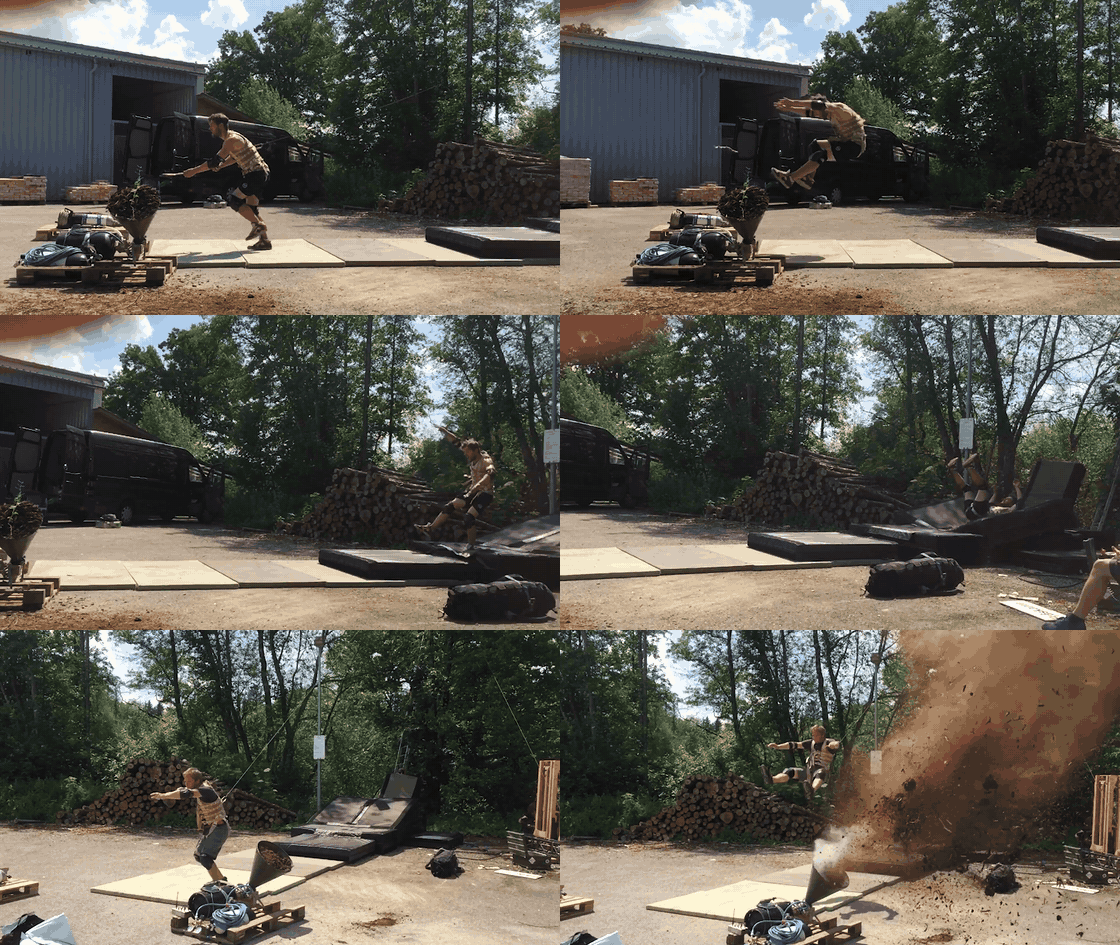
Three terms get mixed up constantly:
Ratchet – colloquially the whole stunt ratchet system: cylinder, compressed air, line and rigging.
Air ratchet – the device itself, the air-powered pull. An air ratchet does not only pull backwards; it pulls upwards or sideways just as well.
Ratchet pull – the event. The moment it actually rips you away.
A ratchet stunt is used for explosions, vehicle impacts, hits and falls – and just as much for show numbers in circus, acrobatics and on stage. What that looks like inside a real production is written up in my case on the ratchet stunt for the film Trautmann.
The tech: air cylinder, block and tackle, rigging
The core is a pneumatic cylinder. It connects via air hoses to a compressed-air bottle and is controlled through a trigger system – a control unit wired to a release. When the operator presses it, the cylinder retracts instantly.
The cylinder stroke alone would be far too short for a spectacular shot. That is why pulleys sit at the end of the cylinder, forming a block and tackle. The block and tackle translates the cylinder stroke – and that is exactly where you set the three variables that matter: distance, speed and force. More gearing means more distance and more speed; less gearing means a brutal pull over a short stretch.
All of it sits inside a rigging construction. In practice that is a robust truss system, built flexibly and precisely to whatever the shot needs. Outside the camera frame, deflection pulleys can be mounted on the truss so the line pulls in exactly the required direction. An example: the explosion is meant to go off behind you and throw you forward – so you get attached at the front, and the line pulls forward via a redirect.
The harness: wherever the line sits, that is where you fly
The harness is developed specifically for stunt performers and resembles a skydiving harness: it wraps the entire body, with loops you step into at legs and shoulders. Distributed across the whole webbing are further loops and eyelets the line can be clipped into.
That is not cosmetics, it is the actual direction of the stunt: depending on the pull direction you need, you get tied in at the corresponding point – and that is exactly where you get ripped. Chest, back, hip, shoulder. If you are meant to fly backwards, you hang at the back. If you get pulled up, you hang up top. At the moment of release you do not feel it as a pull but as brute impact.
The most dangerous moment: no slack in the line
This is the one point where a ratchet stunt tips from spectacular to life-threatening, so it gets stated bluntly: before the release, the line must be at its limit, fully under tension. No slack. Not a little.
The reason is simple and ugly. If a ratchet fires at full force into a sagging line, the system first accelerates to top speed and then hits the body all at once. That is no longer a pull, it is an impact – and it breaks your bones. With a chest attachment we are talking ribs and vertebrae.
Everything that happens around a ratchet pull in terms of timing, briefing and rehearsal serves that single goal: that the line is taut at the moment of release. That is why the sequence gets run again and again until the point is exact – performer in frame, line under tension, effect firing.
Ratchet stunt numbers
A ratchet is not a universal tool, it is a tool for a very clearly defined range. In film an explosion likes to throw someone five to ten metres – and that is precisely what a ratchet renders beautifully. If it needs to be significantly more, you have to switch to a winch system.
The whole event lasts a fraction of a second and is filmed in real time, because it is modelled on a real explosion – no time lapse, no speed-up in the edit. Several g are at work. In the final moment it feels to me like 50 to 80 km/h; that is explicitly my personal perception as a performer, not a measured value. The air comes from standard diving bottles that can be filled to 300 bar. How far and how high it ultimately goes depends on the block and tackle, on rope length, and on what the shot demands.
Throw distance | 5–10 metres (beyond that: winch system) |
Duration | a fraction of a second, filmed in real time |
Forces | several g |
Perceived speed | 50–80 km/h at the final moment – personal perception, not a measurement |
Air supply | standard diving bottles, up to 300 bar |
Lead time | 1–2 weeks for rehearsal and team availability |
Setup | approx. half a day with existing rigging · otherwise 1 day rigging + 1 day rehearsal |
Takes | several firings per bottle · break after 3–4 takes |
Adjustable variables | pulley gearing · rope length · attachment point on the harness |
Who fires, who aborts – and why trust is the real technology
The release is done by an operator, usually a fellow stunt performer. It is coordinated through the stunt coordinator, who works closely with the director: the director owns camera framing and the set, the coordinator knows when to give the operator the signal – in agreement with the performer. Timing is agreed beforehand, partly through audio cues, partly through floor marks.
As the performer you concentrate on exactly one thing in that moment: your agreed trigger point or your cue. Everything else sits with the others. The operator watches performer, scene and coordinator – and his most important skill is being able not to fire when something is off.
“You are quite literally placing your life in someone else's press of a button.”
Anyone on the team who sees something can call an abort. It just has to happen in time, because once everything is running – camera, pyro, performer in motion – a great deal is in play simultaneously. If health is at stake, you abort, full stop. Otherwise the rule is: see it through, because a half abort mid-movement is more dangerous than a take carried cleanly to the end.
That is why it matters so much that the same people keep working together. Between performer, coordinator and operator a basis of trust builds over years that cannot be manufactured at short notice. What that feels like in practice is in the case on Kalte Füße, where I worked on ice with those same Face Off colleagues.
Body position: flying motionless is hard work
The most important part of the performance happens in the fraction of a second after the release – and it consists of doing as little as possible. If an explosion is to look real, the body has to fly motionless through the air. A person being torn away does not tense up; they get thrown.
So I keep everything loose and surrender to the pull. Anyone reacting on instinct tenses too much – and your own movements look unnatural on film, you see it instantly. You still need a certain baseline tension in the core, otherwise the body folds at the attachment point. That balance of “core holds, everything else is loose” is the part you have to train.
A second point is counter-intuitive: the performer has a big influence on the distance. If you actively jump with the pull at the right moment, inertia means the load on the system drops enormously – and you get ripped considerably further or higher. The same ratchet pull ends up looking twice as spectacular.
Related systems: fan descender, wire work, Skywalker winch
A ratchet is not the right tool for every movement. The most important neighbours in stunt work:
Fan descender – for higher falls. The rope unwinds from a drum that can be conical, so the rope pays out at varying speed and cushions the fall. A fan wheel sits on the drum, looking like a windmill, braking the rotation speed; the angle of the blades controls the fall speed. Classic use: jumps and falls from high roofs.
Wire work – here practically everything is done by hand: several stunt performers haul a performer through the air manually via a pulley system. Slower and less brutal, but far more finely controllable.
Modern computer control – ratchet systems now come with controllers that regulate speed, release and cylinder movement far more precisely. That makes several higher jumps in sequence possible, for example.
Skywalker winch system / Spidercam – the top tier: four winches at four positions that move an object, a camera or a stunt performer in the middle three-dimensionally and under computer control through space, via deflection pulleys. That is how you genuinely make people fly. From football stadiums you know the principle through the cameras floating above the pitch. My stunt agency Face Off works with such a system – here is the Skywalker demo video by Face Off: it is old, from 2009, but it still shows impressively what such a system can do.
On top of that comes a development outside film: winch systems in sport are spreading. There are winches for wakeboarding and for towing skiers; I own a motor winch myself. Electric cable winches are used more and more, for instance to tow paraglider pilots up from a fixed point. If they are strong enough, they pull not just objects but people. What a tow system feels like when it really picks up speed is in the case on aircraft skiing behind an airplane.
What a ratchet stunt costs a production in effort
This is the question productions actually care about – and the answer is rarely “one afternoon”.
Lead time: one to two weeks. Not because the equipment takes that long, but because a larger ratchet stunt has to be rehearsed and the capacity for that rehearsal has to exist. The team must be available for the rehearsal too.
Setup: around half a day if rigging construction is already in place. If it has to be built from scratch, budget one day of rigging plus a further day of rehearsal.
Takes: a single take goes relatively fast, and one air bottle lets you fire the system several times. After three or four takes a break is due in any case – for people and for equipment.
Parallel departments: a ratchet rarely runs alone. Usually explosions, pyrotechnics or soil shot up by compressed-air cylinders hang off it. All of those systems and the entire set dressing have to be reset for every single take. That is the line item most often underestimated in schedules.
Testing and maintenance: everything gets tested extensively, plus the technical maintenance of all equipment.
I deliberately do not quote budget figures here, because they depend entirely on the setup. The relation can be stated cleanly though: a ratchet stunt is considerably more expensive than a normal stunt – and in turn considerably cheaper than a larger winch system. How that kind of effort fits into a realistic shooting plan is covered in the complete guide to planning an outdoor shoot.
And perhaps the most important information for productions: a ratchet stunt belongs in a professional team and should not be scheduled lightly, because the injury risk is high. The alternative is normal rigging setups where stunt performers pull the performer manually – and there a non-professional or a model can be pulled through the air safely.
Sometimes the alternative is not shooting outdoors at all. For a commercial production for Lidl I shot ski clothing – not on the mountain but in a studio in Hamburg, suspended on ropes with skis on while artificial snow was sprayed in the background. As a ski professional that was a strange experience. But that is exactly the alternative, and sometimes it is done that way because it is cheaper.
Preparation: fitness, rehearsal and bruises
For this job baseline physical fitness is a requirement, not a bonus. I train regularly in the gym and with my own bodyweight methods. Because deep core musculature matters most to me there, I developed my own training device for it: the inflatable training cushion BOLSTair – my own product, born from exactly that need. Deep musculature is not only athletically relevant: it strengthens the inner muscles and protects the organs. And muscle protects generally – in a job where you land on mats at high speed on a regular basis, that is not an academic consideration.
The second part of the preparation is rehearsal. In the own training hall in Seeshaupt at Lake Starnberg – a large hall with plenty of mats and equipment – every scene can be recreated before a shoot. That is exactly what you see in the reel further up in this article: training and timing rehearsals in that hall. I execute ratchet stunts together with the stunt colleagues at Face Off, and because there is always a great deal of rehearsal beforehand, nothing has ever gone wrong.
Bruises still happen. If you re-enact an explosion realistically, it has to look realistic – and that hurts too. You land on mats, but across many consecutive rehearsals it is decisive to stay fit and to warm up properly before every rehearsal and every take.
What a client takes away
A ratchet stunt is not a courage topic, it is a technology and trust topic. It delivers exactly the image an explosion is supposed to produce on screen – five to ten metres, in real time, over in a fraction of a second – and it delivers it reproducibly when lead time, rehearsal and team are right.
What I bring as a performer is experience in this field: execution together with the stunt colleagues at Face Off, rehearsing every scene beforehand in our own hall, and the ability to stay loose at the decisive moment instead of reacting. On top of that comes the judgement of when a ratchet is the right choice – and when a simple rigging setup delivers the same shot more safely and more cheaply.
Are you planning a scene with an explosion, a vehicle impact, a hit or a fall – or a show number on stage, in circus or in acrobatics? Send a booking request.
FAQ
What is a ratchet stunt?
A ratchet stunt is a stunt in which a performer hangs off a compressed-air cylinder via a Dyneema rope and a full-body harness and is ripped away with very high force at the push of a button. On film it mainly simulates explosions, vehicle impacts, hits and falls.
What is the difference between an air ratchet and a ratchet pull?
The air ratchet is the device – the compressed-air-driven pull that can act backwards, upwards or sideways. Ratchet pull describes the event, meaning the moment the performer is ripped away.
How far and how fast are you pulled in a ratchet pull?
Five to ten metres is typical, filmed in real time and over in a fraction of a second. At the final moment it feels like 50 to 80 km/h to me – that is my personal perception, not a measured value. If it has to go considerably further, you need a winch system.
What is the biggest danger in a ratchet stunt?
Slack in the line. The rope has to be fully under tension before the release. If a ratchet fires at full force into a sagging line, the pull acts as an impact instead of a pull – and that breaks bones.
How much lead time does a production need for a ratchet stunt?
One to two weeks. Plus half a day of setup with existing rigging, otherwise one day of rigging plus one day of rehearsal. A break belongs in the schedule after three or four takes, and parallel effects have to be reset for every take.
Can a model or a non-professional do a ratchet stunt?
No. A ratchet belongs in a professional team, the injury risk is too high. For non-professionals and models there are normal rigging setups where stunt performers pull the person manually via pulleys – considerably slower, but cleanly controllable.
Read on: sport double or stunt double?
A ratchet is the extreme end of the scale – a stunt that has nothing to do with any sport any more. Where the line between a sport double and a stunt double actually runs in everyday productions, what a separate booking costs and why one face is usually cheaper than a model plus a double is in that article.
Who does what around a ratchet
A ratchet is never operated by one person alone. The rigger builds the rig, the coordinator decides whether it runs and gives the signal, the performer rides it, and a safety watches the whole thing from outside. Who exactly is responsible for what — and who books and invoices whom — is broken down role by role in Who is who on a stunt set.
More posts