Filming in the Bavarian and Austrian Alps: what the Chiemgau, Berchtesgaden and Salzburg region delivers
What the Chiemgau, Berchtesgaden and Salzburg region delivers as a filming location — described as a radius rather than a postcode. With the annual calendar of what works when, the shrinking glacier window, the local wind systems that clear fog from one valley and not the next, and why a locally informed enquiry gets through differently.
Written by
Reading Time
13 minutes


| Insignificant 1 | Minor 2 | Significant 3 | Major 4 | Severe 5 | |
|---|---|---|---|---|---|
| Almost certain 5 | Medium 5 | High 10 | Very high 15 | Extreme 20 | Extreme 25 |
| Likely 4 | Medium 4 | Medium 8 | High 12 | Very high 16 | Extreme 20 |
| Possible 3 | Low 3 | Medium 6 | Medium 9 | High 12 | Very high 15 |
| Unlikely 2 | Very low 2 | Low 4 | Medium 6 | Medium 8 | High 10 |
| Rare 1 | Very low 1 | Very low 2 | Low 3 | Medium 4 | Medium 5 |
The same activity moves through the zones depending on conditions — weather, surface, light and daily form shift the rating.
A region is a radius, not a postcode
When a production looks for a location in the Bavarian or Austrian Alps, a place name usually comes first — a mountain, a lake, a valley someone remembers from a holiday. That is rarely the best starting point. What actually decides how a shooting day goes is not a single point on the map but the question: how many different subjects can I reach from one base without constantly moving the crew?
That is why I describe my region here as a radius. The core is the Chiemgau, the Berchtesgaden region and the Salzburg region. But the catchment reaches considerably further, and the interesting subjects often sit at its edge.
This article is deliberately a reference text for productions: what the region delivers, at which time of year, with which pitfalls — and why a locally informed enquiry lands differently with lift operators, tourism boards and landowners than one from out of town. The formal side, permits and responsibilities, is covered in depth in the pillar article Planning an outdoor mountain shoot.
Where I am based — and what I cover from there
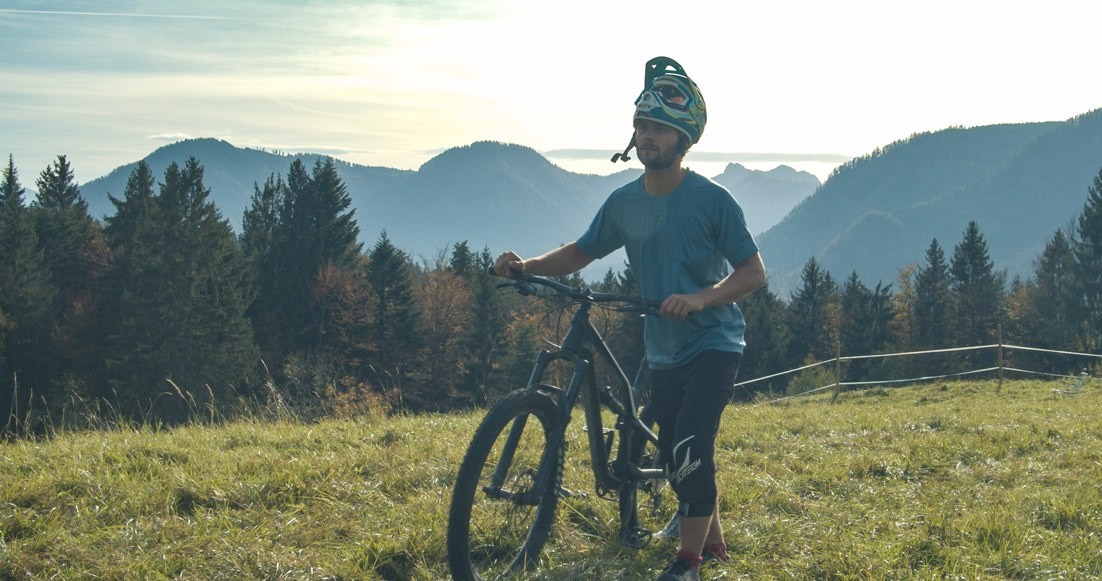
I currently live near Freilassing on the Salzburg border — still the Berchtesgaden region. Before that I lived 15 years in the Chiemgau, near Siegsdorf. Originally I am from Munich. Those three home bases are the reason the catchment looks the way it does — it is not researched, it is driven.
The core — Chiemgau, Berchtesgaden region, Salzburg region: a single day here can cover a lot of different facets: mountain trails, via ferrata, rivers, lakes, wide views. And that is the beauty of the pre-alpine area: you get spectacular sunsets, especially from the smaller summits.
Upper Bavaria is fully part of it. I was born and raised in Munich and know the whole region very well. The paragliding flight for the German TV film "Neid ist auch keine Lösung" was shot at Brauneck near Lenggries, the alpine pasture scenes at Zwieselalm. The Aircraft Skiing project — skiing behind an aeroplane across a frozen lake — took place at Riegsee and is described as its own case: Aircraft Skiing.
Tyrol as well. For one commercial film we had Innsbruck as the location — also terrain I know well, not just scenically but in terms of the routes to get there.
And the glaciers. Kitzsteinhorn, Hintertux, Stubai and Sölden are about an hour and a half away. That is where I regularly do the apparel shoots for winter collections. A large number of ski resorts in the Salzburg region and Tyrol are reachable in around an hour.
In the end it always comes down to the same question: where can I perform which of my sports, and how do I make that understandable to a production? That is exactly what I can assess immediately: where I do what, and why that spot is the right one for it.

The spots that are not overrun — and the one that is
Hochfelln, Hochgern, Hochplatte, Kampenwand — exactly the mountains that are not overrun and still give a wonderful overview across the flatland. They create longing, and for a campaign that is often worth more than a spectacular rock ridge nobody can identify with.
These are deliberately not the severe high alpine peaks. Those you get in the Berchtesgaden region and already around Bad Reichenhall — steep, rocky, serious. Having both within one radius is the real advantage: you can shoot "inviting" and "awe-inspiring" on the same day.
The counterexample is the Königssee. You effectively cannot shoot there any more — it is completely overrun, visitors come from all over the world, and you get neither an empty frame nor a calm workflow. At the same time the Chiemgau has hidden lakes and secret spots that deliver exactly what productions look for at the Königssee and no longer find.
I deliberately do not give those spots away in this text — I share them on request. That is not a negotiating tactic: a published secret spot stops being one within a season, and the people who live there have every right to want it to stay that way.
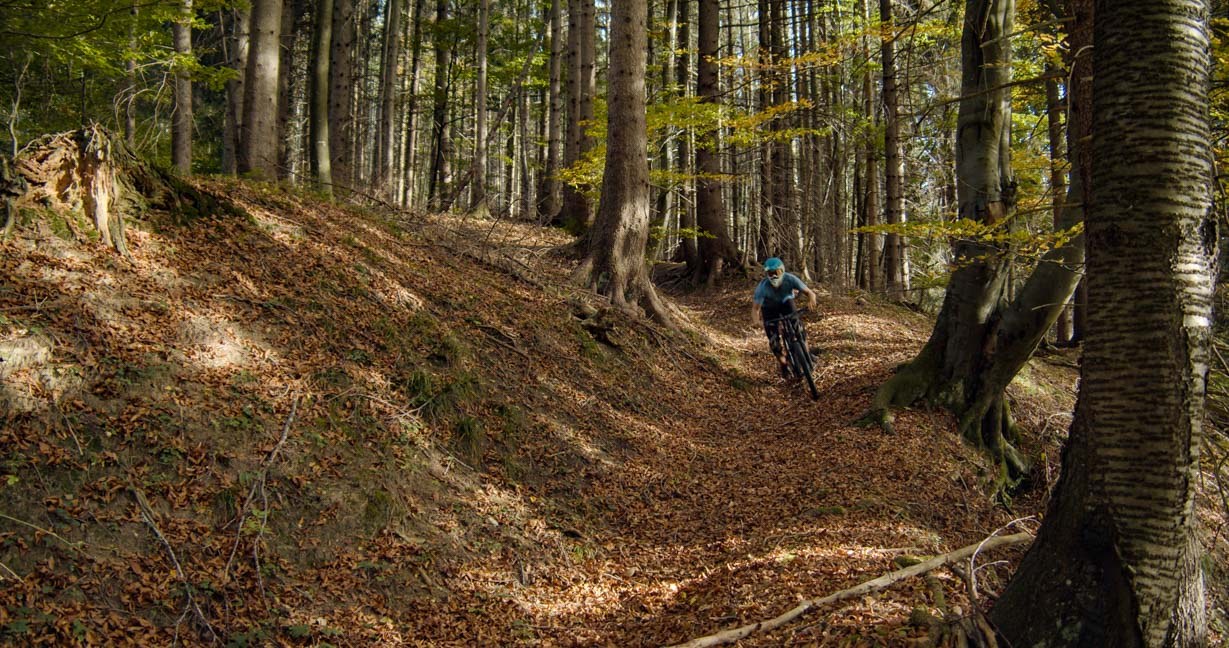
The region's annual calendar: what works when
The most common question from productions is not "where" but "when". The region delivers almost year-round — with one clear exception and one important limitation on snow.
Period | What the region delivers | Well suited for | What to watch out for |
January – March | Winter in the ski resorts (about an hour away), snow-covered forest, frozen lakes | Ski and winter topics, winter lifestyle | The Chiemgau itself is not high — valley snow cannot be planned |
April – May | Spring in the valley while there is still snow on the glaciers | Transitional collections, combined winter and spring shoots in one day | The glacier window closes in May |
June – August | Everything very green, lush nature, alpine pastures, lakes, long days | Summer, bike, water, hiking and via ferrata topics | No reliable snow — not even on the glacier |
September – October | Beautiful, colourful autumn backdrop, clear air, the glacier window opens again | Autumn and winter collections, mountain mood, portrait and lifestyle | Early mornings bring fog to many valleys — extremely local |
November – December | Transitional phase: leaves down, no snow yet, mostly grey skies | — | Avoid this period if possible — almost no subject wins here |
September – May | Glacier window: Kitzsteinhorn, Hintertux, Stubai, Sölden — about an hour and a half away | Winter collection shoots, plannable snow | Powder is getting rarer, the glaciers are visibly retreating |
The glaciers — and why the snow window is shrinking
The Chiemgau is not particularly high. Reliable snow is therefore found on the glaciers, and the nearest are Kitzsteinhorn, Hintertux, Stubai and Sölden. In theory there is snow there all year.
In theory — and I say this with concern: the glaciers have retreated sharply in recent years, and I see it alarmingly clearly. We used to shoot many campaigns on the glaciers in high summer. That is barely possible today, because the snow is very icy and the background reads rocky rather than white — and outdoor shoots want spraying powder, not blue ice.
Realistic glacier window today: roughly September into May. Anyone who has to produce a winter campaign in high summer hits a hard limit in Europe — and then has to go to the southern hemisphere or change the timing. What such a shoot on the other side of the world looks like is described in the case SportScheck "Es beginnt" in New Zealand.
More important than the season: the exact location
The sentence I say most often in pre-production calls is: the exact location matters more than the season. An average day at a very good spot beats a perfect day at an arbitrary spot almost every time.
There are three reasons. First, light: whether a face gets sun at half past eight in October or only at eleven decides whether the shooting day has two usable windows or one. Second, emptiness: a subject with no hikers standing in it saves waiting time, retouching and discussions. Third, access: a spot the crew reaches with equipment in twenty minutes gets used three times; one with a ninety-minute approach gets used once.
That is exactly why every suggestion I make comes with a time of day, not just a place.
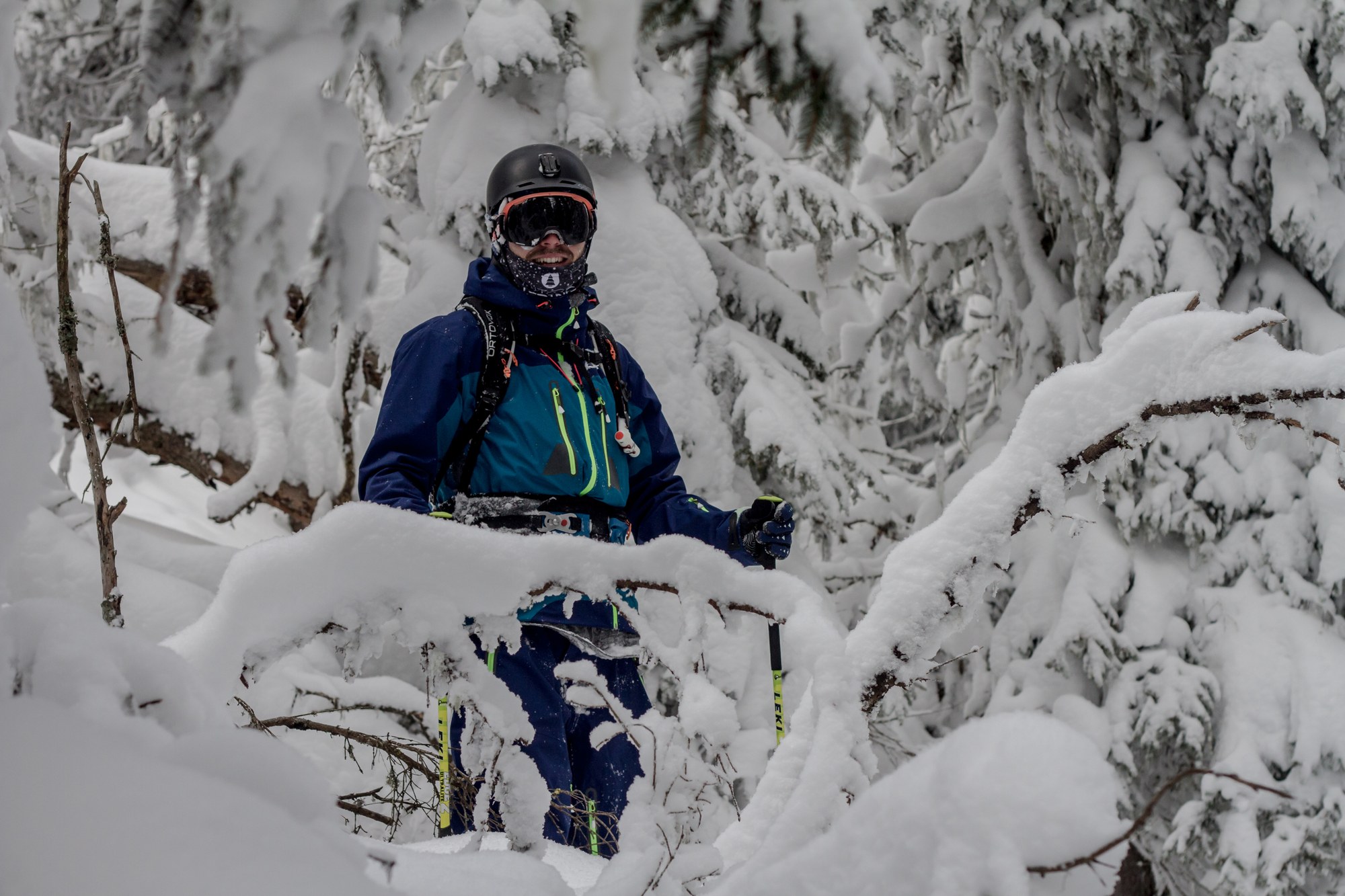
Weather within the region: what actually works — and what does not
The big divide is the Alps themselves. The northern and southern Alps can have completely different weather. That sounds like a convenient fallback, but it is not: four to five hours of driving lie between them. For a spontaneous change of plan on the shooting day that is too far. Anyone counting on the south side as plan B has to budget it as its own shooting day.
Snow behaves differently — it falls extremely locally. The Chiemgau gets little, the Salzburg region considerably more. Within twenty minutes of driving you can move from bare ground to full winter. Here you have to read the local snow reports and the specific weather situation — and the forecasts in this region are often very accurate if you read the right ones.
And then there are the local wind systems. They blow fog out earlier, for instance. Around Salzburg or in Marquartstein there is almost always fog early on autumn mornings — while Bergen or Siegsdorf are already clear at the same moment. And those are only a few minutes apart by car.
That is the most honest proof of local knowledge I have. It is not about knowing a region. It is about knowing which valley is already clear at seven in the morning — and sending the crew there instead of waiting two hours in grey.
Why the region is logistically efficient
The first rule of any budget is: how long does the crew have to travel? Travel costs explode when you shoot in the farthest corner and the whole crew has to be flown in. This is exactly where the region has a structural advantage: Munich, Salzburg and Innsbruck are all nearby, the motorway runs straight through, and the subjects sit close together.
On top of that comes density. Mountain, forest, lake, river, alpine pasture, via ferrata, ski resort and glacier lie within a radius you can cover several times in a day. For a production that means fewer travel days, more shooting time — and the option to change the subject when the weather turns instead of cancelling the day.
The minimal, efficient crew
A fast outdoor shoot needs surprisingly few people. This is the line-up I prefer and the one that delivers most in practice:
Photographer plus one assistant
Videographer plus one assistant
One person from marketing with product responsibility and decision authority
Me in front of the camera
Nothing more is needed. On a fast, weather-dependent outdoor shoot you do not want to be constantly moving a whole crew around in the background. Every extra person costs not only money but reaction time — and in the mountains reaction time is the scarcest resource.
An underrated factor: it helps enormously when the crew already know each other. When photographer and videographer are in sync, have done several productions together and also know the model, you get up to speed considerably faster. That is one reason I like suggesting local people to productions — not out of local patriotism, but because the warm-up phase disappears.
The planning mistake I keep having to raise
Photo and video have to be shot separately. This is where most outdoor productions lose time — and the only one that can be solved purely through planning.
Performing a scene for video looks different from holding an expression, a gesture or a specific emotion for a still frame. Both at once does not work, and you can see it in the results afterwards. The right way is to alternate: the scene once as video only, then the same scene as stills only. A production has to plan that in advance — in time and in daylight.
What that does to a whole shooting day I described using a hotel campaign as an example: "das Liebner" in Sölden.
Local knowledge: why a local enquiry gets through differently
I have worked repeatedly with key people in the region — though they change often, which is why a list of names is worth little. The real advantage lies elsewhere.
When you enquire as a local and describe precisely what you have in mind, you can show that you know the location. That lands differently from an out-of-town production simply asking. Lift operators and tourism boards care about nature — about how people behave there, what exactly is planned, how many people are coming, what gets built. When they notice that the person asking is from the region and knows why they are doing what, when and how, it goes through much more easily.
A detail out-of-towners do not have on their radar: for some locations in the region, local associations own the land. There it matters even more to describe upfront who you are and what you intend — an association does not have a permits department, it has a board you reach in the evening.
And one practical point many underestimate: the people who live there regularly ask to see the filming permit. Not out of hostility, but because they are used to it. It is worth a lot if someone on site can say: I am from this region, I know my way around, everything is registered. The details — who is responsible for what and which permit is needed when — are in the permits article and in the complete guide to planning an outdoor shoot.
Who has already shot here — and what infrastructure exists
A few productions from my own work that show what the region covers:
The Hacker-Pschorr campaign „Himmel der Bayern" at the Hochplatte, shot with a small team together with Michael Müller — the idea was a play on words: you sit in front of the television in the evening, but you can just as well enjoy the beer in nature and look far into the distance.
Image films for hotels in the region, among them the Hotel Edelweiss in Berchtesgaden in 2026.
skywalk and Flysurfer in Marquartstein — I used to develop products there as an engineer and was involved in commercial shoots both in front of and behind the camera. The paragliding side of that is in the paragliding and speedriding article.
Winter collection shoots on the nearby glaciers, regularly over the years.
Aircraft Skiing at Riegsee and a jetboard shoot at Lake Fuschl with ZOOOM Productions in Fuschl am See — both described as their own cases: Aircraft Skiing and Yodobashi at Lake Fuschl.
And the infrastructure is here. Several film production companies are based in the region — among them MISCHFABRIK — as well as photographers such as Klaus Listl / Freezing Motions and Michael Müller from Stephanskirchen, with whom I work regularly. Add production companies such as spreadfilms in Traunstein, which also coordinate internationally. For a production that means: you do not have to bring the whole crew. Camera, stills, lighting, vehicles and local knowledge are available on site, and I can usually put you in touch with the right contact quickly.
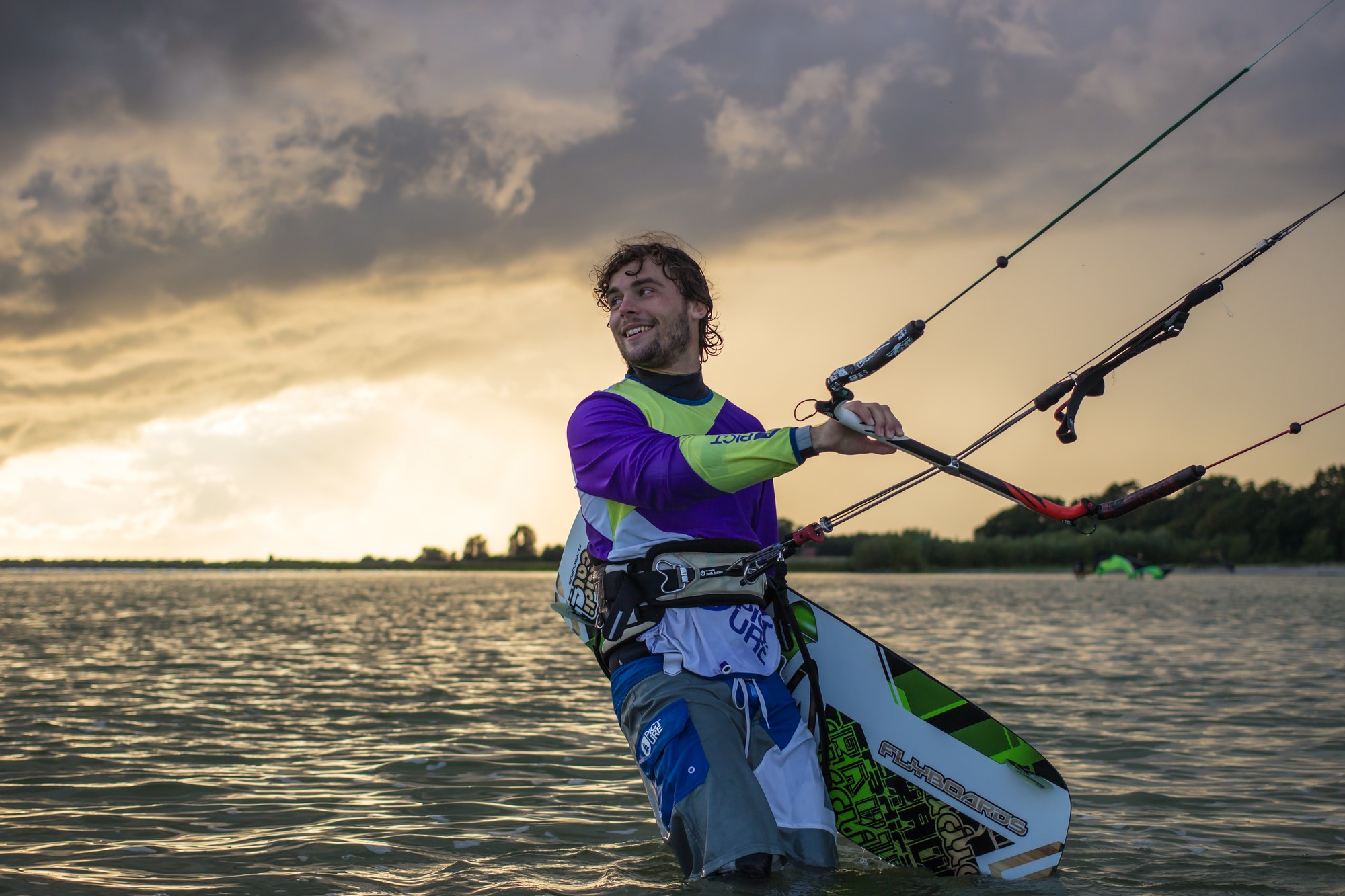
What I can deliver in the region — in front of and behind the camera
In front of the camera I cover the whole outdoor spectrum within this radius: skiing, freeskiing, mountain biking, paragliding, trail running, kitesurfing on the Chiemsee, via ferrata, bouldering, hiking, SUP and sailing. All weather-dependent — but that is precisely the point: one person covers the entire spectrum, without someone having to travel in for each discipline. Which sports those are in detail and at what level is in the sports I ride in front of the camera; the winter disciplines in the freeski and ski article, the water disciplines in the kitesurf article.
Behind the camera I advise as a location scout. The ideal process looks like this: the production states what it wants — an idea, a framing, or best of all reference images. Then I propose concrete locations I would shoot at: ones the crew can reach easily, that match the light at the planned time of day, and that cover as much as possible at once. Along with what is formally required and who needs to be asked.
And if it does turn out more complex than expected — if a sports scene becomes a prepared stunt — Who is who on a stunt set helps to work out who is needed for it.
Planning a shoot in this region? Send me your reference images and the intended period — I will tell you honestly whether the region delivers that at that time, which spots I would suggest, and what comes with it in terms of permits. The hidden lakes and secret spots do not go online, but I share them on request. Get in touch.
FAQ
Which area is meant by the Chiemgau, Berchtesgaden and Salzburg region?
The core lies between the Chiemsee and Salzburg: the Chiemgau, the Berchtesgaden region and the adjoining Salzburg region. The practical catchment is larger: Upper Bavaria as far as Munich, Tyrol as far as Innsbruck, plus the glaciers at Kitzsteinhorn, Hintertux, Stubai and Sölden. Ski resorts are about an hour away, the glaciers about an hour and a half.
When is the best time for an outdoor shoot in the Bavarian Alps?
Spring and summer for everything green, September and October for the colourful autumn backdrop and clear air, January to March for winter topics in the ski resorts. For plannable snow, the glacier window from roughly September to May is the reliable answer. Avoid November and early December: the leaves are down, there is no snow yet, and the sky is mostly grey.
Is snow reliable in the region?
Not in the valley. The Chiemgau is not particularly high, and snow falls extremely locally here — the Salzburg side gets considerably more. Plannable snow is on the glaciers at Kitzsteinhorn, Hintertux, Stubai and Sölden, all about an hour and a half away. The realistic window there today runs from roughly September to May, because the glaciers are visibly retreating and look icy rather than white in high summer.
Why does a locally based contact matter so much on a mountain shoot?
Because the decisive information is not on maps. Local wind systems clear fog out of one valley earlier than the next — around Salzburg or in Marquartstein there is almost always morning fog in autumn, while a few minutes away by car the sun is already out. Then there is the permit side: lift operators, tourism boards and in some cases local associations as landowners respond very differently to a locally informed enquiry than to one from out of town.
How large does the crew for an outdoor shoot need to be?
Considerably smaller than most assume. In practice a photographer and a videographer with one assistant each, one person from marketing with decision authority, and the person in front of the camera are enough. Every additional person costs not only budget but reaction time — and on weather-dependent mountain shoots reaction time is the scarcest resource.
Can photo and video be shot at the same time on one day?
No, at least not without losing quality. Performing a scene for video means moving differently than holding an expression or emotion for a still frame, and you can see it in the results. The right approach is to alternate: the same scene once as video only, then as stills only — and that has to be planned into the schedule and the daylight in advance.
Can you still shoot at the Königssee?
In practice barely. The Königssee is completely overrun, visitors come from all over the world, and you get neither an empty frame nor a calm workflow. The good news is that the Chiemgau and the Berchtesgaden region have hidden lakes and lesser-known viewpoint mountains that deliver exactly what productions are looking for there. I deliberately do not publish those spots, but I share them on request.
More posts