Trautmann: Ratchet Stunts & Explosions – Why Timing Is Everything
Being ripped through the air by an explosion – controlled: how a ratchet works, why slack in the line is life-threatening, and why trust in riggers like Bastian Volkmer decides everything.
Written by
Tobi Deckert
Reading Time
5 minutes



What a ratchet is
For the film “Trautmann” I was ripped through the air by an explosion – in a controlled way, using one of the most common tools in stunt work: the ratchet. It is a device with a compressed-air bottle and a cylinder that pulls with high force in a very short time. The cylinder connects to a rope through several pulleys – block-and-tackle principle: a short cylinder stroke becomes a very long, very fast pull on the line. The performer is hooked into the line from behind via a chest harness and gets yanked backwards.
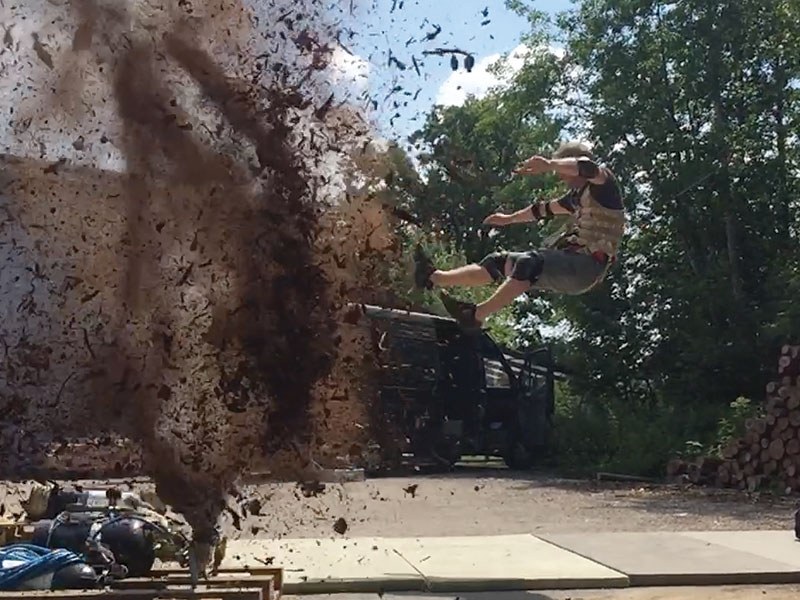
Timing is everything – and can be lethal
The decisive factor is timing. The line must have no slack: if it sagged, it would snap against the chest with far too much force and could break every thoracic vertebra. That is why the coordination with the person triggering the ratchet is life-critical – and the scene has to be planned precisely together with the explosion effects.
The sequence: I run forward; there is the one moment when the line comes under tension – then the explosion fires, and exactly in that moment the ratchet releases and rips me backwards over several meters. The harder you jump into the onset of the pull, the further you fly. To make it look real, the body stays calm and the muscles relaxed – after all, an explosion is supposed to be throwing you. Mats lie in the background, hidden in the film by the edit.


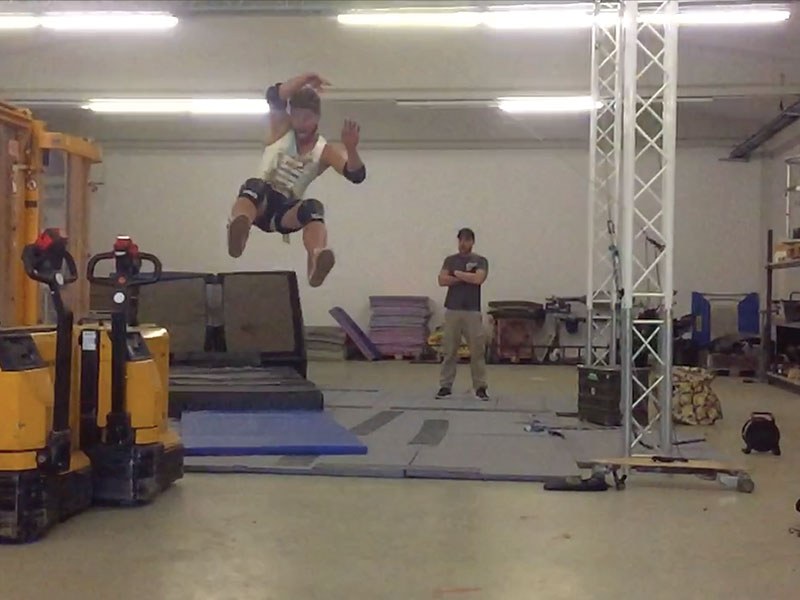
Rehearsals at Face Off – and dirt from compressed air
We rehearsed in a dry setup at Face Off at Lake Starnberg – the crew has its own hall for tests like these. Many rehearsals, until we could offer the director several variants: angles, movements, explosions. The interplay with the special effects team matters: cylindrical metal containers are filled with soil; via valve and compressed air, the dirt gets fired through the air like a real explosion – it looks strikingly authentic. The reel further up in this article shows exactly these training and timing rehearsals.
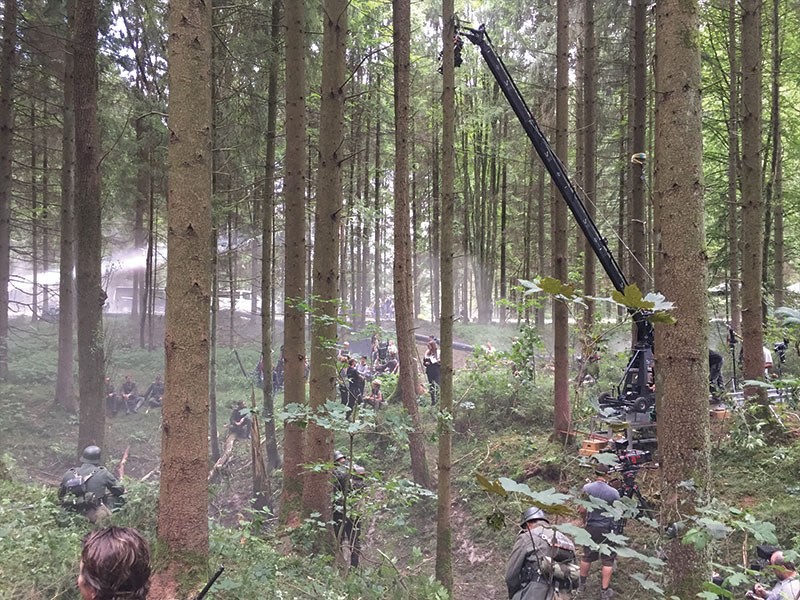
The real take
Because we had rehearsed so much with a well-practised team, the actual shoot ran routinely – no mistake, and none was allowed. That is the message: a perfect stunt looks spectacular but is in truth planned through and safe. The moment of being ripped silently through the air, briefly weightless, is fantastic – but only when you can trust the team blindly. How that risk is priced properly is shown in the risk matrix.
Trust has a name: Bastian Volkmer
In this case, trust is called Bastian Volkmer – one of the technical gurus in the Face Off team, an outstanding stunt performer with enormous engineering know-how and countless self-built rigs. For “Aquaman” he welded a metal construction Jason Momoa was strapped onto to shoot the underwater movements.
Bastian and I share many shoots – among them “Kalte Füße” with Emilio Sakraya and Heiner Lauterbach: Bastian doubled Lauterbach in a modified wheelchair down a frozen road, I doubled Sakraya on skis behind him. There, in turn, his trust lay in my hands. That is how a real basis of trust builds over years – there is nobody I would rather trust with a ratchet scene. Bastian also taught me the highsider, a sideways fall over an obstacle. And by the way: the man keeps a helicopter engine in his mother’s garage and tinkers with it on weekends. Anyone with hobbies like that understands machinery.
What a client takes away
Ratchet, explosion, wheelchair on ice – spectacular images are not made by courage but by rehearsal, engineering and a practised team. Exactly that combination is what I bring to any set as a sports model with a stunt background, beyond film productions too. The Eddie the Eagle shoot worked the same way. Credits: IMDb – Tobi Deckert. Send a booking request.
FAQ
How is an explosion scene with a person filmed?
With a ratchet: a compressed-air cylinder plus pulleys rip the performer backwards on a chest harness exactly at the moment of the explosion. The explosion itself is usually soil fired by compressed air.
What is the biggest risk in a ratchet stunt?
Slack in the line: if it sags, the pull snaps against the chest at full force – which is why timing and the coordination with the trigger operator are life-critical.
How long do you rehearse for a scene like this?
Far longer than you shoot: many rehearsals in a dry setup until several variants are safe – the real take then runs routinely, without a single mistake.
Project facts
Film | Trautmann / The Keeper (2018) |
Stunt | ratchet pull in a war scene with explosion SFX |
Crew | Face Off Stunts & Rigging · rigging: Bastian Volkmer |
Related shoots | Kalte Füße (2019) · Eddie the Eagle (2016) |
Credits |
→ Booking a sport or stunt double for your production
Read on: how a ratchet works
This case shows one ratchet stunt in practice. If you want the technical background – air ratchet versus ratchet pull, the block and tackle behind the cylinder, the harness attachment points, the numbers and the production lead time – it is all in the explainer What is a ratchet stunt?.
More posts